 Historical Figure MBTI
#555 · 4-27-26 · The Age of Saladin
Reynald of Châtillon
Lord of Kerak · Brigand of the Caravans · The Man Who Provoked Hattin
c. 1125 — 1187
8 min read
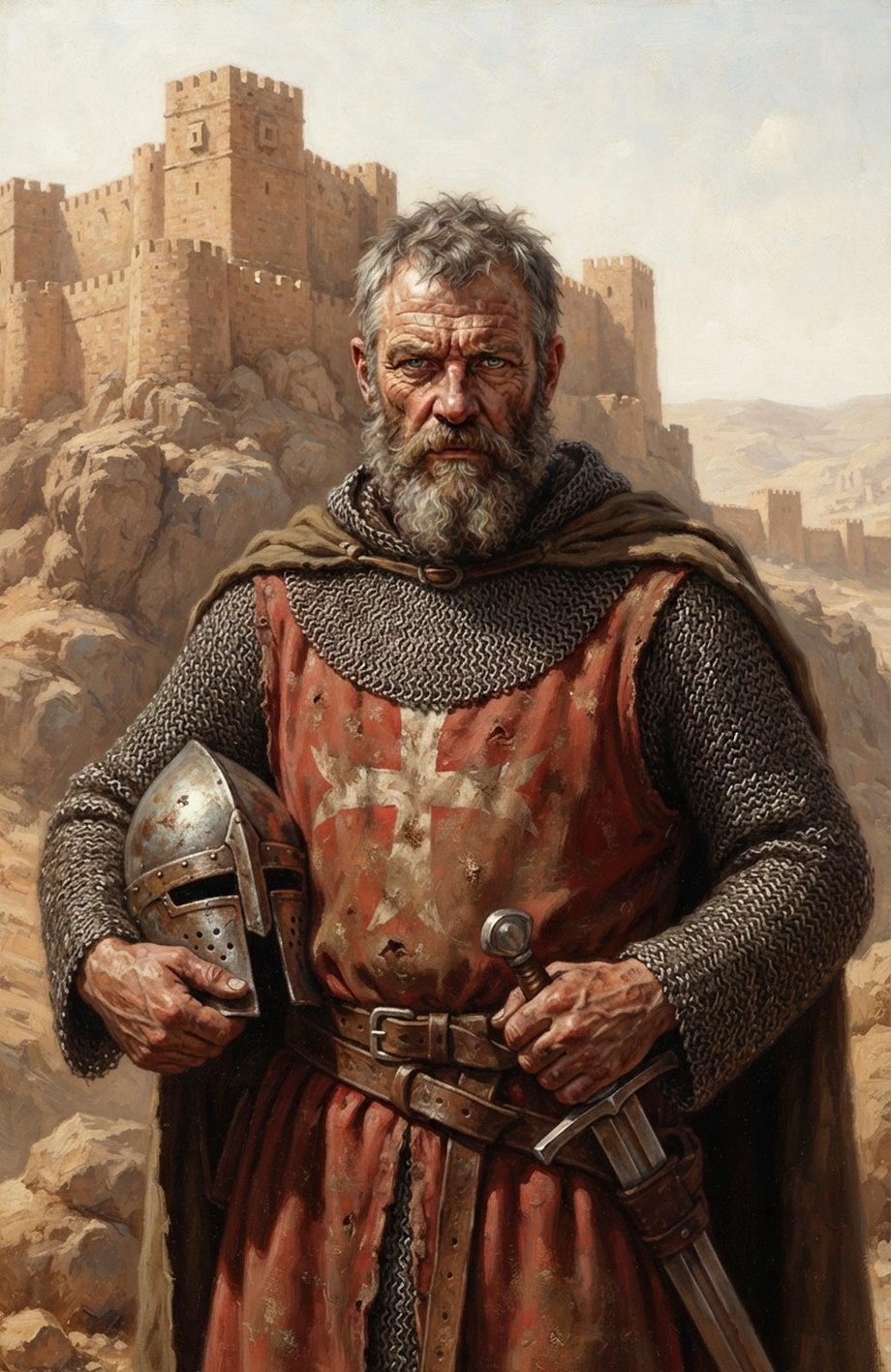
AI-assisted Portrait of Reynald of Châtillon
The Freebooter Who Lit the Fuse
He was the wrong man in every room he entered, and it made him the most dangerous man in the Latin East. Reynald of Châtillon arrived in the Holy Land around 1147 as a landless younger son with nothing but a sword arm and an appetite for the main chance, and by sheer audacity he clawed his way to a throne—marrying into the principality of Antioch, then, after sixteen years in a Muslim prison in Aleppo, marrying again into the desert lordship of Oultrejordain and its castles of Kerak and Montréal. Astride the caravan and pilgrim roads between Egypt and Damascus, he treated that position not as a trust to administer but as a hunting ground to raid.
What set Reynald apart from the other barons of Jerusalem was not cruelty—the age had cruelty to spare—but his total indifference to strategy, truce, or consequence. In 1182–83 he did the unthinkable: he launched a fleet down the Red Sea toward Mecca and Medina, threatening the holiest cities of Islam—an outrage that scandalized the whole Muslim world and made him the personal enemy of the one man he could not afford as an enemy, Saladin. Then, in a time of truce, he plundered a rich caravan and refused to give it back. It was the provocation Saladin had waited for. The road from Reynald's greed ran straight to the catastrophe of Hattin.
Reynald is the ESTP stripped of every civilizing restraint: Se's raw appetite for the bold physical stroke, fused to a raider's cold Ti calculus of exactly what he could seize and get away with—a man who lived for the raid in front of him and never once looked at the war behind it.
The Appetite for the Raid
Se — dominant
Dominant Se lives for the seized moment—the concrete opportunity taken now, before it closes. Reynald's whole career is a sequence of such seizures. He rose by grabbing what was in front of him: a marriage to the widowed princess of Antioch that a more cautious man would never have dared, a lordship won the same way a generation later. His response to any prospect of plunder was immediate and physical—mount up, ride out, take it. He did not scheme for years or build slow alliances; he read the terrain, saw a caravan or an undefended shrine, and struck.
The Red Sea expedition of 1182–83 is Se in its most spectacular and reckless form. No strategic logic demanded it—no fortress to take, no army to defeat, no lasting gain to hold. There was only the sheer audacity of the stroke: to build ships, haul them overland to the Gulf of Aqaba, and raid down the Arabian coast toward Mecca itself, burning shipping and terrorizing pilgrims. It was the kind of physical gamble no institutional mind would ever conceive, because its payoff was not conquest but the shock of the deed and whatever loot came with it. Even the sixteen years in an Aleppo dungeon seem only to have sharpened the appetite—he came out of prison and went straight back to the raid.
The Raider's Private Logic
Ti — auxiliary
Reynald was not a stupid man—that is the trap in reading him only as a thug. Beneath the appetite ran a cold, private auxiliary Ti: a raider's calculus of leverage, weakness, and what could be gotten away with. His choice of target was not random. He understood precisely where his castles sat—on the jugular of the trade and pilgrimage routes between Cairo and Damascus—and he grasped that a lord in that position could bleed an empire simply by existing and striking. That is a real strategic insight, even if he wielded it for banditry rather than statecraft.
The signature of Ti is that this logic was entirely his own, answerable to no external order. When the King of Jerusalem swore a truce with Saladin, Reynald reasoned that the truce bound the king, not the independent lord of Oultrejordain, and replied that he was master in his own land and had made no peace he was obliged to keep. This is not lawlessness out of ignorance but a privately consistent system—he had worked out, coldly, that his castles were impregnable and the kingdom too weak to punish him, so he could break faith and survive it. What the calculus lacked was any feel for the wider consequence: brilliant in the small, catastrophic in the large.
The Court Performer
Fe — tertiary
Tertiary Fe gives the ESTP a real, if intermittent, gift for reading a room and playing to it—charm, bravado, the ability to bind other men to his boldness. Reynald had it. For all his lawlessness, he was no isolated outlaw: he was a great magnate of the realm, a fixture at the court of Jerusalem, and a man who could make himself the loudest voice in the war councils. Under the failing Baldwin IV, the young Leper King, and then around the throne of the weak Guy of Lusignan, Reynald positioned himself as the champion of the aggressive war party—the man who spoke for action against the cautious barons who counselled restraint.
His Fe was the belligerent-baron performance: the swaggering advocate of striking the enemy, the voice that flattered a nervous king's desire to look strong. When Guy of Lusignan hesitated on the eve of the 1187 campaign, it was the hawks around him—Reynald foremost—whose urging carried the day and marched the army to its destruction at Hattin. But tertiary Fe is shallow-rooted, and Reynald's reached only to his own faction, never to the wider Christendom whose truces he trampled. He could rally a war council; he could not feel the consequence of rallying it wrongly. The charm served the appetite—it never governed it.
The Consequence He Never Saw Coming
Ni — inferior
Inferior Ni is the ESTP's blind spot: the long arc, the single converging future toward which present actions bend. Reynald was constitutionally unable to see it. Every raid was, to him, a discrete event—this caravan, this stroke, this profit—never a link in a chain that led somewhere. He could not hold the picture of a Muslim world unified by outrage, of a Saladin who would spend years patiently assembling the coalition that Reynald's provocations made possible. Where a strategist would have weighed the raid against the war it might invite, Reynald simply saw gold on the road and took it.
The failure of inferior Ni is written into the end of his life with almost fable-like clarity. When Saladin crushed the Crusader army at Hattin in 1187, he received the captured nobles with the courtesy owed to prisoners of rank—and then singled out Reynald. He had sworn to kill this one man with his own hand, and he did: he offered Reynald water and the chance to convert, and when Reynald refused, defiant to the last, Saladin struck him down himself, sparing every other noble in the tent. The man of the seized moment, who never once looked past the raid in front of him, met the man who had spent years looking at nothing else—and the future he could not see arrived in the shape of a sword he could not dodge.
Why ESTP Over ESTJ
Why not ESTJ?
It is tempting to read a great territorial lord who dominated war councils as an ESTJ—the commanding organization man. But the ESTJ is the servant of order, law, and institutions: he upholds treaties, administers his lands, and subordinates himself to the structure he serves. Reynald was that type's exact inverse. He broke every truce the moment it inconvenienced his purse, obeyed no strategy but his own gain, and served no order but the next raid. Where the ESTJ builds and maintains the system, Reynald was the freebooter who plundered through it—a Se–Ti opportunist, not a Te–Si administrator.
The distinction is the difference between a magistrate and a pirate who happens to own a castle. An ESTJ in Reynald's position would have grown rich as a keeper of the peace, taxing the caravans he protected and honoring the truces that made the tolls flow. Reynald could not think that way for a season: his logic began and ended with the stroke he could land now. That is the ESTP freebooter to the core—not a builder of order, but a seizer of moments, right up to the moment that seized him.
Connected Figures
Further Reading
- The Leper King and His Heirs: Baldwin IV and the Crusader Kingdom of Jerusalem — Bernard HamiltonThe essential study of the failing kingdom Reynald served — indispensable for the court politics and war councils that led to Hattin.
- The Elephant of Christ: Reynald of Châtillon — Bernard HamiltonThe key revisionist essay, arguing that Reynald was a more calculating strategist than the caricature of the mad brigand allows.
- The Crusader States — Malcolm BarberThe best single-volume history of the Latin East — sober, authoritative context for Reynald's brigandage and its consequences.
- A History of the Crusades, Vol. II: The Kingdom of Jerusalem — Steven RuncimanThe classic narrative account; vivid on Reynald as the reckless provocateur, though harsher on him than recent scholarship.
