 Historical Figure MBTI
#1221 · 9-7-26 · The Mughal Empire
Basawan
Imperial Painter · Maker of Historical Images
Active c. 1556–1600
5 min read
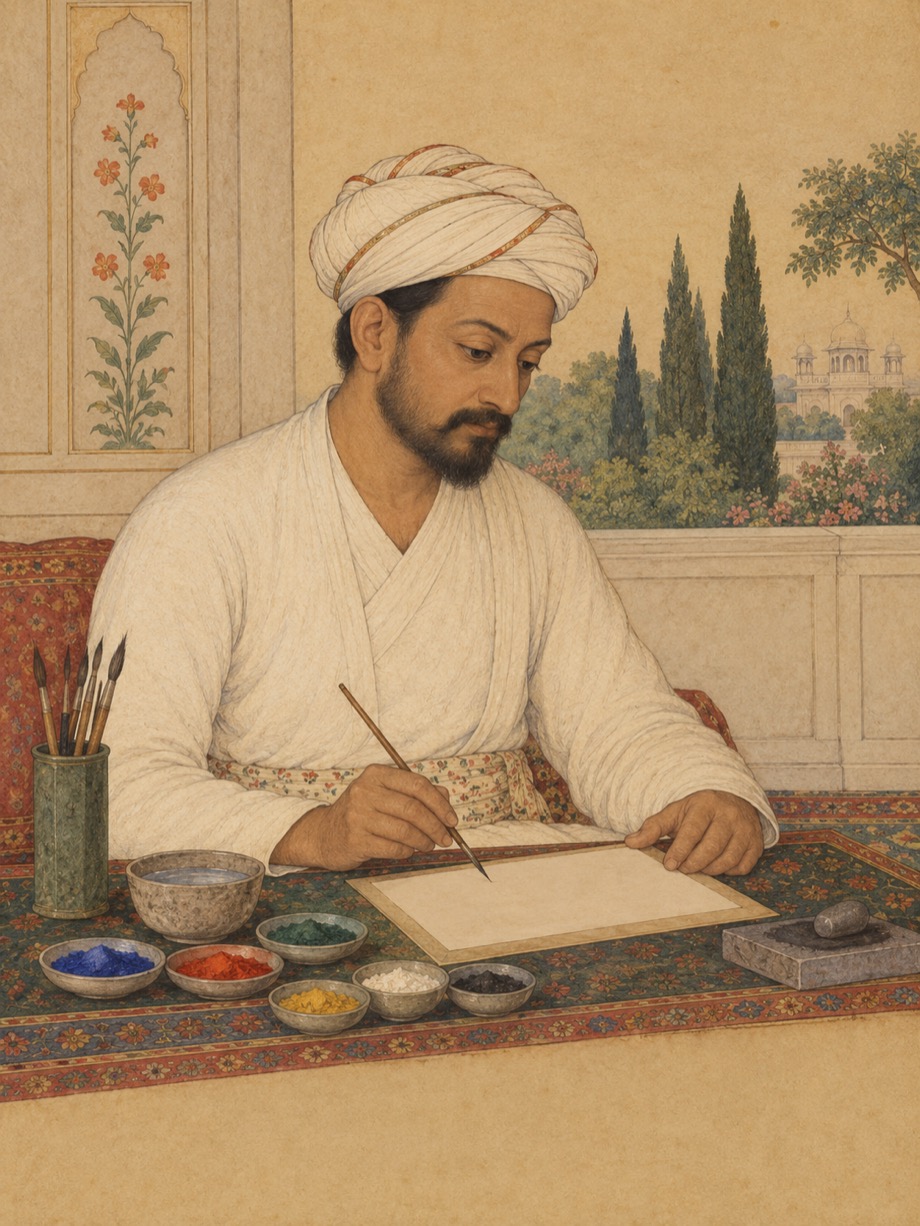
AI-assisted Portrait of Basawan
The History Within a Face
Basawan helped make the Mughal past look inhabited. In a manuscript painting, a crowded assembly could become legible through the placement of bodies, the distinction of faces, and the relationship between figures and their setting. Contemporary praise singles him out for precisely such skills. It gives us an artist whose decisions mattered to imperial representation, even though it gives us very little of the man outside the workshop.
He was active in Akbar’s atelier from roughly the middle of the sixteenth century to about 1600. His name is associated with major manuscript projects and with the growing naturalism of Mughal painting. The life dates are not a complete biography; they describe a working period reconstructed from objects, inscriptions, and historical notices. Birthplace, private attachments, and ordinary conversations remain much less recoverable than painted surfaces.
Basawan remains untyped. A convincingly differentiated face does not prove psychological empathy in its maker, just as an adventurous use of perspective does not prove an intuitive personality. What can be examined is the artistic work: choices of arrangement, models drawn from different traditions, and participation in a court production system that rewarded particular talents.
Named Within the Atelier
Abu’l-Fazl’s Ain-i-Akbari praises Basawan for composition, the drawing of features, the distribution of colour, and portraiture. It also notes that some critics preferred him to Daswanth. This is valuable contemporary testimony to his standing and to the criteria by which achievement was recognized. The praise is also part of a larger account presenting Akbar as a ruler who identified and cultivated excellence.
The passage locates Basawan within a company of artists. It does not imagine an isolated genius working outside institutions. Painters were evaluated, rewarded, and assigned to ambitious projects. A folio might distinguish the person responsible for its initial design from the person who completed its colour. That separation helped a workshop coordinate production while still acknowledging particular skill.
Attribution therefore involves more than deciding whose name should stand beneath an image. A securely recorded role may identify composition without giving one painter sole responsibility for everything visible. An inscription may be contemporary, later, or ambiguous. The difference changes what we can claim about Basawan’s work, especially when a powerful modern preference for individual authorship meets a collaborative manuscript.
An Empire Composed on Paper
The imperial manuscript presented history through repeated acts of selection. A narrative had to become a particular scene: who stood where, which gesture carried the action, and how the setting made an event understandable. Such decisions were consequential even when an artist was illustrating an assigned text. The painting gave readers a way to encounter the dynasty’s account with their eyes.
Basawan’s contemporary reputation for arrangement and likeness suggests why his work was valuable in that process. Recognizable differences among people prevent an assembly from becoming an interchangeable pattern of bodies. Changes of scale, position, or attention can make a dense event readable. These are formal effects that can be observed without claiming to know whether he privately sympathized with each figure.
The same restraint applies to the historical truth of a painted episode. An imperial illustration could be vivid while remaining retrospective and shaped by a patron’s account. Faces and clothing do not automatically turn the scene into eyewitness documentation. Basawan helped construct persuasive historical images; that accomplishment should not be confused with a camera’s record or with an independent endorsement of every imperial claim.
European Models, Mughal Purposes
Art historians identify Basawan as a significant participant in the court’s encounter with European pictures and prints. New models offered ways of showing volume, distance, drapery, and sacred figures. Their arrival did not erase Indian and Persian practice. An artist could borrow a device, reposition it, and make it function within a different composition and a different reading culture.
The Mother and Child with a White Cat, dated around 1598, provides a useful warning as well as an example. Scholars have attributed the work variously to Basawan or to his son Manohar. Its European-derived elements are clear enough to discuss, but the disputed authorship should remain visible. Calling it simply Basawan’s personal statement would conceal the very uncertainty that careful comparison has exposed.
It would also be unwarranted to infer conversion from Christian-associated imagery. A court painter could work with a circulating model because it interested a patron, solved a visual problem, or supplied a useful motif. The resulting image shows an artistic encounter; it does not necessarily disclose the maker’s faith. Similarly, technical experimentation tells us what a painter attempted on paper, not how he habitually evaluated every sphere of life.
What the Surfaces Keep
Basawan’s son Manohar also became a distinguished painter. That connection makes artistic transmission within families visible, but it does not authorize a sentimental account of instruction. Objects and attributions support a professional relationship between generations more clearly than they preserve domestic life. Workshop inheritance may include models, methods, status, and opportunities that cannot be disentangled into one remembered lesson.
The surviving evidence nevertheless allows an individual career to emerge from an imperial label. Mughal painting was made by people with differing strengths, and contemporary records sometimes recognized those distinctions explicitly. Basawan matters because the named artist and the attributed body of work can be brought into conversation, with discrepancies preserved rather than smoothed away.
Connected Figures
Further Reading
- The Ain-i-Akbari, Volume I — Abu’l-Fazl; translated by H. BlochmannContemporary praise identifies Basawan’s skills within Akbar’s organization of the arts.
- Wonder of the Age: Master Painters of India, 1100–1900 — John Guy and Jorrit BritschgiThe catalogue places named artists, workshop roles, and disputed attributions at the centre of interpretation.
- Indian Miniatures of the Mughal Court — Amina OkadaA detailed treatment of major imperial artists and the formal development of Mughal painting.
- The Jesuits and the Grand Mogul: Renaissance Art at the Imperial Court of India, 1580–1630 — Gauvin Alexander BaileyExamines European images and their transformation within the Mughal court.
