 Historical Figure MBTI
#1220 · 9-7-26 · The Mughal Empire
Tansen
Court Musician · A Legacy Beyond the Legends
Born early 16th century; died 1586 or 1589
7 min read
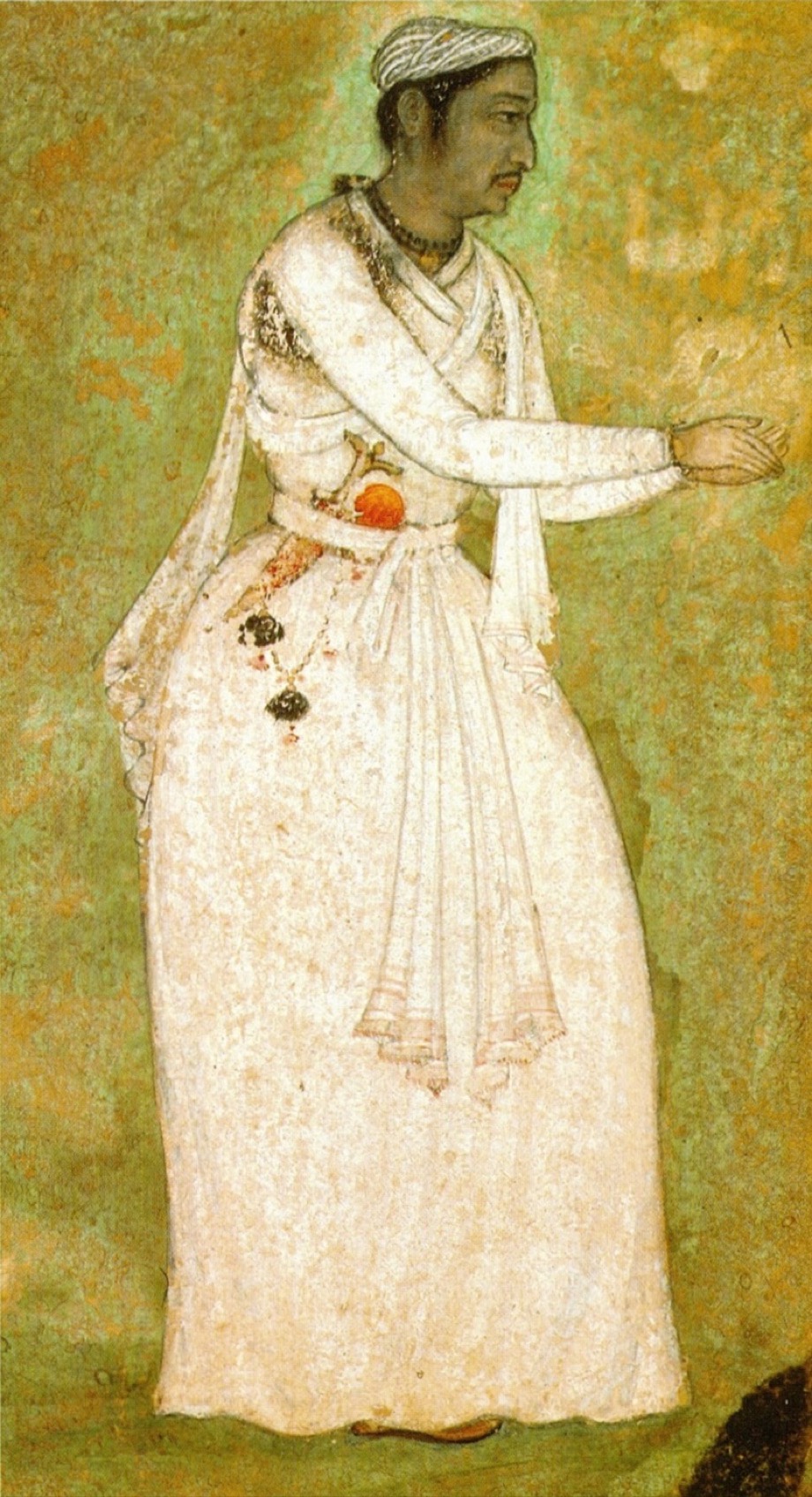
Portrait of Tansen — 1585–1590
A Voice Larger Than Its Biography
Tansen’s reputation preserves an extraordinary musician and obscures an ordinary life. Later stories give his voice power over fire, rain, and animals. Contemporary court writing supplies a different kind of distinction: Akbar valued him above an already accomplished company of singers, and his death was marked as a loss to the whole musical establishment. The first portrait can be enchanting; the second is the firmer historical beginning.
He came to the Mughal court from the service of Raja Ramchandra of Rewa. His origins are associated with Gwalior, a region whose musical importance preceded Akbar’s empire. The transfer brought an established performer into a larger concentration of patronage rather than creating his talent at the moment the emperor discovered it. Neither the childhood scenes nor every famous teacher-student relationship in later retellings can be treated with the same confidence as that courtly career.
His birth belongs somewhere in the early sixteenth century, with competing dates. The death date is also transmitted inconsistently: 1586 remains common in accounts, while the Akbarnama places his death on 26 April 1589. The latter is specific contemporary evidence, but retaining the disagreement makes the limits of the inherited biography visible. Precision should follow the sources rather than the familiarity of a commemorative date.
A Court Could Request a Singer
The move from Rewa to Akbar’s service belongs to the politics of patronage. A powerful ruler’s wish to hear a celebrated musician could become a request another court could scarcely ignore. Accounts of Ramchandra’s attachment to Tansen emphasize his value before the transfer. They should not be converted into verbatim scenes of reluctant farewell, but they establish that the singer’s availability mattered to more than one ruler.
Musicians could cross political boundaries without changing the foundations of their training at each crossing. Rewa and the Mughal court offered different resources and audiences, yet performance drew on earlier learning and repertoires. The broader historical point is that imperial culture gathered accomplishments from established regional worlds. Akbar’s court became a centre by attracting people whose excellence had been recognized elsewhere.
Tansen’s distinction therefore cannot be described solely as a gift bestowed by Akbar. The emperor provided honour, support, and a setting in which the singer’s reputation expanded. Tansen brought the accomplishment that made those resources worthwhile. Court chronicles naturally make the ruler the centre of the exchange, but their admiration inadvertently records how much that centre depended on the people it gathered.
First Among a Working Company
Abu’l-Fazl’s Ain-i-Akbari names Tansen first in its list of leading imperial musicians. The surrounding account is as revealing as the extravagant praise. Singers and instrumentalists came from several regions, including Gwalior, Kashmir, Iran, and Central Asia. Men and women participated in the court’s musical life. Music was organized into seven divisions assigned to the days of the week, so performance formed part of a repeated institutional routine.
This organization gives Tansen an environment rather than leaving him alone with a miraculous voice. He worked among other trained performers, under conditions of recurring availability, royal taste, and differentiated expertise. The list identifies singers, players of the bin, flutists, and performers on several bowed or plucked instruments. It records an ensemble of skills whose variety should survive any biography centred on its most celebrated member.
The same source names Tantarang Khan, a son of Tansen, as a singer. Later notices connect Bilas and succeeding musicians to his family. Such references support a history of transmission through households and professional relationships. They do not authenticate every later lineage claim. A tradition could preserve knowledge of a prestigious ancestor while changing the music, stories, and social purposes associated with his name.
What a Name Can Carry
Tansen is strongly associated with dhrupad and with ragas whose names preserve the honorific Miyan. Their continuing place in musical tradition is part of his historical significance. Yet attaching a name to a raga does not supply an autograph score or establish exactly how its sixteenth-century form sounded. Oral practice can preserve structures while generations of performers develop, select, and reinterpret them.
Composition, performance, and attribution therefore need separate treatment. A text transmitted under Tansen’s name may belong to a continuing repertory without providing his unmediated speech. A modern performance of a raga associated with him demonstrates a living inheritance, not a recording of his own voice. The historian has neither the physical sound nor a complete set of original notations from which to reconstruct every expressive decision.
This is a reason to be precise about what survives, not to dismiss oral inheritance. Musical history depends on testimony, teaching, terminology, and repeated acts of performance in ways that a history of printed books may not. Tansen’s reputation helped those acts acquire authority. The challenge is to honour that inheritance while recognizing that reputation, attribution, and recoverable individual authorship are different kinds of evidence.
The Legend Measures the Admiration
Stories in which Tansen’s singing kindles lamps or summons rain dramatize music’s power over listeners by giving it power over the elements. They are valuable as evidence of how later communities imagined exceptional mastery. They cannot establish that the historical singer performed a supernatural act, and they offer no sound basis for reconstructing his psychology. Their wonder belongs to reception rather than verified event.
The same care applies to accounts linking him with Swami Haridas and Muhammad Ghaus, and to the competing stories about his religious identity. These relationships and memories belong to an important devotional geography around Gwalior. Their transmission is uneven, however, and a seamless modern life story can hide the distances between contemporary notice, community tradition, and later narrative elaboration.
The simplest safeguard is to name the kind of claim being made. A court list establishes employment and esteem. A later teaching lineage establishes remembered authority within that lineage. A miracle tale establishes admiration expressed through a particular story. None needs to displace the others, but they should not be merged into a single evidentiary surface on which every detail appears equally secure.
A Funeral With Music
The Akbarnama records that musicians and singers accompanied Tansen’s body to the grave at Akbar’s order. The account makes music itself the form of mourning. Its rhetoric presents the loss as an almost impossible silence in the emperor’s world, but the reported ceremony also gives a concrete public action: professional colleagues gathered to mark the death of one of their own.
That passage is more useful than an invented final performance. It situates the singer within a group capable of honouring him and a court capable of ordering and supporting that honour. It also explains why the date of 1589 deserves serious weight against the frequently repeated 1586. The discrepancy should be acknowledged without creating a false impression that there is no contemporary evidence at all.
Connected Figures
Further Reading
- The Ain-i-Akbari, Volume I — Abu’l-Fazl; translated by H. BlochmannThe list of imperial musicians and its notes locate Tansen within a diverse working court.
- The Akbarnama, Volume III — Abu’l-Fazl; translated by Henry BeveridgeRecords Tansen’s death in 1589 and the musical ceremony ordered by Akbar.
- Tansen, in Cultural Leaders of India: Musicians and Composers — K. C. D. Brahaspati; volume edited by V. RaghavanA study of the musician and the difficult relationship between historical evidence and tradition.
- Ranjani vina — The Metropolitan Museum of ArtA museum account of an instrument offers context for North Indian musical traditions rather than a relic of Tansen.
