 Historical Figure MBTI
#1219 · 9-7-26 · The Mughal Empire
Abd al-Rahim Khan-i-Khanan
Poet · Patron · Imperial Commander
1556–1627
7 min read
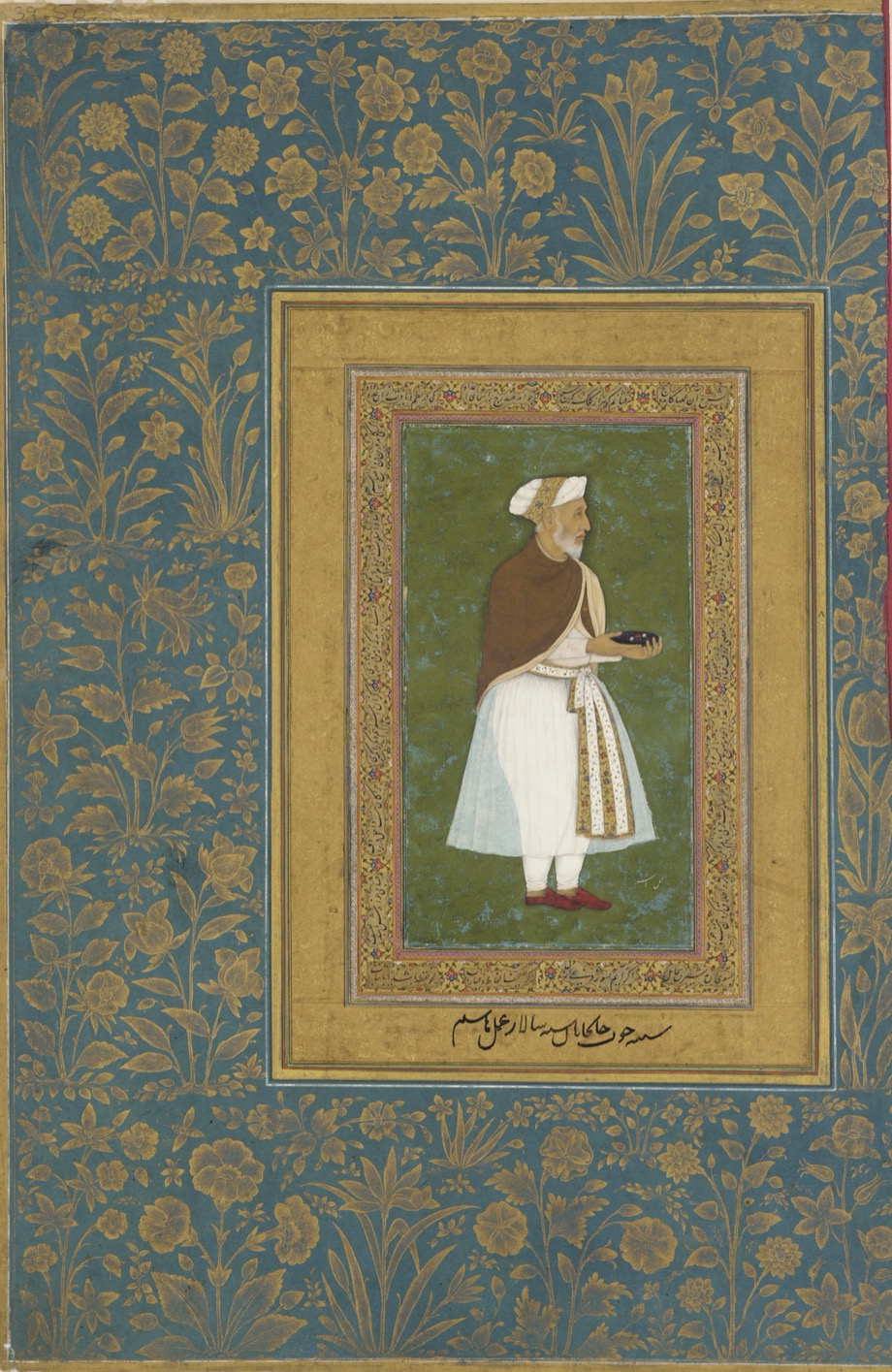
Portrait of Abd al-Rahim Khan-i-Khanan — circa 1627
The General With More Than One Language
Abd al-Rahim Khan-i-Khanan could direct an imperial campaign and sustain a poet’s livelihood. Neither activity was incidental to his standing. The son of Bairam Khan became one of Akbar’s major commanders, a translator of Babur’s memoir, and a patron whose household drew scholars and craftsmen from far beyond the imperial capital. His career troubles the comfortable division between an inward literary life and the public exercise of force.
Born at Lahore in 1556, Rahim entered Akbar’s care after his father’s assassination. His ascent was shaped by that dynastic protection, but his later authority depended on work of his own. Service in Gujarat, Sind, and the Deccan placed him among the men through whom the empire expanded. The literary record, meanwhile, shows that he wanted his resources to sustain books, languages, and people as well as armies.
This archive proposes INFP with low confidence. The argument begins with the range and persistence of his chosen literary commitments, then tests them against the commander and courtier. Poetry is not proof of a feeling preference, and generous patronage could build political power. What makes the interpretation plausible is the repeated investment in a cultural world larger than any single official assignment.
The tentative INFP reading places dominant Introverted Feeling in Rahim’s sustained personal investment in literature, patronage, and relationships across languages.
A Patronage That Had to Be Maintained
Rahim’s literary household was an establishment, not a mood. Abd al-Baqi Nahavandi’s Maasir-i-Rahimi devoted extensive attention to its poets, scholars, buildings, and officers. The work was produced under Rahim’s patronage, so its architecture of praise must be recognized. Yet the variety of people it records gives substance to the reputation: writing depended on salaries, craftspeople, accommodation, and access to someone able to keep providing them.
That sustained expenditure is the strongest evidence for a preference beyond occasional courtly display. A manuscript required copying, illumination, illustration, and binding; supporting a poet might mean helping a household through years of service. Rahim used the resources of a great noble to maintain that process. Patronage advertised greatness, but it also demanded continuing attention to particular forms of work that military rank alone did not require.
Introverted Feeling is a tentative way to describe the personal selection of what deserved that attention. It should not transform every recipient into a beloved friend or every grant into a selfless act. A patron could be generous and demanding at once. The relevant pattern is durable cultural commitment, supported by a material institution and visible through evidence more substantial than the charming gift stories later attached to his name.
The scale of that establishment also changes how generosity should be judged. It is not enough to admire a large sum in a single anecdote. The more revealing question is what the household continued to make possible after the gift: a copied text, a poem composed without immediate hunger, or skilled labour retained for another commission. The written record is strongest when it identifies those practices, and weakest when an astonishing number serves only to make the patron seem immeasurable.
Babur in Another Tongue
At Akbar’s direction, Rahim translated the Baburnama from Chagatai Turkish into Persian. The project brought the founder’s recollections into the language most widely used by the later court. Translation here did not merely decorate an established dynasty. It made an earlier voice available to people whose imperial service and literary education were organized through a different language.
Rahim also composed poetry in Persian and Indian vernacular forms. These activities should not be flattened into a modern claim that all cultural boundaries disappeared around him. Languages carried distinct conventions, audiences, and forms of prestige. His achievement lay in working across those distinctions while preserving enough of each medium to make the crossing productive. A single multilingual career could inhabit several literary expectations.
Auxiliary Extraverted Intuition offers a cautious interpretation of that capacity to extend a commitment through different forms. The same broad household could include an émigré Persian poet and a craftsman making a book. This does not prove an endlessly experimental personality. It suggests that Rahim’s cultural investments remained open to combinations and possibilities beyond the narrowest requirements of imperial service.
The Son of a Displaced Protector
Bairam Khan’s fall and assassination placed his child in a relationship of dependence on the emperor his father had helped secure. Rahim’s subsequent elevation made the title Khan-i-Khanan a connection to his father’s public standing as well as an earned reward for service. The inheritance did not supply an uncomplicated emotional script. The same imperial household could offer protection, demand obedience, and become the arena in which a noble’s position was threatened.
The translation of Babur also participated in dynastic remembrance. Rahim helped preserve the founder’s account while serving descendants whose needs and ambitions had changed. Such acts give a modest basis for discussing tertiary Introverted Sensing: maintaining a usable connection to earlier people and texts. They do not permit invented scenes of childhood grief or claims that his father’s death secretly governed every later decision.
The Soldier the Literary Portrait Must Keep
Rahim’s victory at Sarkhej in Gujarat in 1584 helped earn his title and advancement. His long involvement in the Deccan included military successes, disputes with princes, recall, and renewed appointment. The imperial record is uneven because command was shared, rivalries shaped reports, and the court evaluated results through its own demands. There was no serene passage from cultivated judgment to uncontested operational success.
Under Jahangir, Rahim’s standing suffered again during the struggles around Prince Khurram’s rebellion. His attempts to occupy a mediating position could be interpreted as divided loyalty. The loss and execution of family members made the consequences severe. Later restoration of rank did not undo those costs. Literature and diplomatic inclination did not exempt him from the violence of the system in which he held high office.
Inferior Extraverted Thinking cannot mean that an INFP was incapable of directing an army. In this interpretation, organization was a developed public capacity, visible in both warfare and patronage, while the proposed centre of preference lies elsewhere. That distinction remains uncertain. A military and administrative reading may fit him better than the surviving literary reputation suggests, which is why the alternative deserves real weight.
Testing the INFP Reading
Why not ENFJ?
ENFJ is a serious alternative because Rahim assembled people, sustained networks, and negotiated relations among princes and officers. His patronage could be understood as outward social leadership rather than private valuation. INFP is weakly preferred because translation and work in several literary forms suggest commitments not exhausted by managing a circle. The record cannot securely establish which motive usually came first.
The verdict therefore describes a possible organizing preference, not a contradiction between poet and general. Rahim’s military competence should stay fully present. The INFP reading becomes useful only when it explains an enduring selection of cultural and personal investments without explaining away command, calculation, or the ambitions of an imperial noble.
Connected Figures
Further Reading
- Maasir-i-Rahimi — Abd al-Baqi NahavandiA substantial patron-sponsored account of Rahim’s service, family, buildings, and cultural circle.
- The Ain-i-Akbari, Volume I — Abu’l-Fazl; translated by H. BlochmannImperial offices and biographical notices place his patronage within a working court.
- The Tuzuk-i-Jahangiri — Jahangir; translated by Alexander Rogers and Henry BeveridgeA royal perspective on the conflicts that complicated Rahim’s later command.
- Abd or-Rahim Khan-e Khanan (964–1036/1556–1627): Staatsmann und Mäzen — Eva OrthmannA scholarly study of his intertwined careers as statesman and patron.
