 Historical Figure MBTI
#1218 · 9-6-26 · The Mughal Empire
Bharmal
Ruler of Amber · Maker of a Dynastic Alliance
c. 1498–1574
5 min read
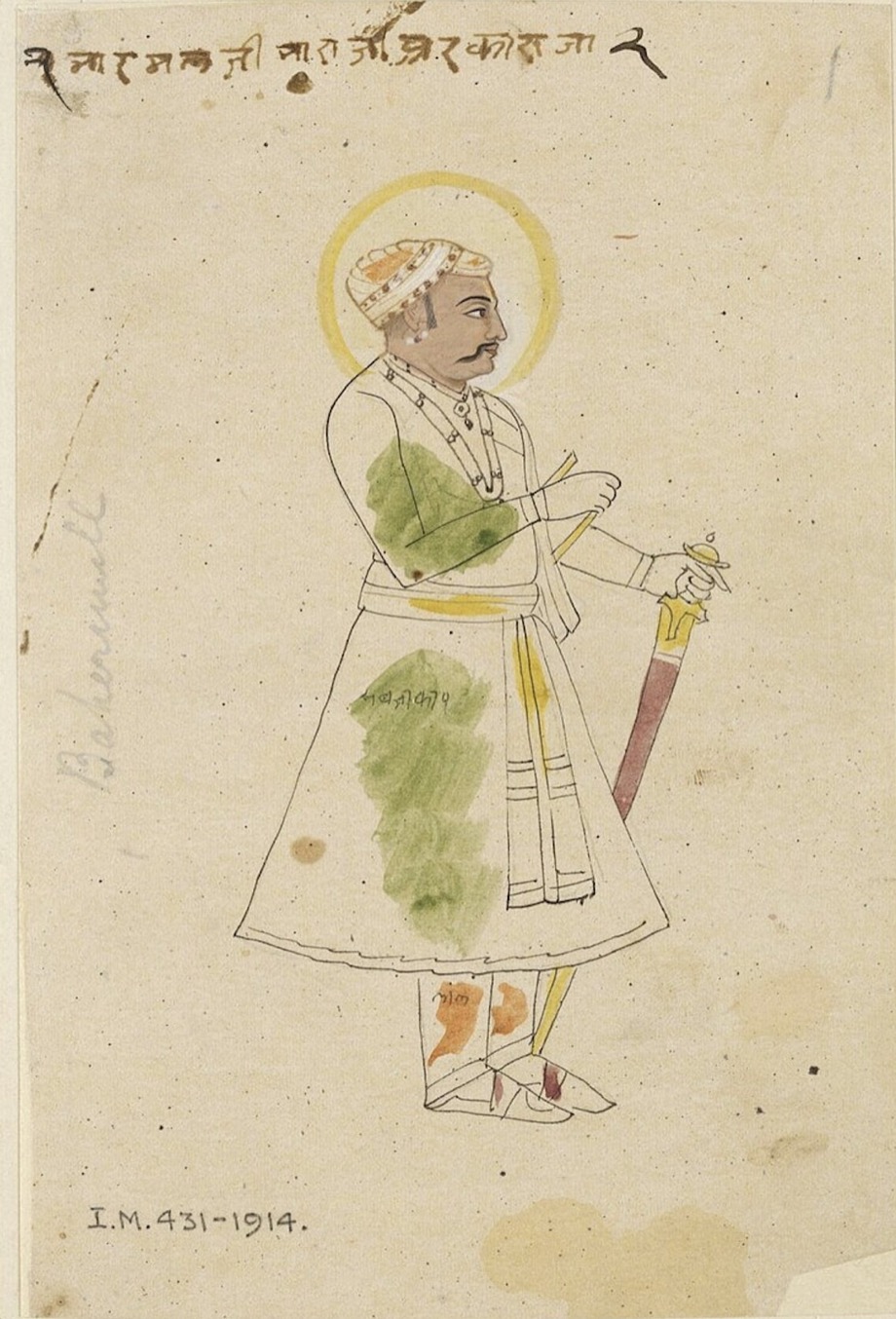
Portrait of Bharmal — 19th century (later depiction)
The ruler who changed the terms of danger
Bharmal did not meet Akbar from a position of comfortable independence. Amber faced pressures from outside and rivalry within its own ruling family. In Abu’l-Fazl’s account, relatives had been taken as hostages by Sharaf al-Din Husain Mirza, whose authority near Amber gave him the means to intervene in its affairs. The ruler’s approach to the emperor in 1562 was therefore a move inside an existing crisis. He sought a relationship that could alter who had the power to threaten him.
The marriage of his daughter to Akbar became one of the best-known alliances of the reign. It is easily converted into a simple explanation of Bharmal himself: visionary pragmatist, timid collaborator, or enlightened advocate of coexistence. None follows automatically from the agreement. A political act may be consequential without revealing a whole personality, and a father’s decision cannot be allowed to replace the history of the daughter whose life the alliance changed.
Bharmal remains untyped here. His accommodation is clear enough; the recurring private preferences behind it are not. The record permits an account of pressures, choices, and consequences. It does not permit confidence that choosing a marriage alliance distinguishes one cognitive pattern from another.
An opening above the local opponent
The Akbarnama describes a rival claimant within Bharmal’s extended family seeking Sharaf al-Din’s help against him. It also describes imposed payments and the detention of close relatives. The chronicle’s purpose is to contrast this local oppression with the emperor’s beneficence, so its portrayal requires caution. But the situation it outlines is politically intelligible: an imperial officer could become a regional ruler’s immediate danger, while the emperor above that officer could become a source of protection.
Bharmal’s approach was mediated through a court connection and then made in person as Akbar traveled toward Ajmer. The form matters. Access to a sovereign was itself a political resource, and favorable introduction could move a ruler’s difficulties from a local arena into an imperial one. The alliance did not simply ask Amber to accept a new master. It also changed the relationship between Bharmal and competitors who had been able to use Mughal power against him.
Abu’l-Fazl presents the resulting encounter as the recognition of an already loyal and worthy chief. That language belongs to the court’s explanation of incorporation. It makes the emperor’s favor appear both discerning and morally necessary. Reading against the grain does not require rejecting the event; it requires recognizing that the account organizes everyone else’s choices around Akbar’s greatness. Bharmal’s own calculation has to be reconstructed from the circumstances, without mistaking the chronicler’s praise for an interview.
The marriage and the household it connected
The marriage took place at Sambhar in 1562. Bharmal’s daughter later became known as Mariam-uz-Zamani and was the mother of the prince who became Jahangir. Her later standing helped give the connection lasting dynastic weight. That future should not be treated as something Bharmal could see in full at the moment of negotiation. The child, the reign, and the woman’s later authority belonged to developments still ahead.
It is also important to keep names precise. The identification of Mariam-uz-Zamani with the popularly familiar name Jodha Bai is not established securely enough to serve as the foundation of this account. A recognizable label often brings a ready-made story with it: a spirited princess, a transformed emperor, a father who understands the whole project. Such scenes may organize later entertainment, but they cannot supply the motives absent from the sources.
The agreement joined households while opening court service to members of Bharmal’s family. His son Bhagwant Das and grandson Man Singh became prominent participants in Mughal power. Marriage was therefore neither the entire alliance nor an incidental ornament to it. It provided one durable relationship within a wider process of rank, military service, and repeated contact. The strength of the connection emerged over time from how family members used it.
Accommodation is also a political choice
Bharmal’s decision can be compared with Mewar’s continuing refusal of incorporation, but it should not become a competition in ancestral virtue. Amber and Mewar occupied different situations, possessed different resources, and developed different relationships with the court. Rajput identity did not prescribe one uniform response to imperial expansion. A ruler could claim to preserve his house through accommodation just as another could claim to preserve it through resistance.
Nor does the survival of a house establish that everyone benefited equally. The agreement redistributed risks and opportunities among a ruler’s relatives, dependents, and subjects. Court access could enlarge a family’s power while drawing its members into distant campaigns and imperial succession contests. The later successes of Man Singh show the reach of the opening, but they also show that this reach depended on service to an authority whose fortunes Amber could influence without controlling.
Bharmal died in 1574, before the full extent of his grandson’s career had unfolded. Retrospective accounts can make him the architect of everything that followed, as though the later dynasty’s achievements were present in a single initial bargain. The more defensible claim is smaller and still substantial. He established a consequential connection under immediate pressure, and it created possibilities that descendants developed through their own decisions.
Connected Figures
Further Reading
- The Akbarnama, volumes II–III — Abu’l-Fazl; translated by Henry BeveridgeImperial narrative of the Amber alliance and campaigns; read its judgments of submission and resistance critically.
- The Mughal Empire — John F. RichardsA scholarly account of imperial institutions, regional incorporation, and the succession of 1605.
- Mewar and the Mughal Emperors, 1526–1707 A.D. — Gopi Nath SharmaA detailed regional study; distinguish its evidence from its older patriotic framing.
