 Historical Figure MBTI
#1191 · 8-31-26 · The Mughal Empire
Babur
Founder of the Mughal Dynasty · Memoirist · Garden Builder
1483–1530
6 min read
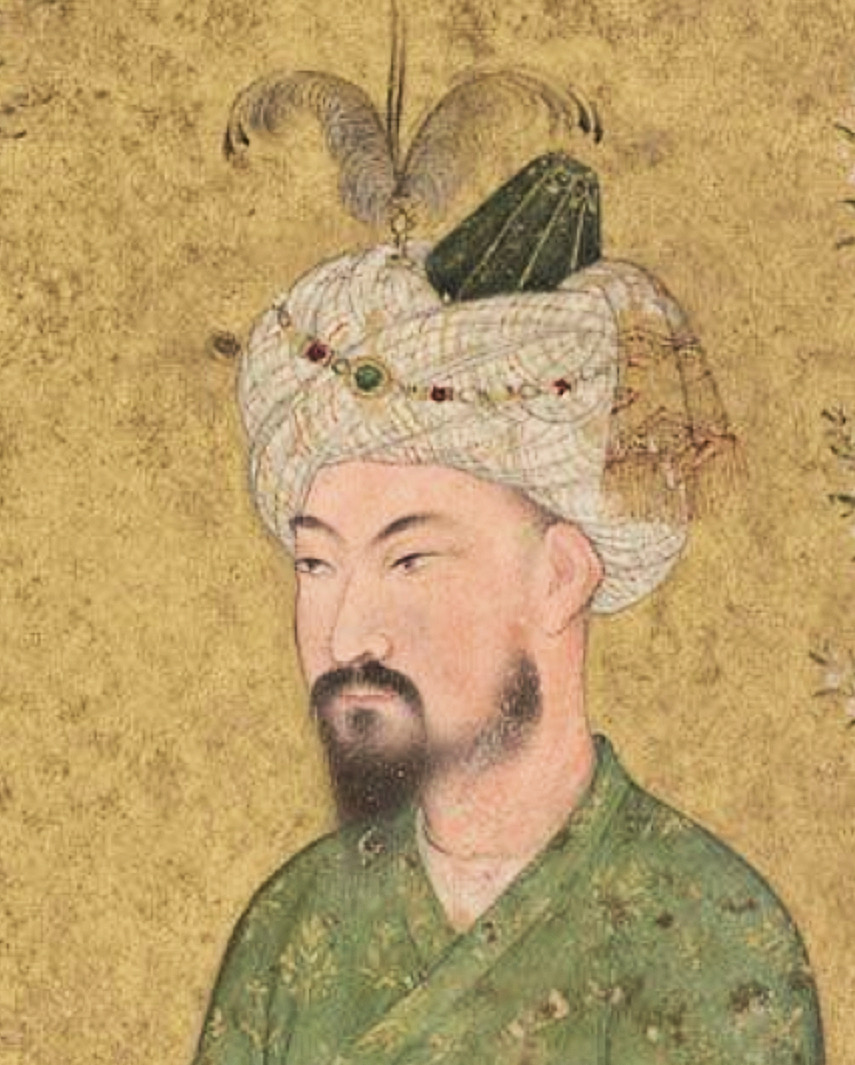
Portrait of Babur — retrospective depiction, 1640
The emperor who kept looking
Babur could win a kingdom and still dislike its fruit. In Hindustan he counted the things he missed: grapes, melons, cold water, familiar bread. His inventory of disappointment sits beside descriptions of unfamiliar animals, irrigation devices, and the staggering resources of the country he had conquered. The eye that measures a battlefield also judges an orchard. He does not become less observant when he becomes more powerful.
Born into the competing inheritances of Timur and Chagatai, he succeeded to Ferghana as a boy in 1494. Samarkand drew him repeatedly; taking it did not mean keeping it, and pursuing it could cost him the territory he already possessed. Kabul, acquired in 1504, eventually provided a durable base. The victory over Ibrahim Lodi at Panipat in 1526 opened a different future, although India never simply replaced the landscapes of his youth.
The proposed ESFP reading begins with this persistent traffic between immediate experience and intensely personal judgment. It is a speculative interpretation of a literary self-portrait, not a diagnosis. The Baburnama gives unusual access to his preferences and mistakes, but a ruler choosing what to record still controls the encounter.
Babur reads as an ESFP led by dominant extraverted sensing: the world reaches him first as something to see, taste, test, and change.
A world encountered at full speed
At Istalif, Babur noticed how the stream ran through the garden and ordered its course straightened. Near Khwaja Seyaran, he had a spring enclosed in a square pool with symmetrical sides overlooking flowering trees. The result was an arrangement to inhabit: shade, running water, a view, a place for companions to sit. His improvements turn close perception into an immediate intervention rather than a detached theory of beauty.
The memoir repeatedly changes scale without apology. Military movements give way to a tree, the quality of a vintage, or the mishaps of a raft. During a river excursion in 1519, companions fell overboard and a treasured cup was lost. Babur recorded the tumbling bodies and the replacement cup as readily as an appointment or an embassy. Such details matter because his attention seems to stay open to what the day delivers, even while he directs it.
This suggests dominant extraverted sensing: confidence in encountering circumstances directly, with an appetite for their texture and possibilities. It does not mean perpetual pleasure or thoughtless impulse. His campaigns demanded vigilance, endurance, and the reading of ground. Nor does it excuse violence. The same memoir that savors gardens records punitive raids and captives. An alert eye could serve both cultivation and conquest.
The private scale of worth
Babur does more than describe his surroundings; he continually decides whether they satisfy him. His judgments can be generous, piercing, or provincial. The complaints about Hindustan reveal the limits of a conqueror measuring another society against the pleasures of home. His preference is unmistakably his own, but personal conviction is not automatically moral generosity. Reading auxiliary introverted feeling here requires keeping that distinction intact.
His treatment of companions offers a smaller, revealing scene. In the 1519 entries he says he did not compel unwilling guests to drink, even while teasing an abstaining young soldier. Elsewhere he records another companion pressuring that man. The contrast is not evidence of modern tolerance, much less a complete ethical system. It does show Babur insisting on a boundary he presents as personally important within a convivial court.
Attachment also gives his narrative its uneven emotional weight. His mother accompanied him through dispossession and died soon after Kabul offered greater security. His account of carrying her to burial is spare, but the physical act survives. Homesickness, family loyalty, and aesthetic preference remain close to the surface of an imperial narrative. The ESFP interpretation rests partly on that unabsorbed personal register.
Pleasure needs an army
Panipat was not a victory produced by enthusiasm. Babur combined field fortifications, linked carts, firearms, and maneuver against a larger opponent. Artillery specialists supplied knowledge he did not personally invent. His achievement included using their expertise within an arrangement that his troops could execute. The commander could recognize an effective instrument and make several instruments work together.
After the capture of Agra, the immediate difficulty changed. Heat, sickness, and homesickness encouraged his followers to demand a return to Kabul. Babur convened a council and argued that conquest required subjects, provinces, and the means to hold them. Khwaja Kalan nevertheless left, with responsibilities for the Afghan possessions. Here Babur is less the adventurer than the employer of men whose private wishes threaten a public enterprise.
Tertiary extraverted thinking is a plausible language for this practical firmness: gather resources, allocate duties, insist on an executable result. The historical evidence also permits a less psychological explanation. Any successful prince needed these capacities, and Babur had learned them through repeated failure. Calling them tertiary describes their proposed place in his portrait; it cannot measure their actual strength or the sophistication of his government.
A future larger than the next ride
Samarkand was an inheritance and an image. Returning to it promised something more than another rich city: restoration of a Timurid position that defeat had made precarious. His repeated attempts show that immediate opportunities could remain tethered to a durable idea of who he ought to be. An interpretation centered on sensation therefore has to explain his persistence as well as his responsiveness.
In India, the long view became an obligation to stay. Before facing Rana Sanga at Khanwa in 1527, Babur renounced wine and made religious commitment part of an effort to steady a frightened army. The act joined inward resolve, public performance, and strategic necessity. We cannot isolate a private psychological cause from those overlapping purposes. What is visible is a ruler trying to bind dangerous present circumstances to a larger meaning.
Inferior introverted intuition offers a tentative reading of that pressure toward a single destination or redemptive purpose. It is the least secure part of the proposed stack. Dynastic ambition and Islamic kingship already supplied powerful frameworks for his conduct. They should remain historical explanations in their own right, rather than becoming decoration around a personality scheme.
Why ESFP Over ESTP
Why not ESTP?
An ESTP reading explains his physical boldness, improvisation, tactical flexibility, and lively company. It could also account for a memoir shaped to entertain and persuade. ESFP has a slight advantage because the writing so often returns to personal attachment and independent assessments of beauty, pleasure, and belonging, rather than making detached analysis its organizing voice. That emphasis is suggestive, not decisive.
The distinction cannot be settled by counting battles against poems. Both readings can accommodate a cultivated soldier. ESFP is offered as the more illuminating lens on the particular voice that survived, with the recognition that genre, translation, and royal self-presentation may exaggerate the very features being interpreted.
Connected Figures
Further Reading
- Baburnama — Babur; translated by John Leyden and William ErskineThe ruler’s own narrative, with its campaigns, pleasures, judgments, and silences.
- Babur: Timurid Prince and Mughal Emperor, 1483–1530 — Stephen F. DaleA concise biography placing the memoir within Timurid politics and cultural inheritance.
- The History of Humayun (Humayun-Nama) — Gulbadan Begum; translated by Annette S. BeveridgeA family account that brings the household and women into the dynastic story.
- Discovering Babur — Smithsonian National Museum of Asian ArtAn illustrated introduction to Babur’s writing and garden landscapes.
