 Historical Figure MBTI
#1193 · 8-31-26 · The Mughal Empire
Khanzada Begum
Timurid Princess · Dynastic Mediator
c. 1478–1545
5 min read
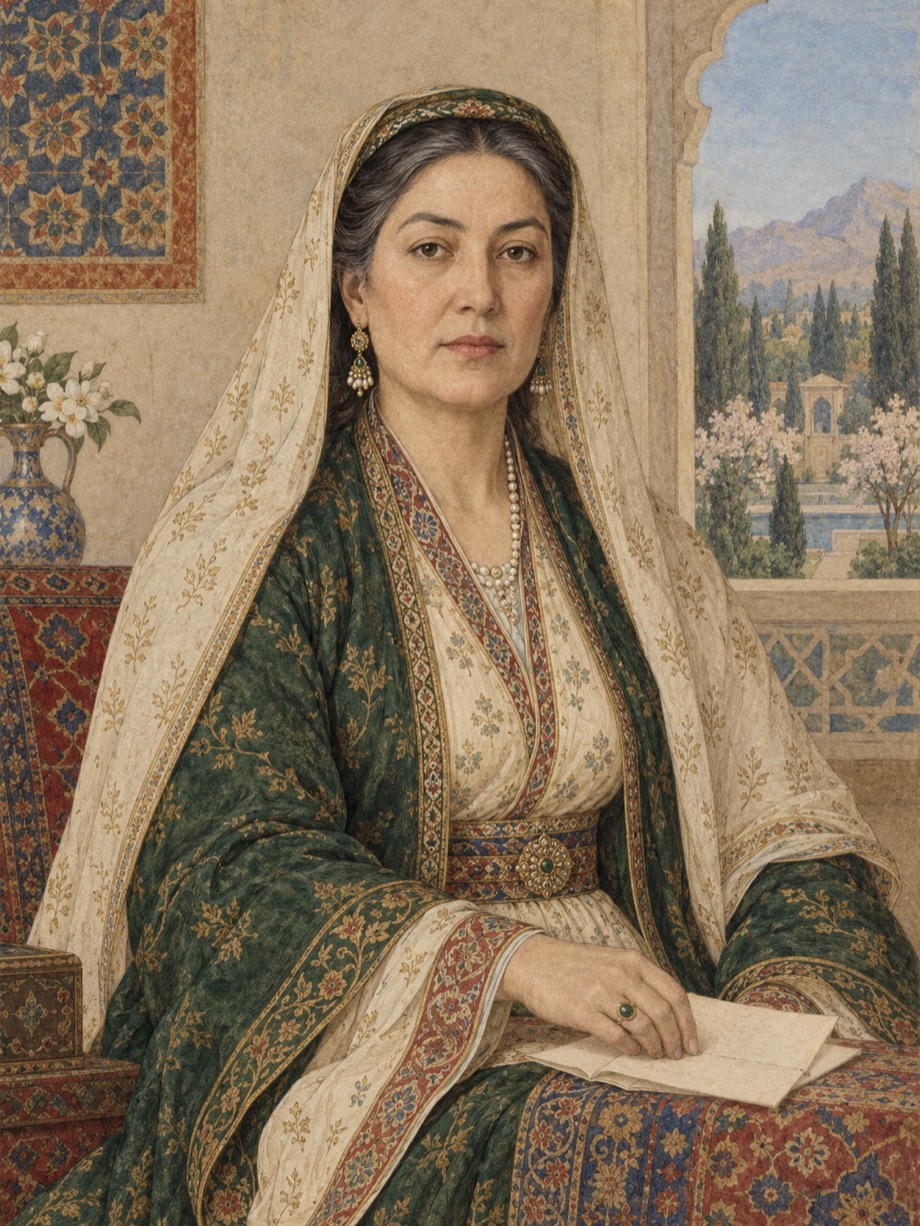
AI-assisted Portrait of Khanzada Begum
The sister left inside the walls
When Babur lost Samarkand to Muhammad Shaybani Khan, his sister did not leave with him. Khanzada Begum remained in the conqueror’s power and became his wife. The family’s later account made her marriage part of the price of Babur’s escape. It is tempting to turn that transaction into a clear scene of willing sacrifice. The surviving narrative does not give us her deliberations. What it gives us is the separation: a brother continuing his search for a kingdom, a sister whose life now lay within the household of his enemy.
Born around 1478, she was older than Babur and shared his parents, Umar Shaikh Mirza and Qutlugh Nigar Khanum. Through them she possessed Timurid and Chagatai royal ancestry. Those connections made her valuable within marriage politics, but value did not mean freedom to choose. In the struggle among Central Asian dynasties, a princess could be both a bearer of legitimacy and a person whose immediate circumstances were decided by defeat.
Her story matters beyond that first terrible bargain. She returned to her family, acquired senior authority in its household, and intervened among a younger generation of competing princes. The woman remembered as having been exchanged for a ruler’s safety later spoke about the limits of princely ambition. The movement from constrained marriage to respected elder is documented more clearly than the private experience that connected its stages.
A reunion with no easy ending
Khanzada’s years among the Uzbeks were not a single continuous marriage. Shaybani divorced her; she subsequently married Sayyid Hada. Her son by Shaybani, Khurram, died young. The sequence survives in dynastic accounts, but not in a diary of her own. These facts should not be padded with imagined humiliation, resilience, or secret plans. Loss is present in the record without our having to supply the words she might have used for it.
Shaybani’s defeat and death at the hands of Shah Ismail in 1510 changed the political conditions of her captivity. She was restored to Babur in 1511. Later family history describes the return with relief, while the broader setting involved Babur’s dealings with the victorious Safavid ruler. Kinship reunion and diplomacy were entangled. The episode neither proves that the Safavid intervention was motivated by compassion nor tells us what compromises Khanzada herself sought.
Back within the Timurid family, she married Mahdi Khwaja. That marriage placed her again in a political household, but the account of her later activities is not confined to her husband. The narrative increasingly treats her seniority as a source of authority in its own right. This is the important change: she becomes someone princes consult, someone whose wishes can determine the arrangement of a major family occasion.
The household as a political institution
In Gulbadan Begum’s History of Humayun, Khanzada is the cherished elder whose role extends across ceremony, upbringing, and counsel. She cared for Sultanam Begum from childhood and arranged the elaborate celebration of Sultanam’s marriage to Hindal Mirza. Gulbadan records gifts, furniture, household goods, and the scale of the feast. Such details show resources gathered and distributed, not simply affection expressed.
The feast also made relationships public. A royal marriage connected households; its celebration established rank, obligations, and the visibility of the people who supported it. Khanzada’s arrangements consequently belonged to the same dynastic order that battles and appointments sought to maintain. There is no need to claim she secretly ruled the empire. Her particular authority was effective precisely because she operated as a senior member of a family whose household was inseparable from government.
The stronger test came after Humayun lost his Indian kingdom. In the struggles around Kandahar, the competing claims of Kamran and Hindal brought the brothers’ political interests into conflict. Gulbadan presents Khanzada as insisting that Babur had designated Humayun his successor and that the brothers should recognize his precedence. The reported intervention ties her counsel to an identifiable principle of legitimacy, rather than to a vague desire that everyone get along.
Trust at the edge of war
In 1545 the young Akbar was placed in her care in Kabul during the struggle between Humayun and his brothers. Later that year she traveled amid negotiations surrounding Humayun’s return from Persia and his recovery of Kandahar. Her presence did not remove the rivalry or guarantee a settlement. Respect for an aunt could create a channel of communication without making armed princes accept one another’s terms.
She died of a fever at Qabal-chak while accompanying Humayun toward Kabul. Gulbadan records an initial burial there and the later removal of her body to Babur’s burial place in Kabul. The detail brings a long life of forced and purposeful movement to rest beside the brother from whom she had once been separated. It also comes to us through a niece remembering a much-loved elder; affection shapes this portrait as surely as royal interests shaped the earlier accounts.
Psychological verdict
Khanzada remains Untyped. Her documented actions support a portrait of trusted seniority, command of household resources, and concern for dynastic continuity. They do not establish a consistent pattern of thought across settings. Gulbadan’s remembered speeches and family judgments are invaluable evidence, but they are selective and retrospective. Constrained marriages reveal especially little about voluntary preference. Assigning a type would turn the expectations of her position into an explanation of her mind.
Connected Figures
Further Reading
- The History of Humayun (Humayun-Nama) — Gulbadan Begum; translated by Annette S. BeveridgeThe essential account of her household work, counsel, journeys, and death.
- Baburnama — Babur; translated by John Leyden and William ErskineThe brother’s narrative supplies the Central Asian setting and family perspective.
- Babur: Timurid Prince and Mughal Emperor, 1483–1530 — Stephen F. DalePlaces the family’s displacement and Safavid connections in political context.
