 Historical Figure MBTI
#1207 · 9-4-26 · The Mughal Empire
Gulbadan Begum
Princess · Historian · Pilgrim
c. 1523–1603
6 min read
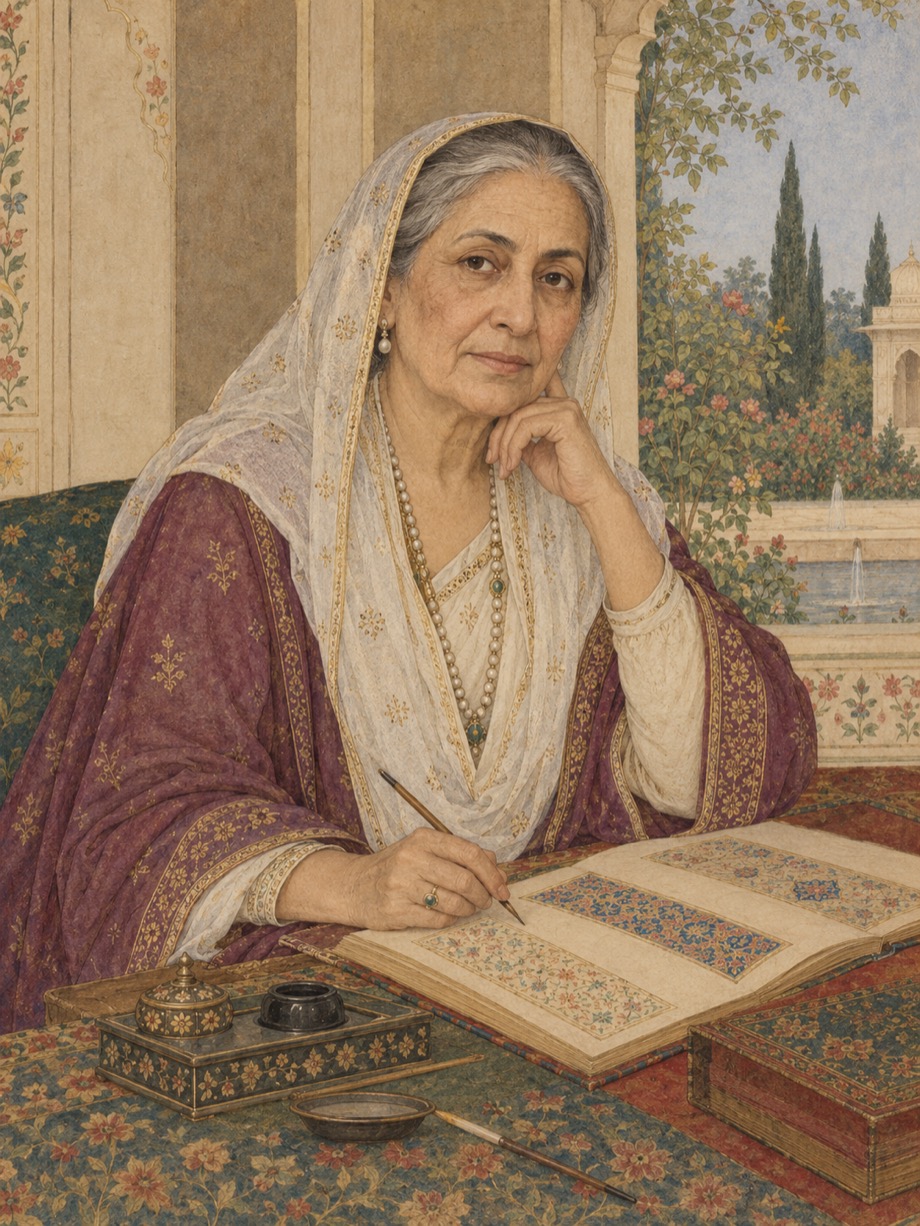
AI-assisted Portrait of Gulbadan Begum
What the imperial history nearly missed
Gulbadan Begum remembered the delay. The horses had not arrived; the women were still dressing; the emperor wanted to leave before the heat grew oppressive. Elsewhere she remembered a meal, a relative's gift, the distribution of provisions, or the awkward behavior that spoiled a princely gathering. These particulars were not decorations added to a history of campaigns. They were the substance of a dynasty experienced from within: authority waiting on household arrangements, affection expressed through material acts, and imperial quarrels entering rooms full of people who had not chosen them.
The daughter of Babur and half-sister of Humayun became a historian at Akbar's request. Her surviving Humayun-nama preserves a perspective the grander chronicles could not supply. ISFJ is a plausible interpretation because her attention repeatedly returns to remembered experience and the relationships that give it significance. Confidence is moderate rather than absolute. Memoir itself encourages detailed recollection, and an older writer's selections cannot disclose every habit of the younger woman.
Gulbadan Begum suggests ISFJ with dominant Introverted Sensing: the dynasty understood through remembered particulars and the bonds they preserve.
A basin, a garment, a remembered wish — Si dominant
Her history notices what makes an occasion different from an interchangeable example. At the brothers' reunion she sets out the order of washing hands, the cousin whose behavior offends the younger princes, and the tablecloth around which the company finally eats. Political concord becomes visible in a shared arrangement, while the small disturbance keeps the scene from becoming a polished emblem. Memory does not merely authenticate the event; it supplies the scale on which the event becomes intelligible.
That attention suggests Introverted Sensing as a reliance on experience retained with its particular human texture. In the account of a family excursion, preparation, timing, horses, and accommodation keep returning. Humayun's irritation and the letters of apology he subsequently demands are part of the same world as moonlit conversation. Gulbadan does not make the emperor uniformly serene. The preserved sequence lets affection coexist with inconvenience and hierarchy. Her account of the excursion is valuable precisely because both survive.
It would be too easy to equate a good memory with a personality type. The stronger case lies in what she repeatedly treats as explanatory. A family member's earlier wish resurfaces at a reunion; gifts acknowledge standing; a missing tent changes an evening. The past is not a storehouse of inert facts. It remains active in interpreting how people meet, recognize one another, and remember their obligations.
A kingdom of relationships — Fe auxiliary
Gulbadan makes women audible. Hamida Banu Begum resists Humayun's proposal for weeks; Dildar Begum persuades, writes, and calls the emperor back after he leaves in anger. The resulting marriage is not presented as the effortless expression of a sovereign's wish. Several people occupy the scene with different positions. Preserving their exchanges makes the household a site where authority is negotiated, even though the power available to each participant is unequal.
Extraverted Feeling is plausible in the way Gulbadan measures events through their consequences for connected people. When the brothers are reconciled, their followers can meet relatives from whom their masters' quarrels have divided them. Agreement repairs more than princely rank. When Hindal dies, the story moves through the women's mourning and the emotional transformation of Kabul. The loss is not confined to a military report or the emperor's reaction. Her narrative continually widens the circle of those affected.
This relational intelligence does not make her impartial. Hindal was her full brother, and her grief hardens the portrayal of Kamran. The same attachment that preserves a person can narrow the judgment of his opponent. Reading her well means honoring the depth of the witness while recognizing its allegiance. Feeling for a household is not equivalent to a fair distribution of sympathy among everyone who has injured it.
The witness distinguishes her place — Ti tertiary
Gulbadan sometimes tells us where she was not. When she cannot join a hunting excursion because her son is ill, that fact establishes a boundary around her presence. Her memoir also distinguishes recollection of Babur, who died while she was young, from the fuller experience available for Humayun's household. These are not modern footnotes, and much remembered dialogue remains impossible to verify. Still, the narrator is a situated witness, not a voice claiming to have stood everywhere.
Tertiary Introverted Thinking is a tentative description of this concern with the shape of an account. Particulars require relations among them: who belonged to which household, who was present, why a journey changed direction. She keeps enough of those distinctions to prevent the family from dissolving into a general tale of royal virtue. The evidence is stronger for a careful narrative habit than for a complete cognitive hierarchy. Her writing allows us to ask where the account gets its knowledge, even when we cannot fully answer.
Beyond the sandstone walls — Ne inferior
The pilgrim complicates any portrait of a woman whose life was confined to preservation. In the 1570s Gulbadan led a party of royal women toward Mecca, with Salima Sultan Begum among them. Their prolonged journey included dangerous sea travel and a troubled return through Aden before they reached India in 1582. Devotion had required them to leave the increasingly settled imperial household and enter networks that a land-based court could not control.
Inferior Extraverted Intuition should not become a claim that she feared novelty. The venture shows determination to pursue a possibility beyond the arrangement already secured for her. Ruby Lal's discussion of Vagabond Princess emphasizes that itinerant life. The type argument concerns the recurring center of Gulbadan's narrative attention, not the outer limit of what she could do. A woman who carried a dense remembered world could also insist on enlarging the world available to her.
Why ISFJ over INFJ?
Why not INFJ?
The memoir has a moral shape, especially as family concord gives way to loss. Yet Gulbadan ordinarily builds meaning from particular remembered encounters rather than subordinating encounters to one comprehensive vision. Small departures from the ideal remain visible, and household arrangements retain explanatory weight. This gives ISFJ an advantage over INFJ while leaving literary genre as a substantial alternative explanation.
The proposed distinction is about where interpretation begins. Gulbadan most often begins with people in a place, the sequence of what they did, and the past that makes an exchange matter. A different writer might compress the same material into a governing argument about empire. Her refusal of that compression is part of the historical value of her voice.
Connected Figures
Further Reading
- The History of Humayun (Humayun-nama) — Gulbadan Begum; translated by Annette S. BeveridgeThe primary memoir, with editorial notes that must be distinguished from Gulbadan's own text.
- Vagabond Princess: The Great Adventures of Gulbadan — Ruby LalReconstructs the princess's itinerant life and her pilgrimage beyond the settled court.
- Domesticity and Power in the Early Mughal World — Ruby LalExplains household relationships as constitutive of imperial politics.
- Three Memoirs of Humayun — Wheeler M. Thackston, editor and translatorProvides comparative translations of three witnesses to the emperor's reign.
