 Historical Figure MBTI
#1196 · 9-1-26 · The Mughal Empire
Hamida Banu Begum
Mughal Empress · Mother of Akbar
c. 1527–1604
5 min read
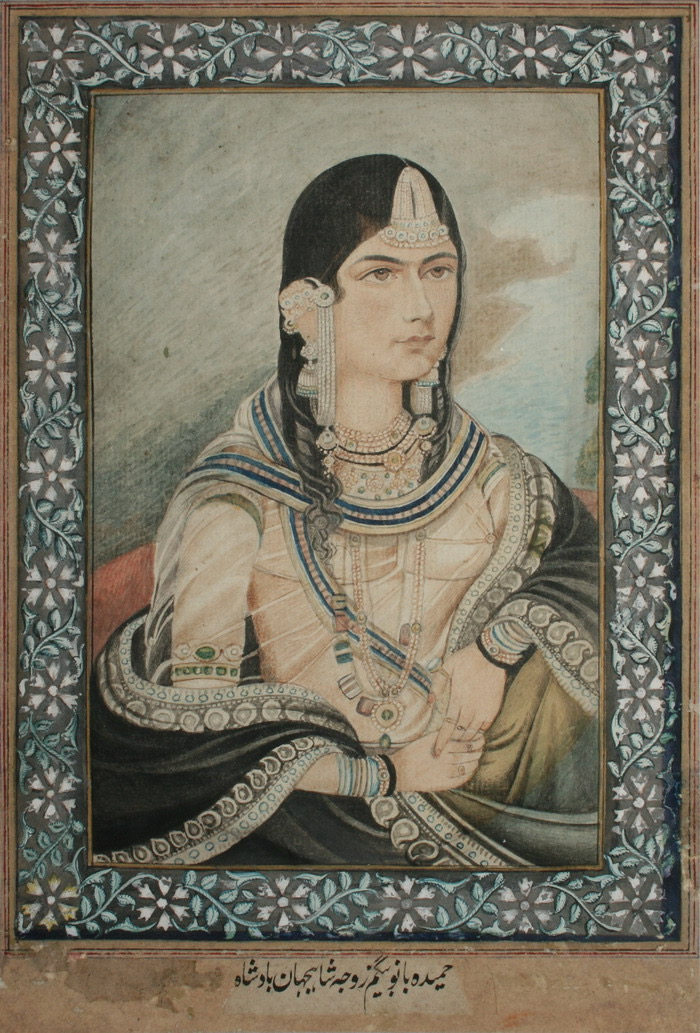
Portrait of Hamida Banu Begum — retrospective depiction, late 19th century
A woman who could refuse
Hamida Banu Begum enters Gulbadan's narrative by declining to come when an emperor calls. Humayun has lost his kingdom, but the imbalance between a ruler in his thirties and a girl of about fourteen remains considerable. For weeks she resists the proposed marriage. The scene has often been softened into a charming courtship. Its sharper value lies in the survival of disagreement: a woman later honored as the mother of an emperor had once been unwilling to marry his father.
An ISFJ interpretation must accommodate this resistance. It cannot be earned by calling her dutiful, maternal, or quiet. The more specific argument concerns her insistence on workable human relationships, her ability to maintain household dignity abroad, and the small acts through which she helped continuity become practical. This is a low-confidence reading. The record offers vivid encounters, but too little sustained access to her thinking for a firm conclusion.
Hamida Banu Begum tentatively suggests ISFJ with dominant Introverted Sensing: continuity protected through concrete judgments about people and circumstances.
A relationship within reach — Si dominant
Gulbadan recalls Hamida measuring a prospective husband against the possibility of ordinary closeness rather than the magnificence of royal status. We should not treat remembered dialogue as a verbatim transcript. Even in paraphrase, however, her objection has a distinctive scale. Dildar Begum offers rank as a reason to consent; Hamida returns to what living with the man would actually mean. The imagined relationship must be accessible enough to inhabit. The marriage episode records that disagreement without erasing its duration.
This makes a more useful case for Introverted Sensing than motherhood alone. Her judgment appears anchored in an apprehensible human arrangement, tested against the abstraction of becoming a queen. The subsequent marriage does not make the earlier objection insincere. Consent emerged after sustained persuasion in a household whose senior women had authority of their own. We cannot know how she weighed every pressure. What survives is the fact that she did not immediately accept the judgment others considered obvious.
Dignity at another court — Fe auxiliary
Exile demanded more than endurance. At the Safavid court, Shah Tahmasp's sister Sultanam hosted Hamida and asked whether comparable ceremonial arrangements existed in India. Gulbadan gives her a deft answer affirming Hindustan's abundance. The response neither dissolves her household's standing into gratitude nor turns hospitality into an open contest. Sultanam takes up the point and reinforces it. Gulbadan's Persian chapter preserves a guest sustaining her own dignity through a relationship with her hostess.
Extraverted Feeling is plausible here as attention to what an exchange does between people. Hamida answers in a form that allows the other woman to agree and the occasion to continue pleasantly. That is a specific social accomplishment, not proof that she always sought harmony. Her earlier resistance demonstrates that accommodation had limits. Together, the two scenes suggest a woman who could defend her position through the available language of relationship, adjusting her manner to the encounter rather than surrendering the position itself.
The household in provisions — Ti tertiary
On a family excursion near Kabul, after delays and the emperor's annoyance had strained the company, Hamida sent sheep to the other women's quarters. The memoir names a concrete distribution rather than a general virtue. Sharing provisions helped make a dispersed traveling household function. Its value was immediate: people could be supplied, entertained, and brought back into ordinary sociability after friction. Such gestures also acknowledged the separate standing of the women who received them.
The reasoning behind the distribution is not recorded, so this supplies only weak evidence for tertiary Introverted Thinking. It may show a practical sense of how a whole arrangement depends on its parts; it may simply be expected aristocratic hospitality. Retaining that uncertainty is more honest than assigning every gift a hidden cognitive mechanism. The act belongs in her portrait because it is hers, and because it makes family continuity visible at the level of food and quarters. Personality interpretation comes after that observation.
Why ISFJ over ESFJ?
Why not ESFJ?
Hamida's diplomatic response and hospitality could support either type. ISFJ has a slight advantage because her clearest early judgment resists the household's shared valuation of royal marriage in favor of a personally workable relationship. Later actions sustain established bonds more visibly than they direct a broad social program. The limited record prevents a secure distinction between inward and outward emphasis.
Neither resistance nor sociability measures introversion by itself. A young woman's room for action differed sharply from an emperor's, and narrative convention shapes which moments reach us. The proposed type helps connect a few choices; it cannot turn those choices into a complete account of her mind.
Connected Figures
Further Reading
- The History of Humayun (Humayun-nama) — Gulbadan Begum; translated by Annette S. BeveridgeA family memoir whose intimate scenes and loyalties require reading together.
- The Mughal Empire — John F. RichardsPlaces the brothers' conflicts within the formation of Mughal military power.
- Domesticity and Power in the Early Mughal World — Ruby LalShows why household relationships belong at the center of early Mughal politics.
