 Historical Figure MBTI
#1208 · 9-4-26 · The Mughal Empire
Salima Sultan Begum
Mughal Empress · Poet · Mediator
1539–1613
5 min read
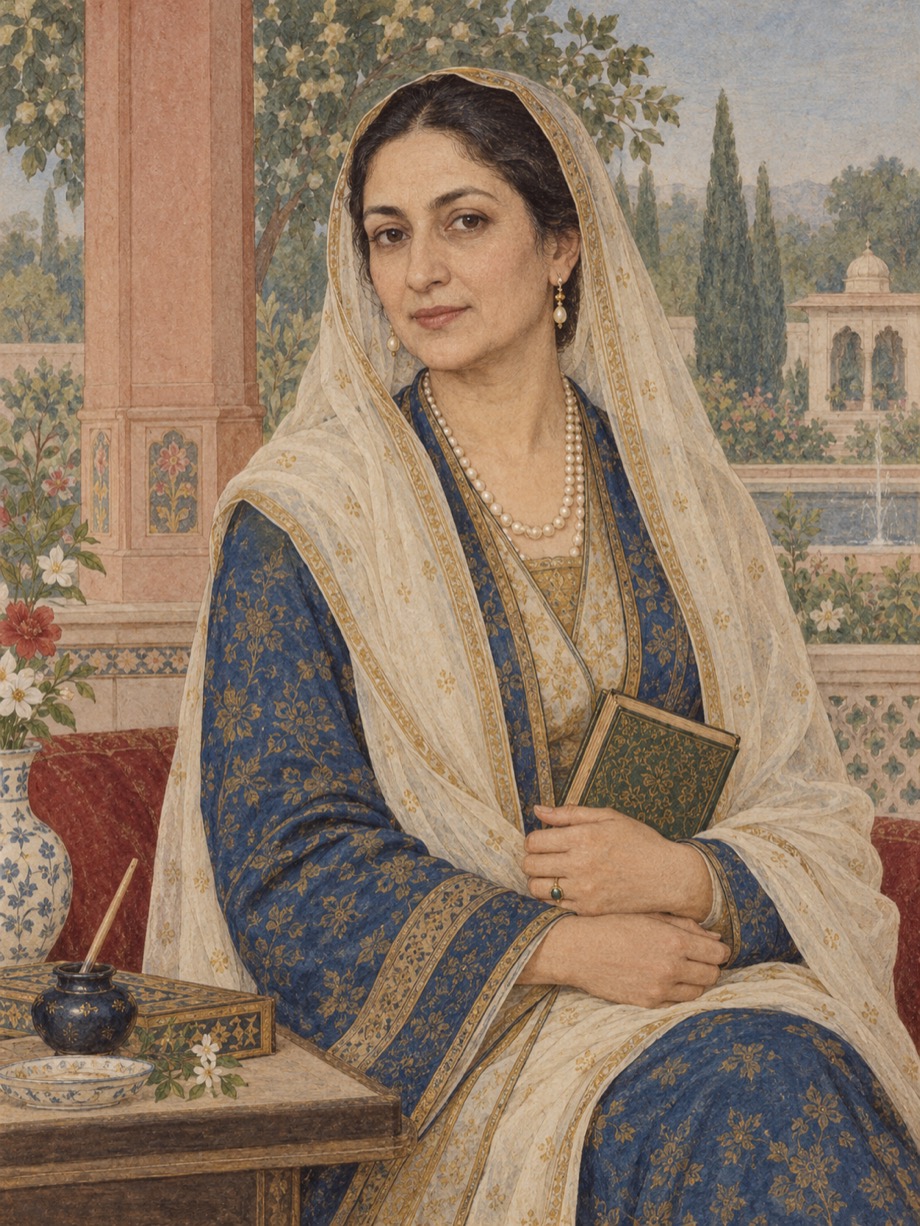
AI-assisted Portrait of Salima Sultan Begum
The person who could cross the distance
Between an emperor and a rebellious son lay more than a road. Anger, suspicion, wounded authority, and the murder of a trusted counselor had made approach dangerous. Salima Sultan Begum crossed that distance in the closing years of Akbar's reign, traveling to the prince Salim at Allahabad and helping bring him back into his father's presence. The act depended on standing accumulated over decades. She could speak within both relationships without holding the throne or claiming it.
INFJ is a low-confidence interpretation of this mediating role: attention to an eventual settlement, pursued through the people whose consent made it possible. The evidence does not establish that she habitually foresaw events or understood everyone around her. We have an intervention, a cultivated reputation, and scattered glimpses from male chroniclers. Those glimpses warrant a portrait while placing limits on the psychological argument.
Salima Sultan Begum tentatively suggests INFJ with dominant Introverted Intuition: immediate conflict approached through the possibility of an enduring settlement.
The settlement beyond the quarrel — Ni dominant
Salima's marriages placed her near the changing center of Mughal authority. A granddaughter of Babur, she married Bairam Khan in 1557. After the former regent's murder in 1561, she married Akbar. These transitions are political facts, not evidence that she privately planned a dynastic course. They matter because they explain the durable standing from which she could later act. She belonged to the family by descent and to its successive ruling arrangements by marriage.
Her journey to Allahabad offers a narrower basis for inference. Helping Salim return made a future relationship possible when the immediate conflict invited punishment or continued separation. Introverted Intuition is plausible as attention to the larger outcome that could organize the next action. But the surviving account gives us her mission and its result, not her deliberations. Duty, the emperor's instructions, and familiar strategies of household intercession remain equally necessary explanations. The proposed function identifies a question about her attention; it cannot settle the answer by itself.
Authority through recognition — Fe auxiliary
Mediation works only when the mediator can remain recognizable to both sides. Salima was Akbar's wife and cousin, and Salim's stepmother. Her authority therefore crossed the divide without requiring her to declare herself an independent sovereign. To convey an opening and help make a return bearable was a political accomplishment. An imperial household was not a private refuge from government: relations within it could determine whether a prince approached the court or remained a rival outside it.
Extraverted Feeling offers a tentative description of that work through relationships. It does not imply a preference for agreeable conversation, nor does reconciliation absolve the participants of earlier violence. Salim had arranged Abu'l-Fazl's killing; restoring his relationship with his father could serve dynastic continuity while leaving that loss unrepaired. Salima's effectiveness must be understood inside this difficult situation. A woman might reduce one danger without possessing the power to resolve every injury that had produced it.
The book that mattered — Ti tertiary
The literary evidence is small but concrete. Badauni recounts trouble over a missing book that Salima wished to study, with his allowance threatened because the volume could not be produced. His account concerns his own grievance, so it should not be read as an impartial description of her conduct. Nevertheless, the incident makes her reading consequential within the court's organization of books. The desired work mattered enough for the emperor to inquire about it.
Tertiary Introverted Thinking is weakly suggested by an interest in learning sustained beyond ceremonial patronage. Yet the book does not tell us how she evaluated an argument. Persian verse is also attributed to her under the pen name Makhfi, a name used by more than one writer. Individual attributions should remain qualified; no disputed poem can be treated as a diary of her inner life. The secure portrait is of a woman recognized for cultivation. It is richer than the evidence needed to call her a poet with a recoverable, unified body of work.
Her reputation therefore rests on more than the survival of verse. A requested volume, a pilgrimage undertaken with other royal women, and an emperor's acknowledgment of her garden are separate traces of intellectual and material activity. Together they restore breadth to a life most often remembered for smoothing a quarrel between men.
Why INFJ over INFP?
Why not INFP?
Reading and attributed verse do not distinguish these types. INFJ receives a slight advantage from the reported mediation: the visible action joins a prospective dynastic settlement to the management of relationships. We have less evidence of decisions explicitly defended through an inward personal conviction. The imbalance may reflect what chroniclers chose to record rather than Salima's actual preferences.
The comparison therefore remains open. A courtly woman's interventions could enter official history while her private judgments disappeared. The archive's label should direct attention to an intelligible pattern of conduct, while allowing the incompleteness of that record to remain visible.
Connected Figures
Further Reading
- The Tuzuk-i-Jahangiri; or, Memoirs of Jahangir — Jahangir; translated by Alexander Rogers; edited by Henry BeveridgeRecords Salima's death, genealogy, garden, and courtly reputation.
- The History of Humayun (Humayun-nama) — Gulbadan Begum; translated by Annette S. BeveridgeIts editorial introduction assembles evidence on Salima's marriages, reading, and pilgrimage.
- Domesticity and Power in the Early Mughal World — Ruby LalSituates women's intercession within the political authority of the household.
- The Cambridge History of India, Volume IV: The Mughal Period — W. Haig and R. Burn, editorsAn older scholarly account of Salima's mission to Allahabad, requiring attention to its dated judgments.
