 Historical Figure MBTI
#424 · 4-8-26 · The Medieval Islamic World
Bayalun
Byzantine Princess · The Khan's Wife Who Went Home
fl. c. 1330s
7 min read
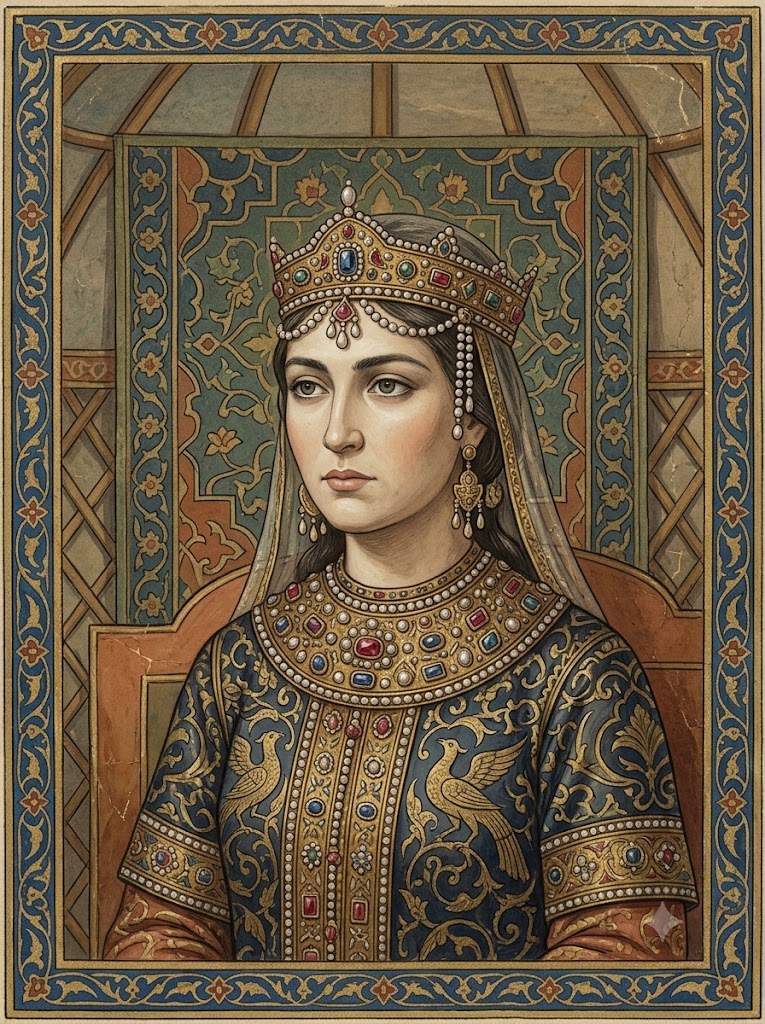
AI-assisted Portrait of Bayalun
The Princess Who Wanted to Go Home
Almost everything we know about Bayalun comes from a single source: the Rihla, the travel narrative dictated by Ibn Battuta a generation after the events it describes. In his telling she is a daughter of the Byzantine emperor—loosely associated with the house of Andronikos III Palaiologos—married into the Golden Horde as a khatun, one of the principal wives of Uzbeg Khan. A Christian princess inside a Mongol-Muslim court, she occupies a few vivid pages and then vanishes from the record.
It is worth saying plainly that her historicity is debated. No Byzantine chronicle names her as Ibn Battuta does, and parts of his account may be embellishment. What survives is less a documented life than a portrait—but the figure he draws is unmistakable. Around 1332 he claims to have joined her caravan as it left the Horde and traveled west toward Constantinople, so that she might visit her family and, in his version, give birth among her own people. The closer the road drew to Christian territory, the more she changed—her bearing, her speech, the rituals she resumed—until the foreign khatun had quietly become a homecoming daughter.
As Ibn Battuta paints her, Bayalun is the ISFP caught between two worlds: a deep, private loyalty to her own origins (Fi) carried intact beneath a court that expected her to belong to it, and lived most fully in the sensory reality of the journey home (Se).
That tension—an inner allegiance that never converted, however far it traveled—is the whole of the character, and it is enough.
The Loyalty That Never Converted
Fi — dominant
Dominant Fi is an inner compass that answers to no one. It does not announce itself, argue, or seek approval; it simply holds—privately, stubbornly—to what feels true. Everything Ibn Battuta notices about Bayalun runs along this single axis. By every external measure—khatun, married into the Horde, surrounded by an Islamic court—she belonged to Uzbeg's world. And yet the part of her that mattered most had never relocated; her faith, her family, the place she came from were kept somewhere the court could not reach.
The genius of his portrait is that he shows this not through speech but through homesickness—the most Fi of emotions, because it is felt long before it is voiced. When the chance to travel back finally came, the change in her was unmistakable: as the caravan crossed into Christian lands she resumed Greek customs, took communion, let herself be greeted as a daughter of her people rather than a wife of the khan. The mask did not crack; it was simply set down. This is the defining ISFP signature—an allegiance intensely personal and never up for negotiation. She was not advancing a cause or defying anyone. Her loyalty was inward, to who she was, and it had survived the entire architecture of her marriage intact.
The Road Itself
Se — auxiliary
If Fi is what Bayalun protected, auxiliary Se is how she lived it—not as an idea about home but as a journey toward it, mile by physical mile. The ISFP pairs a private inner world with an acute attention to the immediate, sensory present, and Ibn Battuta's narrative is, fittingly, almost entirely a story of motion: a caravan in cold weather, a crossing of frontiers, the look of a landscape changing as the Mongol steppe gives way to the approaches of Constantinople.
Her transformation in the Rihla is rendered through concrete, present-tense detail rather than reflection. We are not told what she concluded about her two worlds; we are shown what she did as she moved between them—the customs she resumed, the welcome she accepted, the bodily fact of arriving home pregnant and among kin. Se does not philosophize about belonging; it walks into it. For a figure defined by an inner loyalty that could never be spoken at court, the journey was the one form that loyalty could finally take—a thing done, in the world, with the body. Fittingly, it is an ESFP traveler, forever alert to the texture of the next place, who recognized a fellow creature of the senses and gave her a homecoming we can practically see.
The Single Thread
Ni — tertiary
Tertiary Ni in an ISFP shows up as a quiet, focusing intuition—not strategy, but a private sense of where one is ultimately bound. It lends the Fi compass direction: a feeling that beneath the surface of one's circumstances there is a single thread pointing the self toward home. In Bayalun this reads as the steadiness of her longing—not restless or scattered, but fixed on an object that holds.
Years inside the Horde did not dissolve her orientation toward home. The pull toward Constantinople functions less like a wish than like a quiet certainty about where she truly belonged—the kind of inward conviction that survives long stretches of life lived somewhere else. That is tertiary Ni serving the dominant feeling: it generates no grand visions, but it keeps the inner needle fixed, so that when the road home finally opened she knew exactly what she was walking back into.
The Court She Could Not Command
Te — inferior
Inferior Te—the impulse to organize, assert, and impose order on the external world—is conspicuous by its absence. Married into the most formidable political machine of the steppe, the court of a khan who ruled from the Volga to the edge of Europe, she does nothing with that leverage: no faction, no influence over policy, no mark on the administration of the Horde. Her power is entirely the power to feel and to go home.
This is exactly what we should expect. Where her husband Uzbeg was all outward command and structure—an ENTJ who governed an empire—Bayalun's gravity ran the other way, inward and personal. The contrast is the relationship in miniature: the organizer of a realm beside the woman who quietly kept her own soul exempt from it. The world outside was never hers to arrange; the one territory she held with total authority was the one inside.
Why ISFP Over ISFJ
Why not ISFJ?
An ISFJ would have located her pull in duty and tradition—the outward obligation to serve family, faith, and the role she was born to, defined by what she owed others. But Ibn Battuta's Bayalun is not dutiful so much as homesick. Her longing is for her own roots and her own inner truth, a personal hunger to return to herself, not a sense of debt to be discharged. That is Fi authenticity, not Si-and-Fe service—the difference between “I owe this” and “this is who I am.”
The whole portrait turns on that distinction. An ISFJ's homecoming would read as a daughter returning to her obligations; Bayalun's reads as a self returning to its source. She wanted home the way one wants to be oneself again—quietly, completely, and without needing anyone's permission. That inward, personal authenticity, held intact beneath a foreign court, is the ISFP's signature, and it is the one thing about her that even a debated and half-embellished record makes impossible to mistake.
Connected Figures
Further Reading
- The Travels of Ibn Battuta — Ibn Battuta (trans. H. A. R. Gibb)The Rihla itself — the only source for Bayalun, including the journey from the Golden Horde to Constantinople.
- The Adventures of Ibn Battuta: A Muslim Traveler of the 14th Century — Ross E. DunnThe standard modern study of Ibn Battuta's travels — clear on which episodes, Bayalun's among them, scholars treat with caution.
