 Historical Figure MBTI
#361 · 4-2-26 · The French Revolution
Camille Desmoulins
The Journalist Who Lit the Bastille's Fuse · Pamphleteer · Robespierre's Doomed Friend
1760 — 1794
6 min read
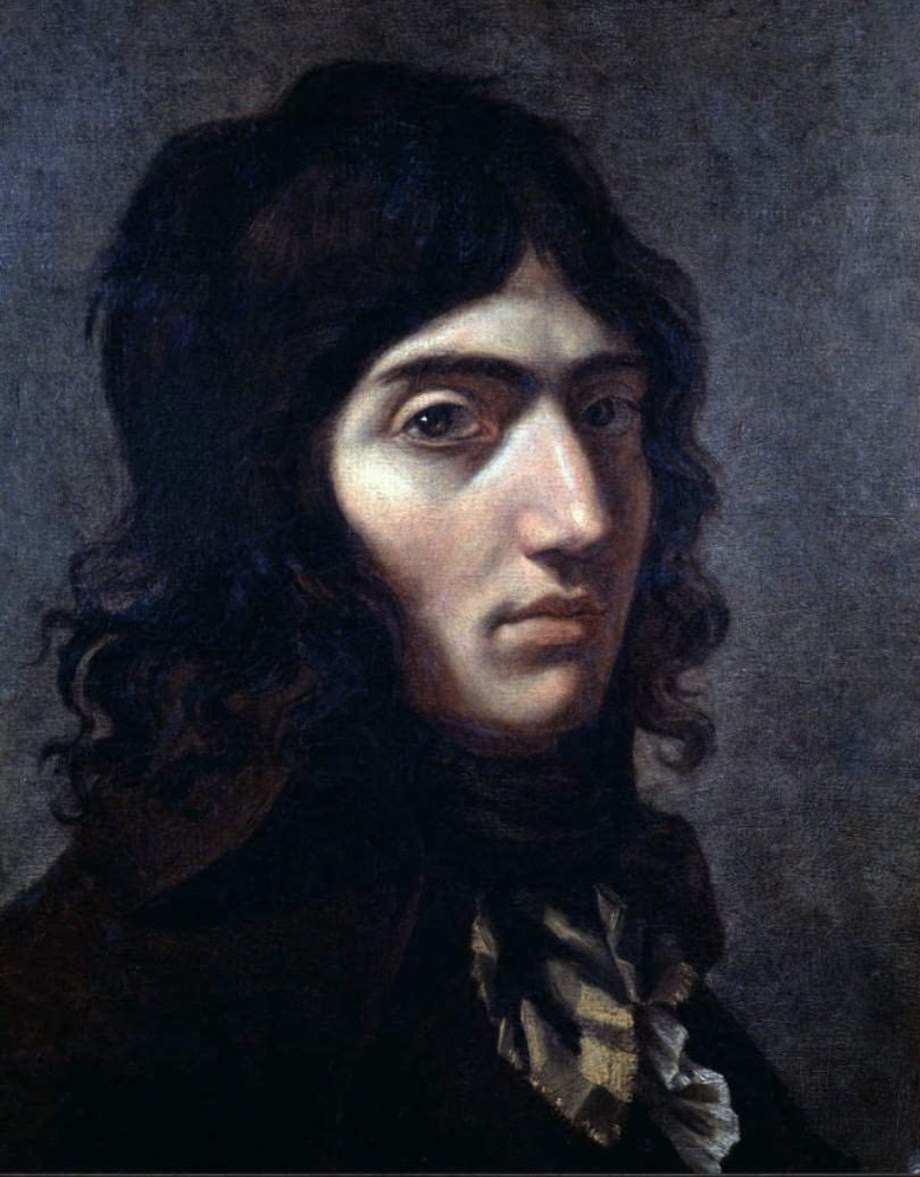
Portrait of Camille Desmoulins
The Boy Who Leapt on the Table
On the afternoon of 12 July 1789, a briefless lawyer with a stammer climbed onto a café table in the Palais-Royal, drew a pistol, and began to speak. Word had come that the king had dismissed Necker. “Citizens,” he cried, “there is not a moment to lose!” He tore a green leaf from one of the trees for a cockade, and the crowd stripped the branches bare. The stammer that had tormented him all his life had vanished. Two days later the Bastille fell. Camille Desmoulins, who that morning had been nobody, was suddenly the man who had lit the fuse.
A scholarship boy at the Collège Louis-le-Grand, he had sat beside Maximilien Robespierre. His stutter wrecked him at the bar; his pamphlets crackled with wit and mockery. He married the adored Lucile Duplessis in 1790, a love match so happy it reads, against what was coming, almost unbearably. He rode the Revolution he had helped begin—until, in Le Vieux Cordelier, he pleaded for an end to the guillotine, setting himself against his own schoolfriend. He was guillotined in April 1794 at thirty-three; Lucile followed days later. He is, in every gesture, a textbook ENFP.
Desmoulins was the ENFP in its purest revolutionary form—dominant Ne improvising an insurrection from a tabletop, auxiliary Fi turning that same pen, years later, against the killing, with a tenderness that cost him his head.
The Revolution Improvised on a Tabletop
Ne — dominant
The leap onto the café table is the dominant function in a single image. Extraverted intuition seizes the live possibility and acts before the spark has cooled. Desmoulins did not arrive at the Palais-Royal with a speech or a plot—he felt in an instant what Necker's dismissal might detonate and made it detonate: the green cockade torn from a tree, the call to arms, assembled out of nothing. The stammer fell away because this was not prepared; possibility was his native element.
His journalism is Ne in print: pamphlets that dart—a classical tag, a flash of mockery, Tacitus beside a jibe at a deputy's wig. He coined nicknames, invented catchphrases, conjured the mood of a moment. And Ne is famously poor at consequences: Desmoulins improvised denunciations as readily as insurrections, his pen running ahead of his judgment, never reckoning that the men he mocked would remember.
The Tenderness That Cost Him His Head
Fi — auxiliary
Beneath the dazzle ran a current of deep, stubborn feeling. Fi is a private compass anchored in the individual heart, not the group's consensus. Desmoulins's loyalties were intensely personal: his marriage to Lucile was the center of his life, and his letters to her from prison are among the most heartbreaking documents the Revolution left. Where Robespierre loved “the People,” Desmoulins loved persons and could never hold an abstraction steady enough to kill for one.
That Fi is what made Le Vieux Cordelier an act of courage. By late 1793 the safe course was silence; Desmoulins could not take it. He published a paraphrase of Tacitus on tyranny so pointed readers gasped, and an open call for a Committee of Clemency. He knew the cost. He did it anyway, because Fi, when it plants its feet, does not negotiate—on no authority but a heart that had seen enough.
The Polemicist's Killing Edge
Te — tertiary
For all his warmth, Desmoulins could be devastating. Te builds the public case; in a pamphleteer it gives intuition its bite. His Histoire des Brissotins was a marshaled indictment—names and charges arranged for maximum force; he helped argue a whole faction onto the tumbrils. The tragic irony: the polemical force he used against the Girondins was the same force he would later turn against the Mountain's excesses, by then far too late.
Even Le Vieux Cordelier owes its force to Te's instinct for the structured case: the feeling supplied the courage; the thinking supplied the architecture that made Robespierre feel he had to answer the pamphlets in person—a supporting function getting its owner killed for being too persuasive.
Blind to the Precedents Piling Up Around Him
Si — inferior
Inferior introverted sensing is the ENFP's blind spot: the patient memory for precedent, the cautionary weight of “remember what became of the last man who did this.” Desmoulins had watched the Revolution eat its own—Girondins, Hébertists, friend after rival fed to the blade—and the lesson never lodged as fear. He kept improvising into the teeth of the precedents, certain that wit and an old friendship would shield him.
When he published Le Vieux Cordelier he believed that his boyhood bond with Robespierre—who had stood witness at his wedding—would hold against the Terror. He read the present through the warm memory of an old loyalty rather than the cold pattern of the recent dead. So the concrete took its revenge: arrested with the Dantonists, guillotined on 5 April 1794 at thirty-three. The recklessness that had lit the Bastille's fuse had nothing left to ignite but himself.
Why ENFP Over INFP
Why not INFP?
The INFP case is tempting—the tenderness, the moral conviction that would not bend. But the INFP's dominant function is inward Fi; its bearing is private, reflective. Desmoulins was the reverse: his feeling sat in the auxiliary seat; what led was the outward Ne that vaulted onto a public table before a roaring crowd. He did not nurse his revolution in a notebook; he announced it from a tabletop. The feeling was real, but it was the second voice.
Connected Figures
Further Reading
- Citizens: A Chronicle of the French Revolution — Simon SchamaThe richest single-volume narrative of the Revolution; Desmoulins appears throughout as a vivid minor key against the Terror's crescendo.
- The French Revolution: A History — Thomas CarlyleVictorian in its intensity, but Carlyle's portrait of Desmoulins — especially the Palais-Royal scene — remains electrifying.
- Robespierre: Revolutionary and Tyrant — Colin Haydon & William Doyle (eds.)Scholarly essays on Robespierre that illuminate the schoolfriend bond and its fatal collapse in Year II.
- Fatal Purity: Robespierre and the French Revolution — Ruth ScurrTracks the Robespierre–Desmoulins relationship from Louis-le-Grand to the scaffold with psychological precision.
- Le Vieux Cordelier — Camille DesmoulinsDesmoulins's own final journal (1793–94), available in French and various translations — the most direct window into his voice and his courage.
