 Historical Figure MBTI
#362 · 4-2-26 · The French Revolution
Jean-Paul Marat
L'Ami du Peuple · The Prophet of Blood · Murdered in His Bath
1743 — 1793
10 min read
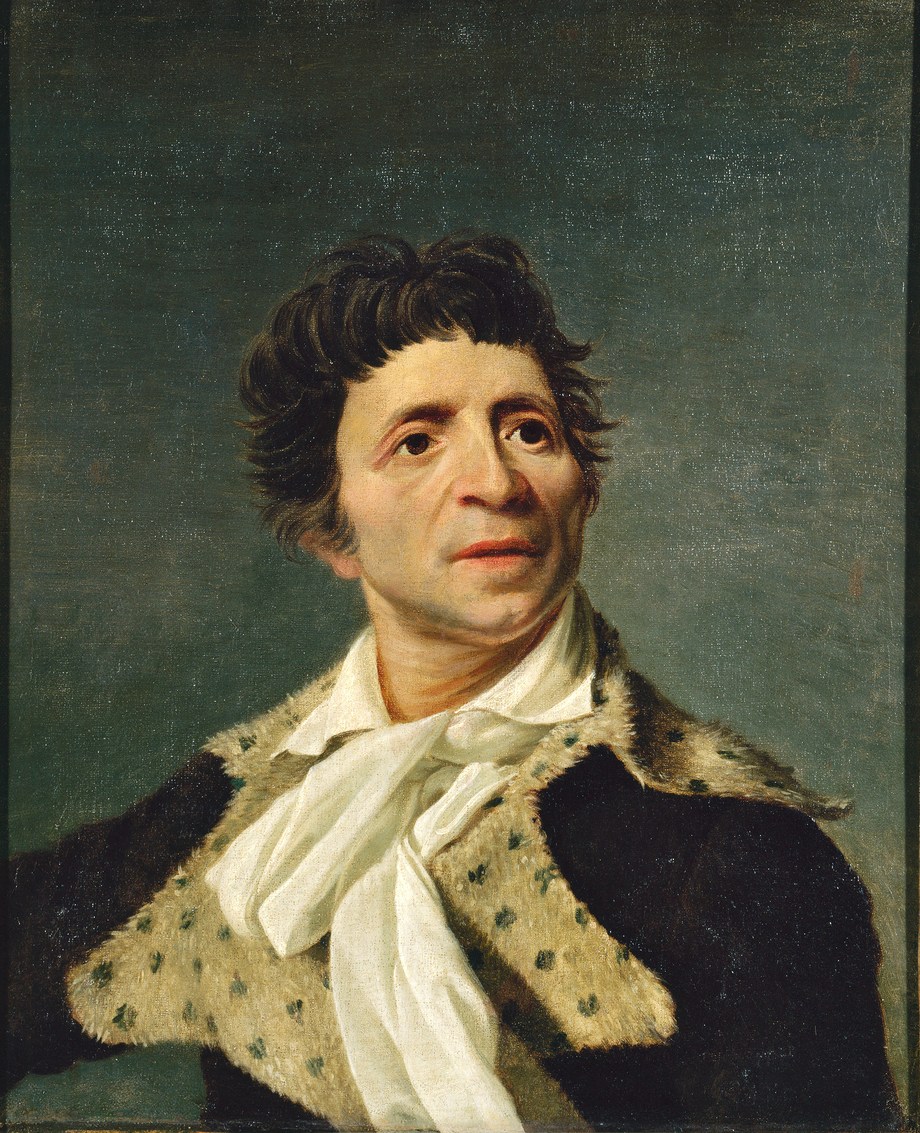
Portrait of Jean-Paul Marat
The Friend of the People, Writing from His Bath
A copper tub shaped like a boot, a plank laid across it for a writing desk, paper and proofs everywhere, a body soaking in medicinal vinegar because its skin will not permit standing. This is Jean-Paul Marat in the summer of 1793, the most feared journalist of the French Revolution, conducting from a bathtub the arithmetic of slaughter.
He had not always meant to end here. Born in 1743 in Boudry, Marat spent the first half of his life chasing scientific immortality. He trained as a physician, practiced in London and Paris, and wrote fat treatises on fire, light, and electricity—grand theories that would, he was certain, overturn Newton. They did not. The Académie des sciences examined his optics and declined to endorse them. To most men this would have been a disappointment. To Marat it was a revelation. He concluded he had not been refuted but suppressed—that a cabal of established men had conspired to bury a truth they could not answer. The wound never closed. It became the lens through which he read everything that followed.
When the Revolution came in 1789 it handed this embittered, persecution-haunted man a vocation perfectly fitted to his mind. He founded L'Ami du peuple and into it poured the conviction that had been festering for fifteen years: that the world is governed by hidden conspiracies of the powerful, that the visible enemy is always a mask for the deeper one, and that only the ruthless exposure and extermination of these enemies could save the nation. He named men by name. He demanded heads not by the dozen but by the hundred, then by the hundred thousand. He was, in the precise clinical sense, an INTJ—the architect-mind turned prophet and then turned executioner.
Marat was the INTJ driven to its darkest terminus—a dominant Ni that saw one hidden conspiracy beneath every event, and an auxiliary Te that built, out of that vision, a working machine for naming enemies and counting the heads required to be rid of them.
The Conspiracy Beneath Everything
Ni — dominant
Dominant introverted intuition collapses the chaos of events into a single hidden form and reads all of reality as evidence for it. In a healthy mind this is the strategist's gift. In Marat it had curdled into something monstrous: a totalizing conspiratorial vision in which every reversal, every shortage, every military defeat was the trace of a single invisible design. He did not arrive at this picture by weighing evidence. He began with it, complete, and bent every fact to fit. Where the conspiracy seemed absent, that absence only proved how well it was concealed.
The seed was the academies. When the learned societies declined his theories of fire and light, Marat did not conclude his physics might be wrong; he concluded that a corrupt establishment had conspired to suppress a dangerous truth. That single interpretive move—rejection reread as persecution, error reread as conspiracy—became the master template of his entire revolutionary career. The cabal that buried his optics became, in L'Ami du peuple, the cabal of aristocrats and traitor-generals plotting the ruin of France. The structure of the thought never changed; only the cast grew. This is Ni's great pathology: a vision so internally coherent that no disconfirmation can reach it, because every disconfirmation is folded back in as further proof of the enemy's cunning.
And the vision was redemptive as well as accusatory. Marat saw a Republic that could be saved, purified, made whole—but only by the removal of those blocking it. From this it followed, with the terrible directness of dominant Ni, that no quantity of blood spilled to clear the way could be too much. When he wrote that five or six hundred heads cut off would have spared the nation, and later revised the figure to two hundred thousand, he was not raving. He was doing the grim subtraction his vision demanded.
The Machinery of Denunciation
Te — auxiliary
A vision alone changes nothing; it needs an instrument. Auxiliary extraverted thinking gave Marat his, and it is what separates him from the mere paranoid pamphleteer. L'Ami du peuple was not a series of essays. It was a mechanism that took the day's events as raw material and produced, as finished output, names to be destroyed. It identified the enemy, supplied the proof, assigned the verdict, and specified the remedy—arrest, trial, the blade—with impersonal efficiency. Marat understood that to move the streets you do not argue; you accuse, concretely and repeatedly, and you tell the reader exactly what is to be done.
The Te shows most clearly in his relationship to numbers. Marat counted. He did not gesture vaguely at the need for severity; he quantified it, revised the figure upward as the crisis deepened, and presented the result as a calculation any rational man could check. This was the same faculty that had organized his scientific treatises, redirected toward extermination. Where Robespierre wrapped the same logic in the language of virtue and the general will, Marat dispensed with the wrapping and gave you the number.
He was also a formidable operator. He kept the paper alive through warrants, raids, and exile, smuggling copy from the cellars and sewers where he hid, and timed his interventions for maximum effect—helping to engineer the fall of the moderate Girondins in mid-1793. Tried before the Revolutionary Tribunal in April, he turned the proceeding into a triumph and was carried back to the Convention in a crown of oak leaves. That is auxiliary Te at work: the vision made operational, the certainty converted into arrests, votes, corpses.
The Martyr in His Own Mind
Fi — tertiary
Beneath the public ferocity ran a single fixed private conviction: that he was a righteous man persecuted by a guilty world. Tertiary Fi in the INTJ is a quiet inner register of personal value, and in Marat it had concentrated into an unfalsifiable sense of his own rectitude. He did not see himself as the aggressor he plainly was. He saw himself as the lone honest voice, hunted, slandered, driven underground, sacrificing his health for a people too distracted to thank him. Every warrant confirmed the story. The persecution was real enough in fact; the meaning he gave it was the work of a wounded Fi that had organized his entire identity around the dignity of the victim.
Marat genuinely loved “the people”—with the abstract, private intensity of a man who trusted few actual humans. He could grieve over the suffering masses in his prose and demand the massacre of named individuals in the same column without contradiction, because the feeling was pitched at the level of his own moral self-image, not at the men and women it touched. Tertiary Fi gives the INTJ a stubborn, unfalsifiable sense of being in the right, and in Marat that sense had become a fortress no argument could enter. The persecuted genius of physics and the persecuted friend of the people were the same man telling himself the same story: always the betrayed innocent, the world always the betrayer.
The Diseased Body and the Single Knife
Se — inferior
Inferior extraverted sensing is the INTJ's great blind spot—the immediate physical present, the body and its dangers, chronically neglected in favor of the vision in the head. In Marat the neglect was written into his flesh. He lived at war with his own body, a body so afflicted it drove him from the world of action into a bathtub, and even then he treated it as an obstacle to be managed rather than a self to be heeded. The vinegar, the clay, the turban soaked in medicinal solution—these were not care but triage, the minimum concession the concrete extorted from a man whose attention was always elsewhere, on the conspiracy, on the count, on the redeemed Republic that existed only in his mind.
On the thirteenth of July, 1793, Charlotte Corday, a provincial royalist of Girondin sympathies, asked to see him. She had bought a kitchen knife that morning. She gained admittance by promising a list of traitors in Caen—the very bait his conspiratorial mind could not resist—and he received her in his bath, plank across the tub, taking down the names she gave him with the eagerness of a man adding to his ledger. He was so absorbed in the abstraction she dangled that he never saw the concrete thing in her hand. She drove the blade once, beneath the collarbone, and he was dead within minutes.
There is no more exact emblem of inferior Se in this archive. The man who had counted heads by the hundred thousand, who saw conspiracies in every shadow—was blind to the one physical fact in the room that mattered: a single woman, a single knife, eighteen inches away. His dominant function was scanning the invisible web of enemies while the actual enemy sat at his side. The vision did not see the knife. It never does.
Why INTJ Over ENTJ
Why not ENTJ?
The ENTJ case rests on Marat's organizational ferocity—a man who built a machine of denunciation, counted enemies, and drove events with the unblinking force of a commander. But the ENTJ leads with Te and lives in the arena: extraverted, mobilizing, reading the real room and adjusting to win it. Marat did the opposite. He was a recluse who governed from a bathtub, who began not with the situation but with a fixed inner vision and forced the world to conform to it—the unmistakable signature of dominant Ni, not dominant Te. His Te was the instrument; the conspiratorial vision was the master.
The decisive evidence is the relationship between vision and fact. The ENTJ's thinking is answerable to results—it registers when a strategy fails and revises. Marat's certainty was sealed against revision entirely: rejection became proof of conspiracy, contrary evidence became proof of the enemy's cunning, and the body count rose as the world declined to match his picture. That is a vision driving the thinking, not thinking testing the vision. The same structure separates him from Robespierre, whose terror was sung in the collective, group-calibrated key of auxiliary Fe—virtue, the People, the general will. Marat had no such warmth for the group as a felt presence. His feeling was private, inward, the wounded Fi of the persecuted righteous man. Introverted vision, executive method, private grievance, fatal blindness to the concrete: the architecture is INTJ to its foundations, and its darkest possible expression.
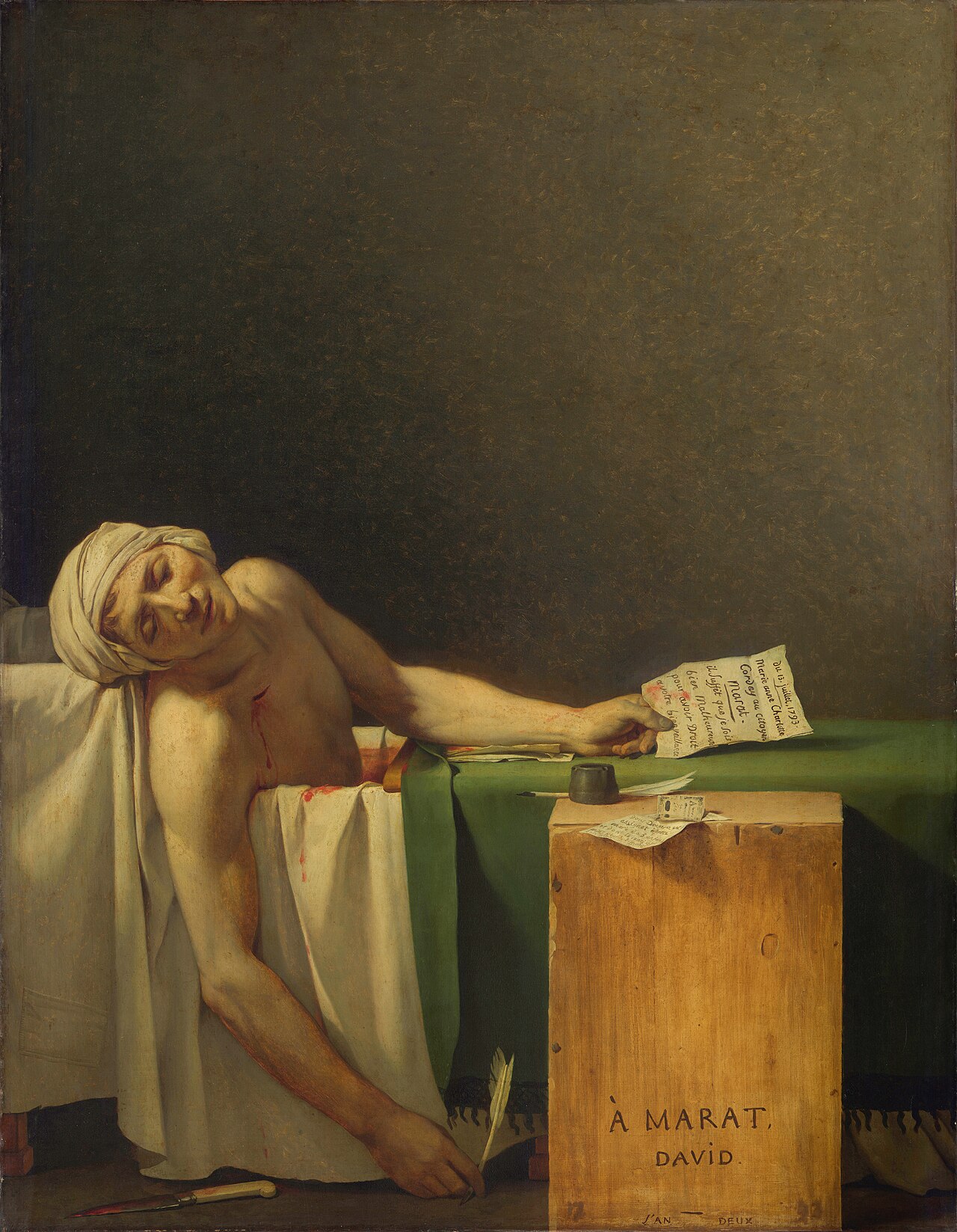
Connected Figures
Further Reading
- Marat: The People's Friend — E. Belfort BaxA classic biography tracing Marat's career from physician-scientist to revolutionary tribune, written from a sympathetic radical perspective.
- The Revolutionary Career of Maximilien Robespierre — David P. JordanEssential context for the radical Montagnard faction Marat helped shape — and the Terror that outlasted him.
- Citizens: A Chronicle of the French Revolution — Simon SchamaPanoramic narrative history that captures the milieu of L'Ami du peuple and the violence of 1793.
- Twelve Who Ruled: The Year of the Terror in the French Revolution — R. R. PalmerA close study of the Committee of Public Safety — the institutional machinery that turned Marat's vision of enemy-lists into state policy.
