 Historical Figure MBTI
#360 · 4-2-26 · The French Revolution
Georges Danton
The Booming Tribune · Minister of Justice · Audacity, More Audacity, Always Audacity
1759 — 1794
9 min read
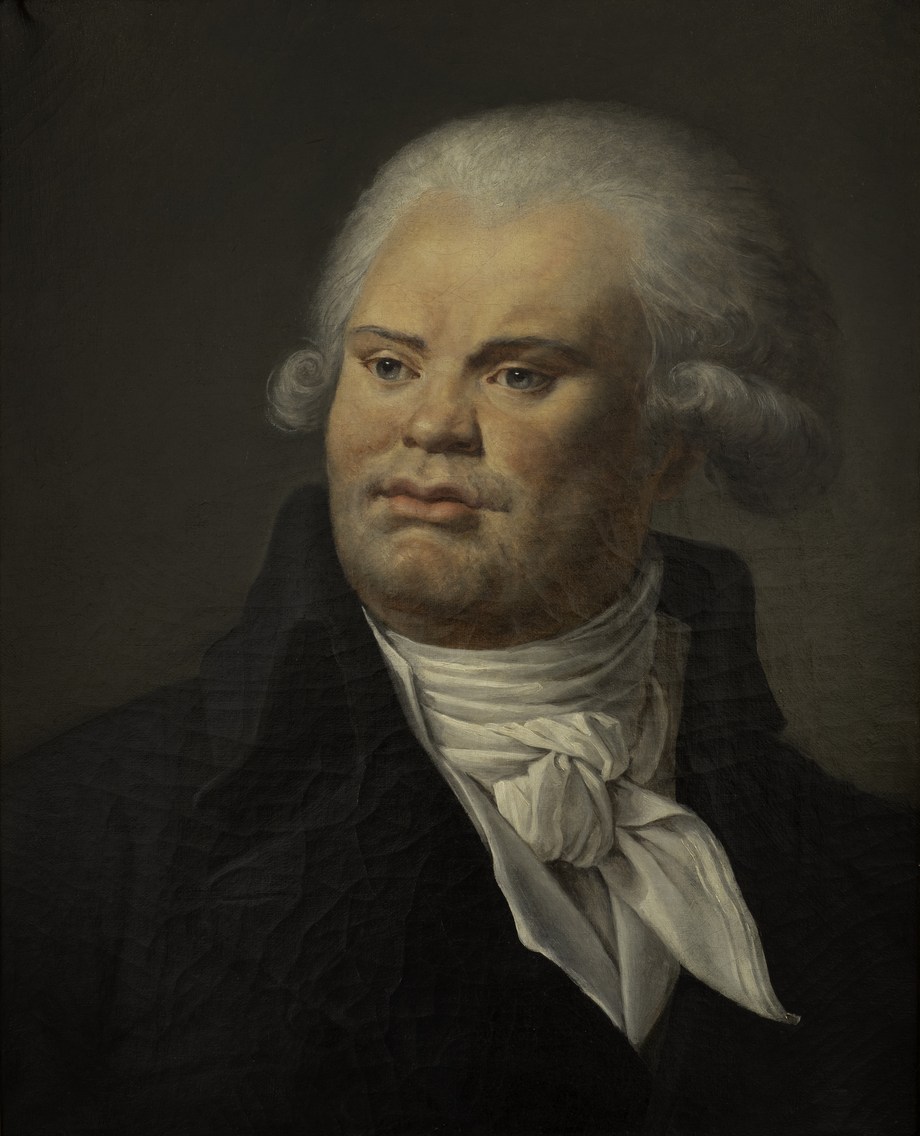
Portrait of Georges Danton
The Giant Who Threw Himself at the Living Moment
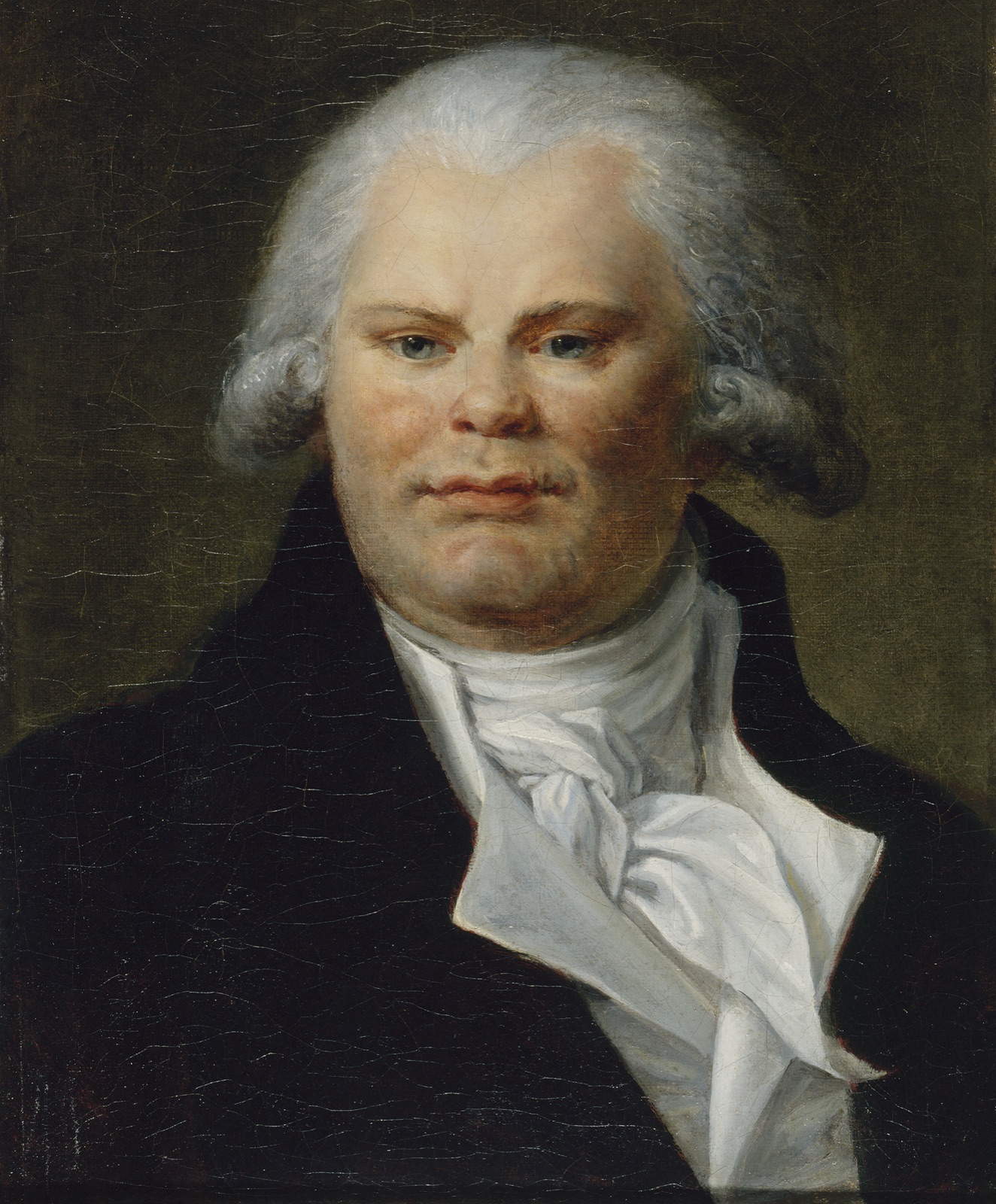
He was enormous—a head taller than the men around him, broad as a door, with a voice that did not so much fill a hall as flatten it. The face was a wreck: pitted by smallpox, the nose crushed, the lip torn by a bull in boyhood, so that by manhood Georges Danton looked like something carved out of the earth by a careless hand. And yet people could not stop following him. Born in 1759, a provincial lawyer who bought his way into a sinecure at the bar of the King's Council, he became almost overnight in 1789 the loudest and most physical force the Revolution produced—a man who seemed to be made of more appetite, more life than anyone else in the room, and who spent all of it without counting.
When the Prussian army crossed the frontier in 1792 and Paris went white with panic, Danton climbed the rostrum and turned the terror outward. De l'audace, encore de l'audace, toujours de l'audace, et la France est sauvée. It was not a plan; it was a transfusion. A nation about to bolt was steadied by one man who refused to be afraid in public. But the same nature made him impossible to defend: he took bribes and scarcely hid the country house he bought with them, and he was Minister of Justice during the September Massacres. The psychological signature is the ESFP: dominant Se seizing the present with overwhelming force, auxiliary Fi of deep personal loyalty that would recoil from the killing, tertiary Te that could organize a ministry overnight, and inferior Ni that never once saw the trap his enemies were laying while he lived for the day.
De l'audace, encore de l'audace, toujours de l'audace! — audacity, more audacity, always audacity. It is the whole of the ESFP compressed into a war cry: not a strategy, not a doctrine, but a man flinging the full weight of his body and nerve at the present moment, trusting that boldness in the now would carry the day the future could not be planned to win.
The Body in the Room
Se — dominant
Dominant Se lives in the concrete present with an intensity other types reach only in emergencies. Danton was its purest political specimen. He did not govern from a study; he governed from the rostrum, the crowded room, where his instrument was his own enormous physical presence. Where Robespierre read from a careful manuscript in a thin, fastidious voice, Danton improvised at the top of a bellow, reading the mood of two thousand frightened men in a glance and turning it.
His career is a chain of seized instants. In August 1792, when the monarchy fell, Danton supplied the nerve the moment required. In September, with the enemy at the gates, he answered panic with an immediate program: ring the tocsin, levy the volunteers, push every able body toward the front. De l'audace was Se doctrine in three words—the conviction that boldness applied now would shatter the crisis, that you win by moving with everything you have.
The same function ruled his pleasures. He ate hugely, loved women, loved the green fields of Arcis to which he kept escaping when Paris grew too thick with intrigue. The appetite was not a vice grafted onto the statesman; it was the same nerve. A man who loved the world that much could never be relied on to burn it for an idea.
The Warmth That Recoiled From the Blood
Fi — auxiliary
Auxiliary Fi gave Danton's force its direction—and, in the end, its limit. He was not a man of doctrine; he had no Rousseauist blueprint. What he had were attachments: to his friends, to the literal soil of his native fields, to the human beings in front of him. He defended Camille Desmoulins with fierce personal loyalty; he loved his first wife so violently that when she died while he was away he had her body exhumed so he could embrace her once more. Every register of him was warm-blooded and particular.
Robespierre's feeling was pitched at the abstraction—the People, Virtue—and could feed real individuals to the guillotine because the individual had become invisible beside the ideal. Danton's feeling could not abstract. He saw the people in the tumbrils as people. Sickened by the rhythm of the killing, he pushed—through Desmoulins's Vieux Cordelier and his own speeches—for clemency. It was not a tactical bid for a faction. It was Fi recoiling, refusing to keep paying for the Republic in blood. That recoil was his death warrant.
Arrested in March 1794, hauled before the Tribunal, Danton did not defend himself with law. He defended himself with his body, his voice, the sheer personal force of being Danton—roaring until the crowd outside began to sway toward him and the judges, frightened, cut the trial short. To the end the instrument was the self: not a principle to be vindicated, but a man in love with his own life, pleading for it in the only voice he had.
The Organizer in the Hour of Crisis
Te — tertiary
Tertiary Te gave Danton an underrated capacity: when a situation demanded decisive organization, he could supply it in bursts. As Minister of Justice and the animating force of the early Committee of Public Safety, he did the unglamorous work of a state at war—requisitioning, coordinating the defense, holding the apparatus of government together in the weeks when it might simply have dissolved. In foreign affairs he was a realist who thought in results—what works, what holds the line—not in doctrinal purity. The tertiary function lending the in-the-moment ESFP enough executive grip to turn audacity into administration.
But tertiary Te has its ceiling. Danton's organizing came in fits, summoned by emergency and then abandoned for the country house and the dinner table. He could not sustain the patient accumulation of committee-power his enemies practised daily, nor bother to cover his financial tracks with the discipline that might have saved his life. The Te was a tool he reached for in the storm, not a habit he lived by. When the storm passed he put it down—and while he rested, the men who never rested quietly built the case that would destroy him.
Blind to the Trap Being Laid in the Dark
Ni — inferior
Inferior Ni is the ESFP's great blind spot: the hidden long-range pattern, the question of where all this is quietly heading. Danton's catastrophe was written into his strength. He could read a crowd in a glance and miss a conspiracy maturing over months. He believed, to the end, that the sheer overwhelming fact of being Danton would protect him—that no one would dare. Friends warned him in the final weeks. His answers were pure inferior Ni in denial: One does not carry one's country away on the soles of one's shoes. He could not credit a threat he could not see in the present tense, and so he did nothing while the trap closed.
His rivals were precisely his shadow. Robespierre and Saint-Just were intuitives who lived in the unseen pattern—patient, indirect, building the case against him in silence while he ate and rested at Arcis. Only on the scaffold, in April 1794, did the suppressed function break through. Riding to the guillotine past Robespierre's lodgings, the man who had never seen the future suddenly named it: Robespierre, tu me suis—Robespierre, you will follow me. He was right to the season. Blind for a lifetime, the inferior function opened at the very end onto a single, accurate vision of what was coming—too late to be anything but an epitaph.
Why ESFP Over ESTP
Why not ESTP?
The ESTP case has surface appeal: Danton was bold, physical, improvisational—all the marks of dominant Se. But the auxiliary settles it. The ESTP pairs Se with introverted thinking: cool, tactical, impersonal. Danton's audacity was warm and particular—he loved people, food, his friends, and his politics moved on human attachment, not leverage. The clemency that killed him was not a tactical miscalculation; it was a man of feeling sickened by the killing—Se-Fi, not Se-Ti.
An ESTP would have calculated the balance of forces and either struck first or cut a deal. Danton did neither, because his second function was not a calculating Ti but a loyal, particular Fi. He turned against the Terror not because the numbers said to, but because he could no longer stomach the blood. He refused to flee because he loved his country in the literal soil of it. He defended himself at the tribunal not with cunning but with the naked force of a man pleading for the life he adored. The audacity was always the Se. The reason it bent toward mercy, and would not bend toward self-preservation, was the Fi. He was an ESFP to the blade.
Connected Figures
Further Reading
- Danton — Norman HampsonThe authoritative English-language biography — meticulous on the politics and carefully agnostic on the corruption charges.
- Citizens: A Chronicle of the French Revolution — Simon SchamaThe grand narrative of the Revolution with vivid portraits of Danton in the pivotal moments of 1792–1794.
- The French Revolution: A History — Thomas CarlyleThe Victorian epic that shaped how English readers imagine Danton — muscular, larger-than-life, and almost mythic.
- Fatal Purity: Robespierre and the French Revolution — Ruth ScurrFocuses on Robespierre but the Danton–Robespierre collision is central — essential for understanding the forces that destroyed him.
