 Historical Figure MBTI
#329 · 3-29-26 · The Enlightenment
Jean-Jacques Rousseau
Philosopher · Author of The Social Contract · Prophet of Feeling and Nature
1712 — 1778
8 min read
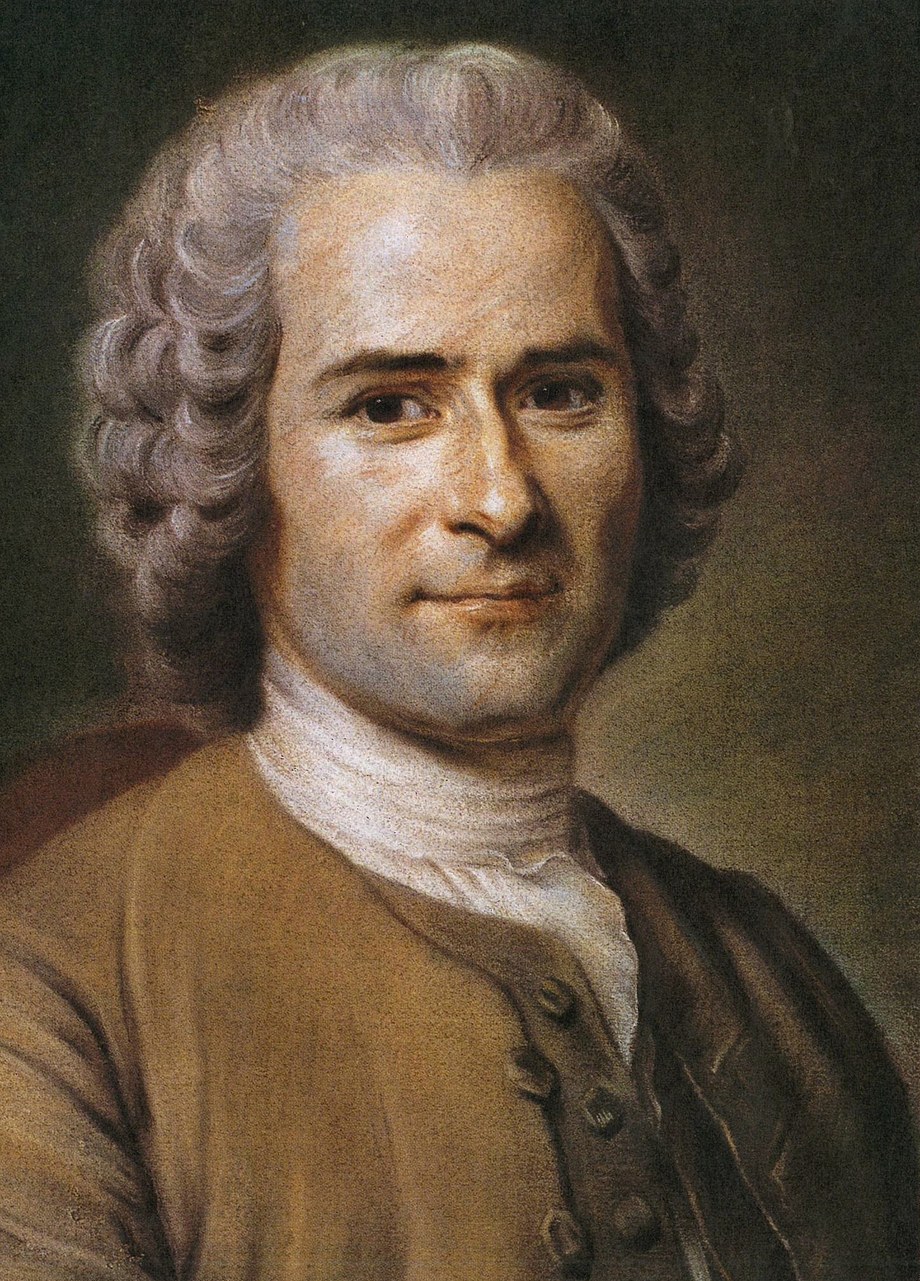
Portrait of Jean-Jacques Rousseau
The Man Who Made a Religion of His Own Heart
He opens the Confessions with a sentence no one had ever quite dared to write before: “My purpose is to display to my kind a portrait in every way true to nature, and the man I shall portray will be myself.” Jean-Jacques Rousseau—born in Geneva in 1712, motherless within days of his birth, a runaway apprentice and wandering autodidact who had been a lackey, a music copyist, and the kept ward and lover of a country baroness—had appointed himself the first wholly honest man in the history of the world. The astonishing thing is how nearly he persuaded posterity that he was.
From that conviction came a body of work that broke the eighteenth century open. Working from feeling alone, against the entire grain of his rationalist age, he argued that civilization had corrupted mankind, traced inequality back to a fall from natural innocence, drowned a continent in sentimental tears with Julie, refounded education withÉmile, and handed the coming revolution its scripture with The Social Contract—“Man is born free, and everywhere he is in chains.” One man became at once the father of Romanticism, of modern democracy, and of child-centered education.
And yet this same man could not keep a single friend. He befriended Diderot and broke with him in bitterness; traded lifelong contempt with Voltaire; ruptured with his patroness Madame d'Épinay; and ended his friendship with David Hume in a storm of paranoid accusation. He wrote the century's greatest book on raising children and deposited all five of his own at a foundling hospital. The contradictions are not incidental to him; they are the man—what you get when a temperament organized entirely around the authority of private feeling collides with a world that runs on compromise. That temperament is the INFP.
Rousseau is the INFP carried to its furthest extremity—a dominant Fi that made an absolute religion of personal sincerity, fed by an Ne that spun that conviction into politics, education, music, and fiction alike. “A portrait in every way true to nature, and the man I shall portray will be myself” is not a literary boast. It is the creed of a type stated in one sentence.
The Tribunal of the Inner Self
Fi — dominant
No thinker has ever made the case for Fi more nakedly than Rousseau, because for Rousseau it was not an argument but a metaphysics. Man is naturally good, he insisted; conscience is an “innate principle of justice and virtue” written into the heart before reason ever speaks; and what corrupts him is everything outside the self—society, opinion, artifice, the masks people wear to please one another. The whole of his philosophy is one long elevation of the authentic inner feeling over the false outer form.
It explains why he could be so unbearable. He could not say the gracious thing that would have kept Madame d'Épinay, who had given him a cottage and a refuge, on his side; he experienced her patronage as a chain on his sincerity and turned on her. When the philosophes urged compromise, he heard only the demand that he betray his conscience. He would rather be persecuted and right than comfortable and complicit, and he paid that price in a life of ruptures.
The Confessions is the purest literary act of Fi ever committed to paper. Rousseau confesses everything—the petty thefts, the false accusation that ruined a servant girl, the abandoned children—not to be forgiven but to be known. Sincerity, not virtue, is his absolute: “I may not be better than other men, but at least I am true.” That ranking—authenticity above goodness, felt inner reality above social performance—is the dominant function of the INFP speaking with nothing held back.
One Conviction, a Thousand Forms
Ne — auxiliary
If Fi gave Rousseau his single, burning conviction—that the natural, feeling self is good and society corrupts it—auxiliary Ne is what let him pour that one conviction into every channel he could find. From the idea of natural goodness corrupted, he generated a theory of inequality, a program of education, a model constitution, an opera that charmed the king, a sentimental novel so saturated with feeling that readers wrote him letters as though its characters were alive, and, in his last lonely years, a botany of the soul. These are not the projects of a careerist diversifying; they are the spray of an Ne that cannot encounter its central intuition without seeing one more place it applies.
Ne is also the engine of his great paradoxes. The arts and sciences, the very glory of the age, corrupt. The savage is happier than the civilized man. Freedom can require that a man be “forced to be free.” These are the inversions of a mind that delights in turning the obvious inside out to expose the hidden truth underneath. The feeling supplied the cause; the intuition found a thousand unexpected ways to argue it.
The Paradise of Remembered Innocence
Si — tertiary
Rousseau's entire philosophy rests on a Si foundation: the state of nature, that lost golden condition before property and society corrupted mankind, is less an anthropological claim than a memory of innocence projected onto the whole species. His thought always looks backward to a purer origin—the natural child before education spoils him, natural man before the social contract chains him, the feeling heart before reason teaches it to lie.
You see it most tenderly in the way he wrote about his own life. The months at Les Charmettes with Madame de Warens—his “Maman,” who took the motherless boy in and made him her ward and her lover—return in the Confessions as an idyll bathed in remembered sunlight. The Reveries of the Solitary Walker, written at the very end, are sustained acts of Si: a man wandering, gathering plants, sinking into recollected sensations of a happier time. Nature, for Rousseau, is never merely a setting but a moral standard—the concrete world of lake and mountain carrying the charge of innocence itself. It is a beautiful faculty and a treacherous one, because tertiary Si idealizes rather than records: the golden origin it remembers may never have existed quite as remembered.
The World He Could Not Manage
Te — inferior
Rousseau's life is a catalogue of Te failures. He could theorize the perfect education and would not raise a child; he handed all five of his children by Thérèse Levasseur to the Paris foundling hospital and spent the rest of his life rationalizing a decision he could never stop being ashamed of. He drifted between patrons and quarreled with each; refused a royal pension that would have secured him because to accept it would have compromised his independence—principled and self-defeating in exactly the way inferior Te is self-defeating, sacrificing the practical good to the purity of the inner stance.
Where inferior Te turns truly destructive is in the paranoia of his later years. Unable to read other people's motives accurately, the besieged Fi dominant fell back on a private logic in which every coldness was a conspiracy. His rupture with David Hume—who had risked his own standing to bring the persecuted Rousseau safely to England—was the apotheosis of it: Rousseau convinced himself, on no evidence, that his protector was the secret coordinator of a Europe-wide campaign to defame him. The inferior function did not merely make him impractical. At the end, it made him unwell.
Why INFP Over INFJ
Why not INFJ?
The grand social philosophy—the general will, the sweeping account of how mankind fell from nature into chains—has the look of an INFJ's prophetic system. And the messianic self-image reads at first glance like dominant Ni. But the decisive test is the auxiliary, and Rousseau has no Fe at all.
Auxiliary Fe is the INFJ's gift for reading and managing people, attuning to a group, seeking harmony—the very faculty Rousseau most conspicuously lacked. He burned every friendship he ever made—Diderot, Hume, Voltaire, Madame d'Épinay—not from carelessness but on principle, prizing authenticity over agreement, which is the exact opposite of Fe's harmony-seeking attunement. His system did not grow from detached Ni systematizing but from personal feeling, conscience, and idealized nature—Fi reaching outward through Ne. He was not a man who managed people. He was a man who could not stop listening to himself.
Connected Figures
Further Reading
- Rousseau: A Free Spirit — Maurice CranstonThe first volume of the definitive three-part biography — exhaustive, empathetic, and grounded in primary sources.
- The Noble Savage: Jean-Jacques Rousseau 1754–1762 — Maurice CranstonThe second Cranston volume, covering the great creative decade — the Discourses, Julie, Émile, and The Social Contract.
- Confessions — Jean-Jacques Rousseau (trans. Angela Scholar)The primary source — Rousseau's own account of his life, written in the 1760s and unmatched as a document of Fi in full cry.
- Jean-Jacques Rousseau: Restless Genius — Leo DamroschA lively, single-volume intellectual biography that situates Rousseau's contradictions within the full sweep of the Enlightenment.
- Rousseau's Dog: Two Great Thinkers at War in the Age of Enlightenment — David Edmonds & John EidinowA focused account of the spectacular rupture with Hume in England — the best window onto Rousseau's paranoia and Te collapse.
