 Historical Figure MBTI
#328 · 3-28-26 · The Enlightenment
Henriette
Casanova's Great Love · The Woman Without a Name · 'You Too Will Forget Henriette'
fl. 1749
5 min read
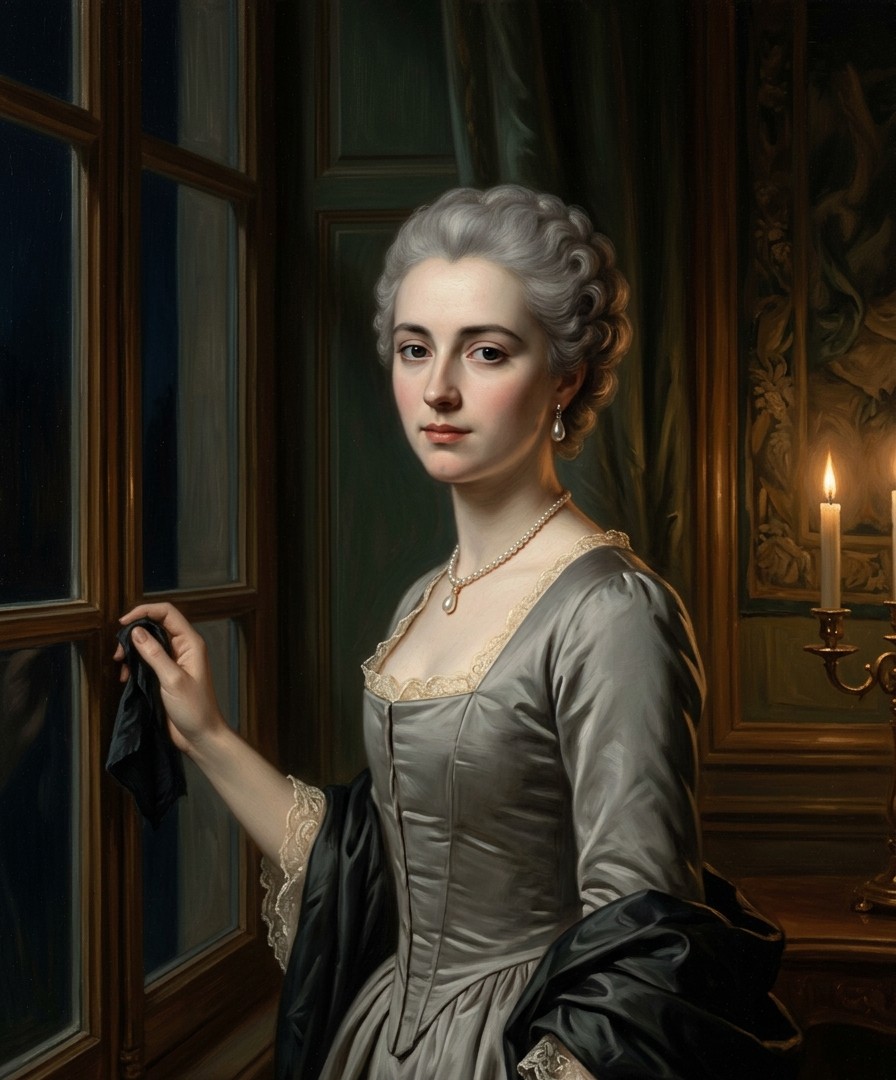
AI-assisted Portrait of Henriette
The Happiness That Left No Surname
In the spring of 1749 a Venetian adventurer named Giacomo Casanova crossed paths, near Cesena, with a traveler in disguise. She wore an officer's uniform and kept the company of a Hungarian captain. She was French, evidently of high noble birth, brilliantly educated, and entirely self-possessed, and for the rest of his life Casanova would insist that no one had ever made him so happy. He never learned her family name. History has it only as she signed it—Henriette, and nothing more.
For roughly three months they lived together in a rapture the most prolific seducer of the eighteenth century described, decades later, as the summit of his existence. The decisive scene came at a private gathering where Henriette, having claimed she could not play, sat down to a cello and performed so beautifully that the room fell silent and Casanova had to leave to weep. She was not a conquest. She was an equal, a mystery, and she knew herself to be both.
Then her concealed past reclaimed her. A letter, a carriage, an older gentleman, and she was gone. She left Casanova money he had not asked for, and with a diamond ring she scratched five words into the windowpane of their inn at Geneva. He saw her only twice more across the decades, both times at a distance she controlled. She remains one of the few people in his chronicle whom he could not possess, could not explain, and could not forget. She is, in the truest sense, untyped: a person we meet only as another person's wound.
With a diamond ring she scratched into the glass of their inn the words Tu oublieras aussi Henriette—you too will forget Henriette—and then proved herself wrong forever, because he never did, and neither, now, can we.
A Woman Traveling as a Man
Everything we know about Henriette arrives pre-shaped by the fact that she was, when Casanova met her, in flight and in costume. She had attached herself to a Hungarian officer to cross Italy unrecognized, dressed as a man, moving through a world closed to a young Frenchwoman of rank traveling alone. The disguise was not a lark; it was strategy. Whatever she was running from—a marriage, a family, a convent—she was running with the competence of someone who had thought it through.
What he records of her, once the costume came off, is a portrait of formidable cultivation. She spoke and reasoned without display, correcting him lightly and laughing at his certainties. The cello scene is the emblem of the whole affair: a woman who concealed her gifts until concealment cost her nothing, then revealed them completely without comment. She gave herself to the happiness of those weeks with full presence and total clarity that it would end. She loved him, Casanova believed, exactly as much as he loved her—and she was the one who could count the days.
The ending was managed by forces she never described to him. Letters reached her; a man of a certain age arrived to collect her, and she went—with the discipline to make the break absolute and the tenderness to soften it. Years later, passing through the same inn, Casanova found the five words still cut into the windowpane where she had left them. The detail may be improved by the consummate shaper of his own legend. But it is the truest thing in the story all the same: the woman vanishes; the sentence she scratched into the glass stays.
The Love That Outranked the Conquests
Casanova's memoir, Histoire de ma vie, is a monument to appetite—hundreds of women and seductions narrated with the cheerful amorality of a man who considered desire the engine of life. Against that backdrop, Henriette is an anomaly. She is the one episode he tells not as a triumph but as a loss, the one woman he never claims to have conquered because the whole point is that she left on her own terms. Where the rest of the Histoire is a ledger of possessions, the Henriette chapters read like an elegy.
This is why she matters beyond the biography of one libertine. Henriette is the proof, embedded in the confession of a man whose whole creed denied it, that intimacy can be real, equal, and irreplaceable. She redeems the memoir by exceeding it—while remaining almost completely unknown, a perfect literary object: all longing, no biography. Scholars have spent more than a century sifting French genealogies for a young noblewoman who fled to Italy in disguise around 1749. Nothing has been confirmed. The blank holds.
The Woman Who Cannot Be Typed
What can we glimpse of her temperament? A capacity for risk married to careful planning—she fled across a country in disguise without being caught. A reserve that concealed her gifts until she chose to show them, then refused to perform them once shown. Self-command at the moment of deepest feeling: she loved without illusion and left without scene. Out of these fragments one can sketch a brave, intelligent, intensely private woman. One cannot sketch a cognitive type.
Henriette resists MBTI classification for the most basic reason: we do not have her. We have Casanova's memory, set down decades after the fact by a man whose love bent every line he wrote about her. We do not know her name, her family, what she fled, or what became of her after the carriage took her away. To assign her a type would be to type a dream—and to mistake the dream for the woman. The blank is not a failure of the record. It is the whole point of her.
Connected Figures
Further Reading
- History of My Life — Giacomo Casanova, trans. Willard R. TraskThe twelve-volume memoir in which Casanova devotes extended passages to Henriette — the primary and essentially sole source for her existence.
- Casanova: The Seduction of Europe — Frederick Ilchman et al.Catalogue from the 2017 Boston–Chicago exhibition; contextualizes Casanova's world and the women who moved through it.
- The Memoirs of Jacques Casanova de Seingalt — Arthur Machen (trans.)The classic early English translation (1894), long the standard for Anglophone readers; the Henriette episodes appear in volumes II–III.
- Casanova: Actor Lover Priest Spy — Ian KellyThe most readable modern biography; Kelly traces the Henriette affair in detail and surveys the scholarly attempts to identify her.
