 Historical Figure MBTI
#247 · 3-25-26 · Catherinian Russia
Catherine the Great
Empress · Philosopher-Queen · Architect of Modern Russia
1729 — 1796
9 min read
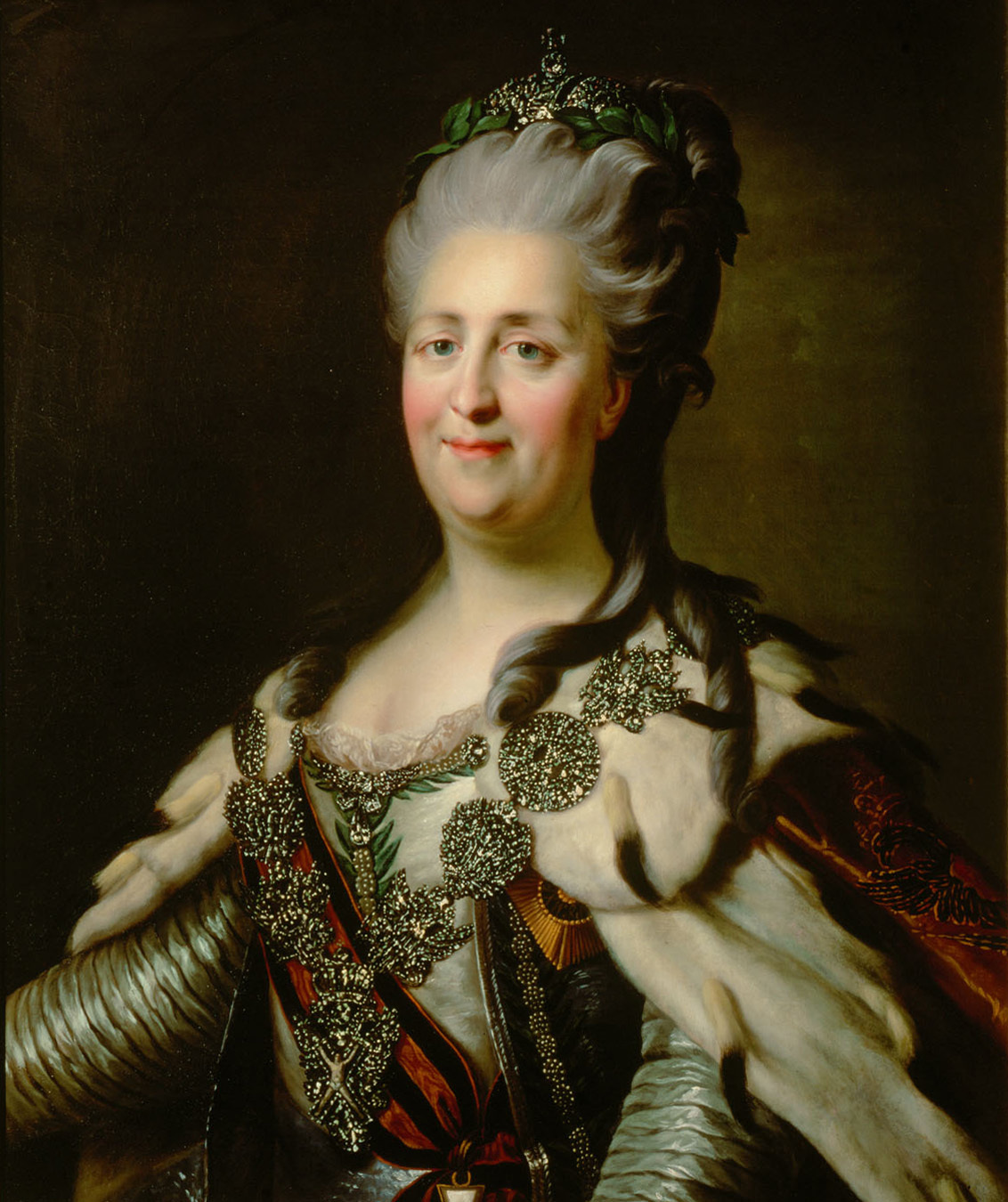
Portrait of Catherine the Great
The German Girl Who Made Herself Russian
On the morning of 28 June 1762, a woman in the green-and-red uniform of a Guards regiment rode at the head of fourteen thousand soldiers out of St. Petersburg toward the palace at Peterhof, where her husband was waiting to be deposed. She was thirty-three years old, a minor German princess by birth, and within hours she would be sovereign of the largest country on earth. The husband she unseated — Peter III, grandson of Peter the Great — signed an abdication so abject it read like a schoolboy's apology, and was strangled at a country estate eight days later by men close to her. Whether she ordered the killing or merely permitted the circumstances that made it inevitable, she never lost an hour's sleep over it. She had a throne to run.
She had been born Sophie of Anhalt-Zerbst in 1729, brought to Russia at fourteen to marry the heir, converted to Orthodoxy, and renamed Catherine by the reigning Empress Elizabeth. For eighteen years she was a foreigner in a hostile court, married to a man who preferred his toy soldiers to his wife, watched and distrusted and almost discarded. She survived that stretch the way she would later govern — by reading everything (Montesquieu, Tacitus, the philosophes), by mastering the language and the faith of her adopted country more thoroughly than the natives, by accumulating allies among the Guards, and by waiting. When the moment came she did not hesitate. She would rule for thirty-three years and die in 1796 still drafting reforms.
What carried her from powerless princess to Catherine the Great was a temperament organized entirely around execution. She is the ENTJ in its imperial form: a mind that converts every situation into a problem of administration, that builds institutions and legal codes and provincial systems the way other rulers build monuments, and that pairs its organizing drive with a long-range strategic vision — the Black Sea, the partition of Poland, the “Greek Project” — held steadily across decades. She corresponded with Voltaire and hosted Diderot, and she understood exactly what Enlightenment was worth to a monarch: a great deal as image, rather less as policy. When philosophy and autocracy collided, the autocrat always won.
Catherine was the ENTJ on the throne — dominant extraverted thinking that governed by system, code, and institution, fused to an auxiliary intuition that fixed on the Black Sea and Constantinople decades before the maps could be redrawn.
Governing by System
Te — dominant
Dominant extraverted thinking treats the world as a thing to be organized, and Catherine inherited an empire that was, by her own account, a chaos of overlapping jurisdictions, untrained officials, and a serf population governed more by custom than by law. Her instinct was never to admire the problem but to draft the apparatus that would solve it. In 1767 she convened the Legislative Commission — five hundred and sixty-four deputies drawn from nobles, townsmen, state peasants, and Cossacks — and handed them the Nakaz, an Instruction of more than five hundred articles she had composed herself, cribbed openly from Montesquieu and Beccaria. The Commission accomplished little and was dissolved when war with the Ottomans intervened. But the impulse is pure Te: gather the data, write the code, build the body that will translate principle into administration.
The reform that actually stuck was the Statute of the Provinces of 1775, issued in the aftermath of the Pugachev rebellion. Catherine looked at a revolt that had nearly engulfed the Volga and concluded, with characteristic Te detachment, that the failure was structural — the provinces were too large and too thinly governed. So she redrew the map, multiplying the provinces, separating fiscal, judicial, and police functions into parallel institutions. She founded a national network of schools, reorganized the Senate, secularized vast church estates. These are not the gestures of a dreamer; they are the work of an executive who measures a reign by what is left running after it ends.
Her management of people followed the same logic. She judged favorites and ministers by output before affection. Her most consequential partner, Grigory Potemkin, held power not because she loved him — though she did — but because he delivered: the annexation of Crimea in 1783, the colonization of the southern steppe, the building of Black Sea ports and a fleet from nothing. She let her generals Suvorov and Rumyantsev win her wars and rewarded them in proportion to results. Te does not confuse loyalty with competence; it staffs the machine with whoever makes it run.
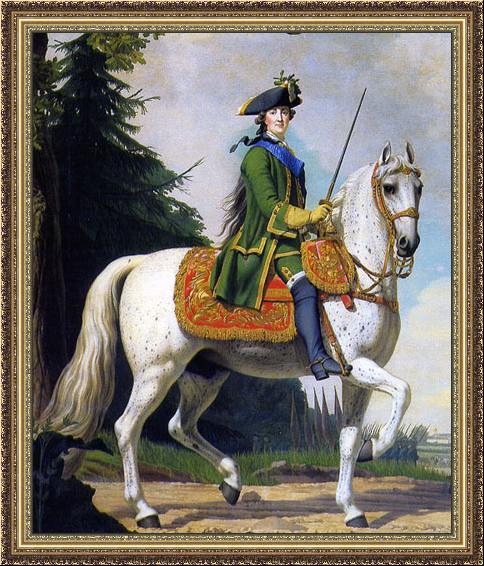
The Long Game Toward the South
Ni — auxiliary
Auxiliary introverted intuition gives the ENTJ's organizing drive a direction — a single distant target toward which all the administration is bent. For Catherine that target was the south: the Black Sea, the Crimea, and beyond them the half-articulated dream of Constantinople restored. The “Greek Project” was its most extravagant expression. She named her second grandson Constantine, had him nursed by a Greek woman, and imagined him on the throne of a revived Byzantine empire carved from the Ottomans. The fantasy never materialized, but the strategic intuition beneath it — that Russia's future ran toward warm water — shaped a century of policy after her death.
Ni works by reading the present as a trajectory and committing early. Catherine saw the Ottoman Empire as a structure already decaying and positioned Russia to inherit its European territories before that decay was obvious to the West. Two long Turkish wars, the annexation of Crimea, the founding of Sevastopol and Odessa — these were not opportunistic land-grabs but the methodical filling-in of a picture she had held in her mind for decades.
The partitions of Poland reveal the same forward-reading mind. Catherine began by installing a former lover, Stanisław Poniatowski, as king in 1764 — a man she could manage, a buffer she could steer. As the Polish state weakened she shifted from control to absorption, dismembering it in three stages until it vanished from the map. She did not lurch at Poland; she watched it fail along the line she had foreseen and closed her hand at the chosen moment. That is Ni in service of Te: a vision held steady for thirty years, then executed without sentiment.
Seizing the Moment, and the Man
Se — tertiary
Tertiary extraverted sensing surfaces in the ENTJ as a capacity for decisive physical action at the critical moment and a frank appetite for the tangible pleasures of power. The coup of 1762 was Se at its most consequential: when she learned that her position was collapsing and arrest might be imminent, Catherine did not deliberate — she put on a uniform, mounted a horse, and rode out to claim the army in person. She understood that power in Russia was seized in the body and in the moment, that fourteen thousand soldiers needed to see a sovereign at their head, and she supplied the spectacle without flinching.
The same function shows in her famous succession of favorites — Grigory Orlov, who with his brother engineered the coup; Potemkin; and at the end the young Platon Zubov, decades her junior. Catherine made no secret of her physical and emotional appetites and refused the shame the age expected of a woman, let alone an empress. There was an Se directness to it: she wanted vigorous, handsome men around her, and she arranged her life to have them, housing favorites in adjoining apartments and rewarding them with estates and titles.
Se also gave her a connoisseur's grip on the material apparatus of magnificence. She collected art on a scale that built the Hermitage — buying entire European collections whole, sometimes precisely to deny them to rival monarchs. For a tertiary function, this can tip into excess, and Catherine's spending strained even Russia's revenues. But she grasped, as her sensing supplied, that an empire is also a thing that must be seen to be believed.
The Conscience She Could Not Afford
Fi — inferior
Inferior introverted feeling in an ENTJ is the quiet pressure of a private moral self that dominant Te keeps subordinated to results. Catherine's case is the textbook drama of that tension. As a young grand duchess she had genuinely absorbed the Enlightenment's humane ideals; she condemned serfdom in the abstract and wrote in the Nakaz against torture and cruel punishment. The values were not a pose. But when they collided with the noble class on whose loyalty her throne rested, Fi lost. She extended serfdom into Ukraine, handed hundreds of thousands of state peasants to favorites, and after Pugachev tightened the landlords' grip rather than loosening it. The empress who hated serfdom on paper became its greatest practical enforcer.
The inferior function's instability shows most when Catherine's ideals were turned against her. When Alexander Radishchev published his Journey from St. Petersburg to Moscow in 1790, applying her own Enlightenment principles to the cruelty of Russian serfdom, she reacted not as a philosopher meeting an argument but as a frightened autocrat — condemning him to death (commuted to Siberian exile) and annotating his book with furious marginal notes. Inferior Fi, threatened, does not reason calmly. It lashes out and then rationalizes.
The same starved feeling-function poisoned her closest familial bond. Her son Paul had been taken from her at birth by Empress Elizabeth and raised at a distance; Catherine never repaired the rupture, kept him from any share of power, and is widely thought to have considered passing the throne over his head to her grandson Alexander, whom she raised herself. She could administer an empire of millions, but the intimate work of motherhood — the domain of Fi — defeated her, and Paul grew into a bitter, resentful man who, on taking the throne, set about dismantling her legacy out of spite.
Why ENTJ Over INTJ
Why not INTJ?
The strategic vision and long-range planning tempt an INTJ reading — the Greek Project, the patient dismemberment of Poland, the decades-long bend toward the Black Sea all look like dominant Ni. But Catherine led with the executive function, not the intuitive one. Her native register was action in the world: convening commissions, redrawing provinces, mounting a horse to seize an army, staffing by output. The INTJ governs from behind the system; Catherine governed from the front, charismatic and present, hungry for the throne in person. The vision was auxiliary, in service of the building — not the other way round.
The distinction is finally one of motivation. The INTJ is driven to understand and will build only enough structure to realize a private inner model; power is a means, often a distasteful one. Catherine was driven to rule — to organize, command, and leave behind a working empire — and understanding was the means. She read Montesquieu not to perfect a philosophy but to extract usable code for the Nakaz. She courted Voltaire not as a fellow seeker but as a sovereign acquiring prestige and cover. Where the INTJ withdraws to think, Catherine advanced to govern — and when thought and government conflicted, she chose government every time.
Connected Figures
Further Reading
- Catherine the Great: Portrait of a Woman — Robert K. MassieThe definitive popular biography — sweeping, authoritative, and alive to the full complexity of the reign.
- Catherine the Great — Simon DixonA concise scholarly account that excels on the administrative reforms and the Enlightenment's real role.
- The Memoirs of Catherine the Great — Catherine II (trans. Mark Cruse & Hilde Hoogenboom)Her own account of the miserable years before the coup — essential for understanding how she built her will.
- Potemkin: Catherine the Great's Imperial Partner — Simon Sebag MontefioreReads as a joint biography; illuminates how the Te–Ni partnership between Catherine and Potemkin actually worked.
