 Historical Figure MBTI
#248 · 3-25-26 · Catherinian Russia
Grigory Potemkin
Field Marshal · Statesman · Catherine's Great Love
1739 — 1791
7 min read
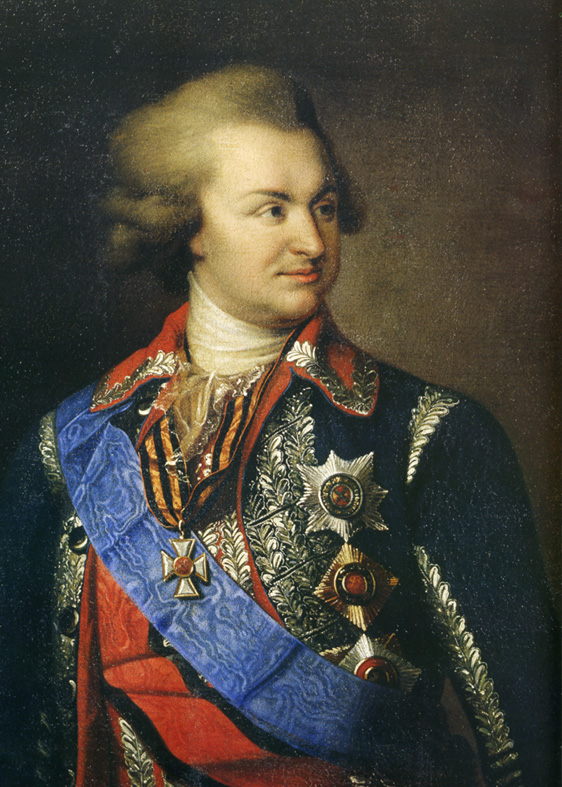
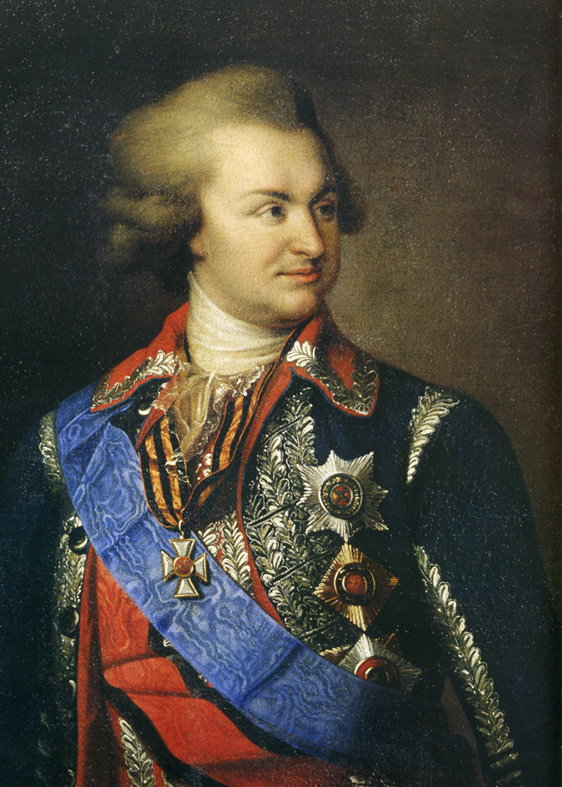
Portrait of Grigory Potemkin
The Prince of Storms
Grigory Potemkin was a provincial nobleman's son, a seminary dropout expelled from Moscow University for “laziness and non-attendance,” who first caught the eye of Catherine the Great during the 1762 coup that overthrew her husband. For a decade he hovered at court, a one-eyed giant of enormous charm and unstable moods, until in 1774 he was summoned into her bed and her counsels at once. Possibly her secret husband, certainly her co-ruler, he became the most powerful man in Russia—governing the empire the way he did everything: in spasms of volcanic energy, biting his nails to the quick, eating raw turnips in bed, dreaming of a reborn Byzantium while signing the orders that would build it.
He was a man of possibility—the ENFP at the scale of statecraft. What drove him was not order but vision: the capacity to see what a barren steppe could become, and to make others see it too. He founded Kherson, Sevastopol, Yekaterinoslav—imagined as a southern Athens with a cathedral larger than St. Peter's. He annexed the Crimea without firing a shot, and then half-abandoned several projects the moment the next idea seized him. Beneath the flamboyance ran genuine religious feeling and a hypersensitivity to his own moods that could collapse the most powerful man in Europe into bedclothes for weeks.
Potemkin was the ENFP at imperial scale—a mind that saw not the steppe but the city it might become, governing in tidal surges of inspiration and collapse, building an empire out of pure possibility and his own bottomless need to be loved.
The City in the Empty Steppe
Ne — dominant
Potemkin's southern enterprise was Ne projected onto geography. Where his contemporaries saw the Pontic steppe as a hostile frontier good for little but raiding, he saw a Mediterranean civilization waiting to be conjured. Kherson rose as a naval arsenal; Sevastopol became the base of a Black Sea Fleet that had not existed a decade earlier; Yekaterinoslav was planned as a metropolis where there was mostly grass. The point is not that all of it succeeded—much of it didn't—but that he could see it at all, and make Catherine and a continent of skeptics see it with him.
The annexation of Crimea in 1783 was Ne as statecraft rather than war. Potemkin worked for years through negotiation, inducement, and manufactured crisis until the peninsula fell into Russian hands without a battle. The Greek Project imagined the dismemberment of the Ottoman Empire and Catherine's grandson on a restored Byzantine throne—megalomania, but also pure dominant intuition: a vision so large it reorganized everyone's sense of what was thinkable.
The shadow side of Ne is the half-finished project. Potemkin was notorious for it: a blaze of conviction, then his attention seized by the next horizon, the undertaking left to stall. Foreign envoys called his energy “convulsive.” The “Potemkin villages” legend captures the real Ne tension—the gap between dazzling possibility and the unglamorous carpentry of making it stand up. He cared far more for the conjuring.
The Monk Who Wanted to Be Loved
Fi — auxiliary
Auxiliary introverted feeling surfaced in Potemkin as a lifelong, almost incongruous religiosity. The most worldly man in the empire was haunted by the cloister. He had trained for the Church, knew the liturgy and the Church Fathers, kept up theological conversations with monks and metropolitans, and more than once spoke seriously of retiring to a monastery. In the depths of his depressive troughs he would grow a beard, refuse to wash or dress, and lie in the dark—not as performance but as the genuine collapse of a man whose interior weather governed him absolutely.
His love for Catherine was Fi at its most exposed. The hundreds of surviving notes between them are not statesmen's correspondence but lovers in extremity—Catherine calling him her “twin soul,” soothing the tantrums of a man reduced to misery by a perceived slight. The probable secret marriage of 1774 mattered to him in a way power did not; even after the romance cooled, he needed to remain the one who held her heart. Potemkin's sense of his own worth was fused to that bond.
This same private valuation made him capable of striking generosity and striking cruelty by turns, both following an inner logic invisible to others. He could raise an obscure officer overnight on a whim of liking, or freeze a faithful servant out for an offense no one else could detect. His favor was a kingdom; his displeasure was a fog you could not argue your way out of.
The Visionary Who Could Also Build
Te — tertiary
What separates Potemkin from a merely dreaming ENFP was a tertiary extraverted thinking that, in his bursts of energy, could organize the world to serve the vision. He reformed the Russian army—abolishing powdered wigs and Prussian uniforms in favor of practical dress, pushing commanders like Alexander Suvorov forward on merit. He raised the Black Sea Fleet from nothing, supervised ports and shipyards, and ran the entire administration of New Russia as its viceroy.
But Te was tertiary, not dominant, and it shows. Potemkin's Te served his Ne: switched on by inspiration, switched off by its absence. He delegated erratically, kept chaotic accounts, mingled state funds with personal extravagance, and left a tangle of unfinished works. His efficiency was a tool he picked up when a vision demanded it and dropped the instant the vision lost its charge.
The 1787 Crimean tour—Catherine and foreign ambassadors conducted down the Dnieper to see New Russia—is the emblem: the fleet on the river, the illuminated towns, the triumphal arches were a genuine logistical achievement and a piece of theater at once. His enemies sneered that the prosperous villages were painted fronts. The truth was more characteristic: the building was real, the staging was real, and for Potemkin the two were never quite separable.
The Body That Kept No Rhythm
Si — inferior
Potemkin's inferior Si was almost a clinical case. He kept no regular hours, slept and ate at random, gorged and fasted by turns—raw turnips, garlic, and salted gherkins in bed. He bit his nails compulsively. He spent staggering sums on palaces and diamonds sewn into his coats, then swung into monkish squalor, unwashed and unshaven in a darkened room. There was no settled baseline, no ordinary life—only the tidal extremes. The body, for Potemkin, was not a steady instrument to be kept in tune but a thing he overrode in inspiration and crashed against in collapse.
His death in 1791 was the inferior function's final word. Ill and feverish, he refused the doctors' regimen, tore off his clothes, and insisted on being carried out of Iaşi onto the open road toward Nikolaev. He died on the bare steppe, on the grass, his head in a Cossack's lap. The man who had conjured cities out of empty grassland died, fittingly, with nothing but grass beneath him.
Why ENFP Over INFP
Why not INFP?
The INFP and the ENFP share the same Fi–Ne values core, and Potemkin's inner intensity, his religiosity, and his bottomless need for a treasured connection can read as the introvert's profile. But the orientation of his intuition was unmistakably outward. An INFP holds the vision inward, refines it privately. Potemkin did the reverse: he broadcast possibility, reorganized empires around his schemes, thrived on crowds and spectacle. His dominant function reached out to remake the external world—annexing peninsulas, staging river progresses, dazzling ambassadors—not in toward a private interior. The Fi is auxiliary; the engine the world saw was Ne. That is the ENFP, not the INFP.
The depressive collapses look like introversion, but they are better read as inferior Si exacting its price—the crash that follows the surge. The moment the fog lifted, Potemkin always returned outward: summoning officers, filling rooms with talk and people. An INFP rests in solitude; Potemkin was restored by the arena. His career was an argument with the world, conducted out loud, on the largest possible stage.
Connected Figures
Further Reading
- Potemkin: Catherine the Great's Imperial Partner — Simon Sebag MontefioreThe definitive biography — exhaustive on the man's psychology, the secret marriage, and the southern empire he built.
- Catherine the Great: Portrait of a Woman — Robert K. MassiePlaces Potemkin at the center of Catherine's reign; invaluable for the partnership and the Crimean annexation.
- The Russian Empire, 1801–1917 — Hugh Seton-WatsonBroad context for the Catherinian expansion Potemkin drove — the strategic stakes of New Russia and the Black Sea.
- Catherine the Great and Potemkin: The Imperial Love Affair — Simon Sebag MontefioreCondensed account of the personal and political dimensions of their relationship, drawn from their private correspondence.
