 Historical Figure MBTI
6 min read
#289 · 3-25-26 · Catherinian Russia
Jose de Ribas
Admiral · Soldier of Fortune · The Spanish-Born Founder of Odessa
1749 — 1800
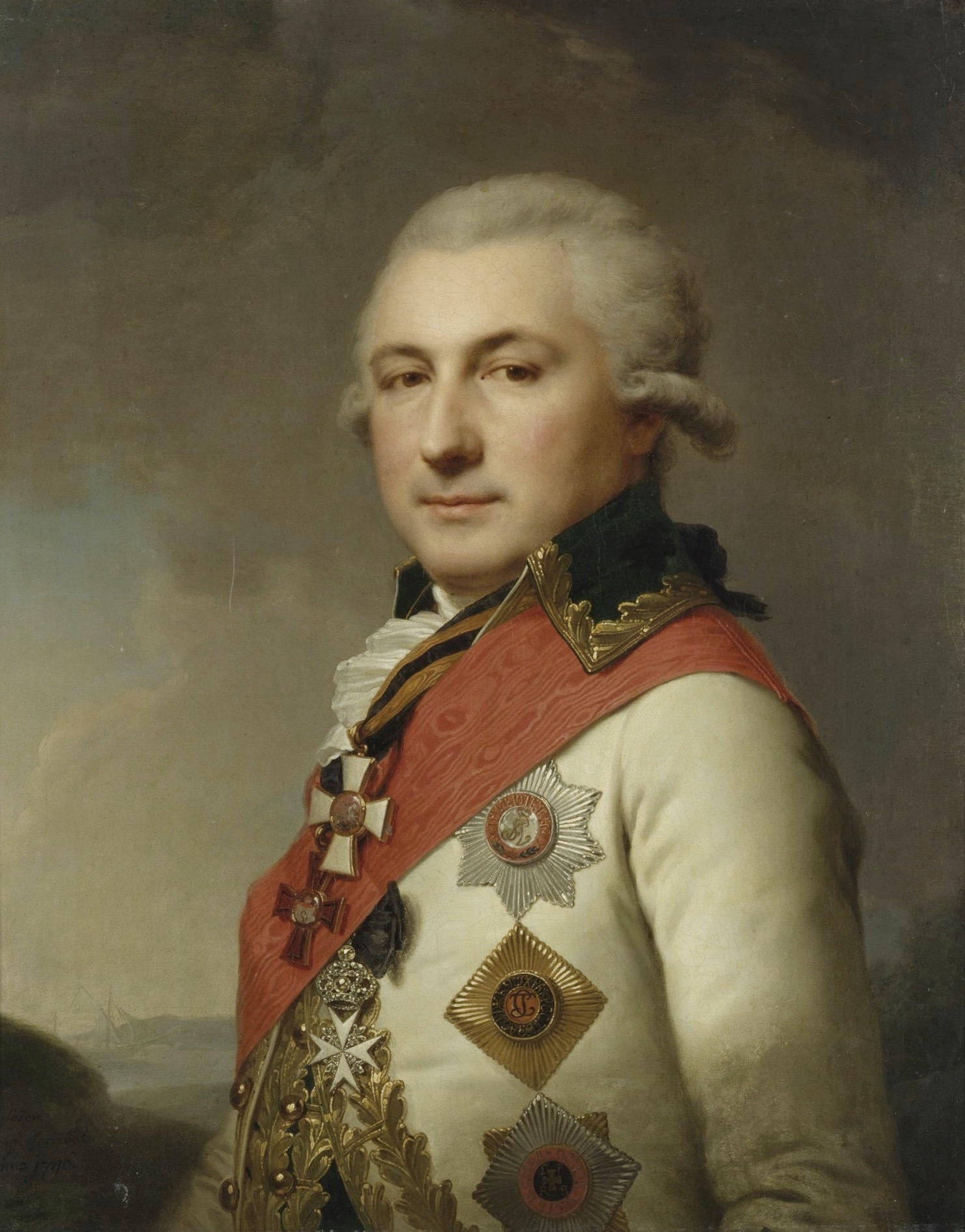
Portrait of Jose de Ribas
The Man Who Founded a City as a Side Project
José de Ribas was born in Naples in 1749, the son of a Spanish diplomat of Irish descent, and died in St. Petersburg in 1800 while conspiring to assassinate the reigning tsar. In between he rose to admiral in Catherine II's navy, fought the Russo-Turkish Wars with enough distinction to win the empress's personal favor, and — almost incidentally — founded Odessa. He chose the name, directed the harbor construction, and laid out the first streets on a Black Sea coastline that had been, until 1794, nothing but steppe and possibility. Then he moved on to the next project.
He spoke multiple languages, adapted to each new environment with uncanny ease, and treated every situation as a puzzle worth solving. When the solution was found — when the city was founded, the battle won, the patron cultivated — his attention moved to the next horizon. He did not build institutions; he built possibilities and left others to institutionalize them.
That's the ENTP signature: Ne generating possibilities faster than any single project can absorb them, Ti providing just enough structural discipline to make the possibilities real.
The founding of Odessa is not the story of a patient city-planner. It is the story of a man who saw a blank coastline and recognized — faster than anyone around him — what it could become: a free port, a commercial gateway, a place where the Black Sea opened onto the world. The insight was Ne. The follow-through was Ti. The city endured.
The Polyglot Adventurer, Always One Project Ahead
Ne dominant figures are perpetually alert to what something could become — what latent pattern a situation contains before it has materialized. De Ribas arrived in Russia as a Neapolitan with no connections and no Russian. Within years he had won command positions in the navy, cultivated Potemkin's friendship, and inserted himself into the inner workings of Catherine's military machine. He saw the path before it was visible.
The Russo-Turkish Wars gave him the stage he needed. His naval operations — particularly the assault on Izmail alongside Alexander Suvorov in 1790 — were marked by improvisation and tactical surprise. He was not a meticulous planner; he was a reader of opportunities who could identify the gap in an enemy formation and move before it closed. The same faculty made him dangerous in court: he could see which alliances were consolidating and which were dissolving before most people could articulate it.
Founding Odessa was the ultimate expression of this function. Catherine needed a Black Sea port; the question of where remained open. De Ribas assessed the harbor at the old Turkish fortress of Khadzhibey — its depth, its access to the steppe hinterland, its proximity to the Danube delta — and proposed the site. By 1794 construction was underway. The name he chose, Odessa, after the ancient Greek Odessos, was characteristically Ne: anchoring a new project in an ancient precedent and giving it a resonance beyond its immediate purpose.
The Tactician's Precision Beneath the Improvisation
Ti auxiliary means the ENTP's improvisation is disciplined by an internal logical framework, even when it looks like pure intuition. De Ribas's military reputation was built not only on his ability to spot opportunities but on the structural clarity of his execution — his tactics calibrated to the specific terrain and opponent, his operations designed to exploit identified weaknesses rather than simply charge and hope.
The city plan of Odessa reflects this directly. The streets de Ribas laid out in 1794 followed a rational grid — unusual for a city improvised on empty coastline. The free-port argument he made to Catherine was Ti-structured: remove tariff barriers, attract Mediterranean traders, let the Ukrainian hinterland export through a competitive port. Each element supported the others. The insight was Ne; the case was Ti.
The ENTP's Ti is often invisible behind the Ne flash — but remove it and what remains is not cleverness but mere excitability.
The Connector Who Survived Every Court
Fe tertiary gave de Ribas genuine social intelligence — not his primary mode, but real. He won Potemkin's favor, maintained Catherine's trust even as her later favorites Platon Zubov and Nikolai Zubov ascended, and read the emotional logic of the court — who needed to feel indispensable, who could be charmed with competence, who required more careful tending.
This social navigation carried him into the conspiracy to remove Paul I from the throne. A plot requires not just a plan but a network of people who trust each other enough to act — Fe made him useful for exactly that. He could read who was ready to move and who needed more time, and broker alliances between the factions. He died in December 1800, from exhaustion and illness, before the assassination was carried out. Characteristic of his Si inferior: he had pushed himself past the point his body could sustain.
Why ENTP Over ENTJ or INTJ
Why not ENTJ?
The ENTJ's Te dominant creates structures that outlast them. De Ribas founded a city but did not institutionalize it — Odessa was built by his successors, notably the Duc de Richelieu, who gave it the administrative structure de Ribas had not stayed long enough to create. He was an improviser who happened to found a city, not an organization-builder who set out to create an enduring institution. ENTJ leaves a system; ENTP leaves a possibility.
Why not INTJ?
The INTJ's Ni dominant sees the endpoint first and works backward from it. De Ribas worked forward from opportunities. He did not plan to found a city; he recognized a city was possible when he saw the harbor at Khadzhibey. An INTJ would have chosen the site at the start of the campaign and organized everything toward that goal. De Ribas saw the goal when the opportunity presented itself. These are fundamentally different cognitive operations, even if the outcome looks similar from the outside.
What makes de Ribas distinctively ENTP is that his attention was always wider than his current assignment, always alert to what the present situation contained beyond its surface. He generated plans, executed them approximately, and was halfway through the next one before the current was finished. Odessa exists because an ENTP with enough Ti to follow through looked at an empty coastline and could not resist asking: what if?
Connected Figures
Further Reading
- Catherine the Great and Potemkin: The Imperial Love Affair — Simon Sebag MontefioreCovers how de Ribas cultivated Potemkin's patronage and rode it to command and the founding of Odessa.
- The Art of Victory: The Life and Achievements of Field-Marshal Suvorov — Philip LongworthPlaces de Ribas alongside his comrade-in-arms Suvorov during the campaigns that made both their names.
- By the Banks of the Neva: Chapters from the Lives and Careers of the British in Eighteenth-Century Russia — Anthony CrossA model for the many foreign-born officers, like the Spanish-born de Ribas, who built careers in Catherine's service.
- Russia in the Age of Catherine the Great — Isabel de MadariagaThe standard account of the empire and expansion that gave a soldier of fortune like de Ribas his opening.
