 Historical Figure MBTI
#256 · 3-25-26 · Catherinian Russia
Paul I
Tsar · Autocrat · Tragic Emperor
1754 — 1801
7 min read
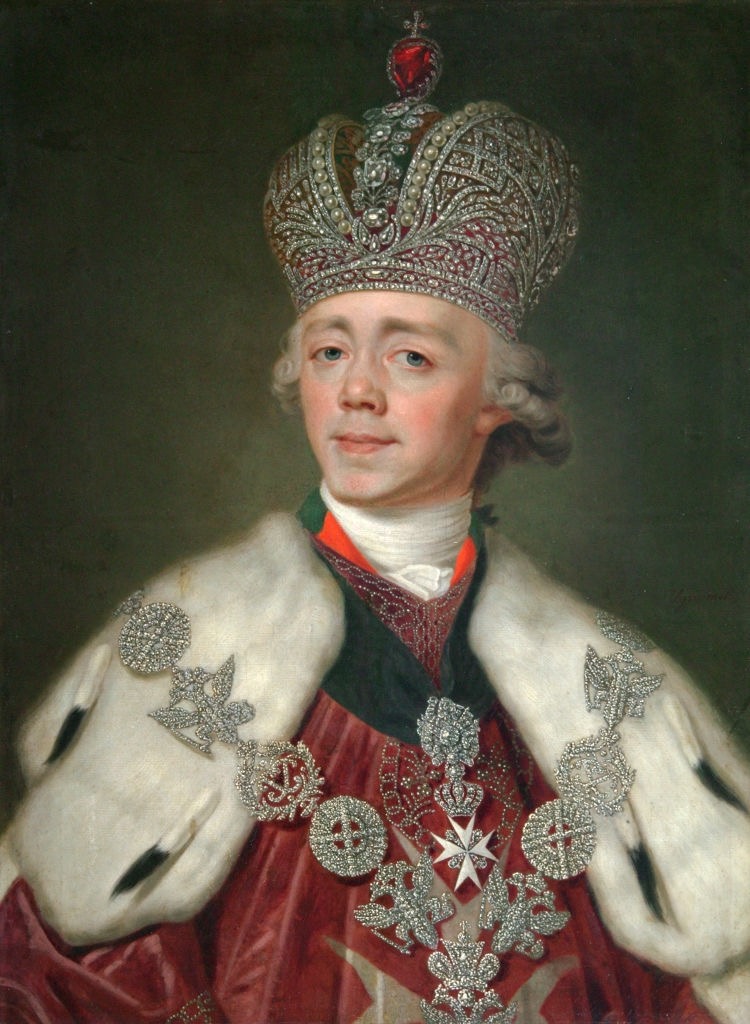
Portrait of Paul I
The Heir Who Waited Too Long
Paul Petrovich was raised as an inconvenience. Born in 1754 to Catherine the Great and Peter III, he was seized at birth by Empress Elizabeth. Within eight years his father was deposed and murdered in a coup his mother led, and Catherine took the throne in her own right. Paul grew up a living question mark—the legitimate male Romanov whose existence quietly indicted the woman ruling in his place, hearing all his life that his real father was Catherine's lover Sergei Saltykov. He grew up inside that ambiguity, and it deformed him. For thirty-four years he waited. Excluded from power, he retreated to his Gatchina estate and built a miniature kingdom: a private army drilled to Prussian standards, uniforms regulated to the button, parade grounds where everything happened on time and by the rule. When Catherine died in 1796 he took the throne at forty-two and ruled the way he had drilled—by decree, by reversal, by the frantic imposition of order onto an empire he had never been allowed to learn how to govern. He was an ESFJ built for a settled role in a settled world who was handed neither, and who tried to manufacture both by force.
Paul I was the ESFJ formed in exile—a man who craved order, loyalty, and a recognized place in the hierarchy, and who, denied all three for thirty-four years, spent his brief reign trying to drill them into existence by decree.
The Hunger for a Recognized Order
Fe — dominant
Dominant Fe orients a person toward hierarchy, role, and the question of who owes loyalty to whom. In Paul it produced a man obsessed with the forms of allegiance precisely because he had been denied the substance of it. In 1798 he accepted the title of Grand Master of the Knights of Malta—an Orthodox emperor at the head of a Catholic crusading order—because what he wanted was the structure of sworn loyalty, the sense of belonging to a hierarchy that owed him fealty. He was warmly attached to his wife Maria Feodorovna and emotionally anchored by the candor of Ekaterina Nelidova—yet could never quite believe in any loyalty. He experienced every relationship as a test that could be failed, elevating favorites then casting them out at the first hint of independence. As emperor his Fe turned coercive: edicts regulating dress, curfews, forbidden French words and round hats, and the demand that anyone encountering his carriage halt and bow in the mud. Fe stripped of warmth and reduced to enforcement, expressed by a man who would not trust order to hold unless he personally policed every inch of it.
The Parade Ground and the Grudge
Si — auxiliary
Auxiliary Si gives the ESFJ its devotion to precedent and the remembered way things were done. In Paul this archive had two contents: the parade ground, and the grudge. At Gatchina he had spent two decades perfecting Prussian drill, making the manual into something close to a moral code; on taking the throne he imposed those standards on the whole imperial army. And his memory for slights was total: his reign was a systematic settling of scores against his mother. He reversed her policies wholesale and most theatrically had the remains of Peter III exhumed, crowned posthumously, and reburied beside Catherine, forcing her accomplices to walk in the funeral procession of the man they had helped to kill. His most consequential act was the same impulse elevated to law: in 1797 he abolished the fluid succession rules that had let Catherine reach the throne over his head, decreeing rigid male-preference primogeniture that no future empress could circumvent. The law held the Romanov succession steady through to 1917.
The Sudden Reversals
Ne — tertiary
Tertiary Ne is the loose cannon of the ESFJ stack—sudden enthusiasms and abrupt reversals that Fe and Si cannot govern. Caprice was the word contemporaries reached for to describe Paul: grand idea embraced with total conviction, then reversed days later when enthusiasm cooled. Foreign policy showed this at its most expensive. He sent Suvorov to campaign brilliantly in Italy as part of the Second Coalition, then—feeling betrayed by his allies and dazzled by Napoleon, who shrewdly returned captured Russian prisoners newly uniformed—reversed the entire orientation of Russian policy, broke with Britain, and dispatched Cossacks toward the steppe on a fantastical joint plan to invade British India. Underneath the chaos was real idealism: Paul genuinely dreamed of a restored age of chivalry and sheltered the exiled French royal family out of authentic conviction. But Ne in the tertiary position supplies vision without the means to test it, and his noble fantasies arrived in the same impulsive rush as his petty edicts about hats.
The Logic He Never Found
Ti — inferior
Ti is the ESFJ's inferior function—the cool reasoning that checks an impulse against logic. Paul's succession reform was genuinely rational, but he could not reliably step back from his own emotional reactions: Fe's demand for loyalty and Si's store of grievance ran the show, and inferior Ti never supplied the brake. He experienced opposition not as a predictable response to his own actions but as fresh betrayal, which triggered more Fe wrath and more Si grudge-keeping, producing more opposition still. He could not see the feedback loop he was standing inside. In his final months he retreated into the fortress-like Mikhailovsky Castle, convinced enemies surrounded him. They did. On 23 March 1801 disaffected officers broke into his bedchamber and murdered him, with the tacit foreknowledge of his heir Alexander I. The man who had built an airtight law of succession to protect his sons died in a palace coup arranged with one of those sons' consent—the exact fate of Peter III, the wheel turning once more on the inability to read the logic of one's own situation.
Why ESFJ Over ISFJ
Why not ISFJ?
The ISFJ leads with inward Si and engages the social world cautiously, preferring to serve order from within. Paul was the opposite: he reached outward to demand loyalty, issue edicts, and police every subject's dress and conduct. He could not leave the social world alone. That outward, controlling, hierarchy-imposing drive is dominant Fe over auxiliary Si—the ESFJ's signature, not the inward-facing ISFJ stack. An ISFJ's tertiary Fe would have made him more socially fluent and consistent; instead his lurching reversals point to tertiary Ne—the impulsive generator of schemes an ESFJ under stress cannot discipline.
Connected Figures
Further Reading
- Paul I — Roderick E. McGrewThe standard English-language biography; comprehensive on Paul's psychology, his reign, and the Gatchina years.
- A History of Russia — Nicholas V. Riasanovsky and Mark D. SteinbergPlaces Paul's brief, convulsive reign in the arc of Romanov autocracy and the legacies of Catherine and Peter.
- Catherine the Great: Portrait of a Woman — Robert K. MassieThe fullest account of the court Paul grew up in and the mother whose long shadow defined his character.
- The Romanovs: 1613–1918 — Simon Sebag MontefioreVivid narrative history covering Paul's strange reign, his murder, and the succession law that outlasted him by a century.
