 Historical Figure MBTI
#257 · 3-25-26 · Catherinian Russia
Ekaterina Nelidova
Ballerina · Confidante · Companion of Paul
1758 — 1839
6 min read
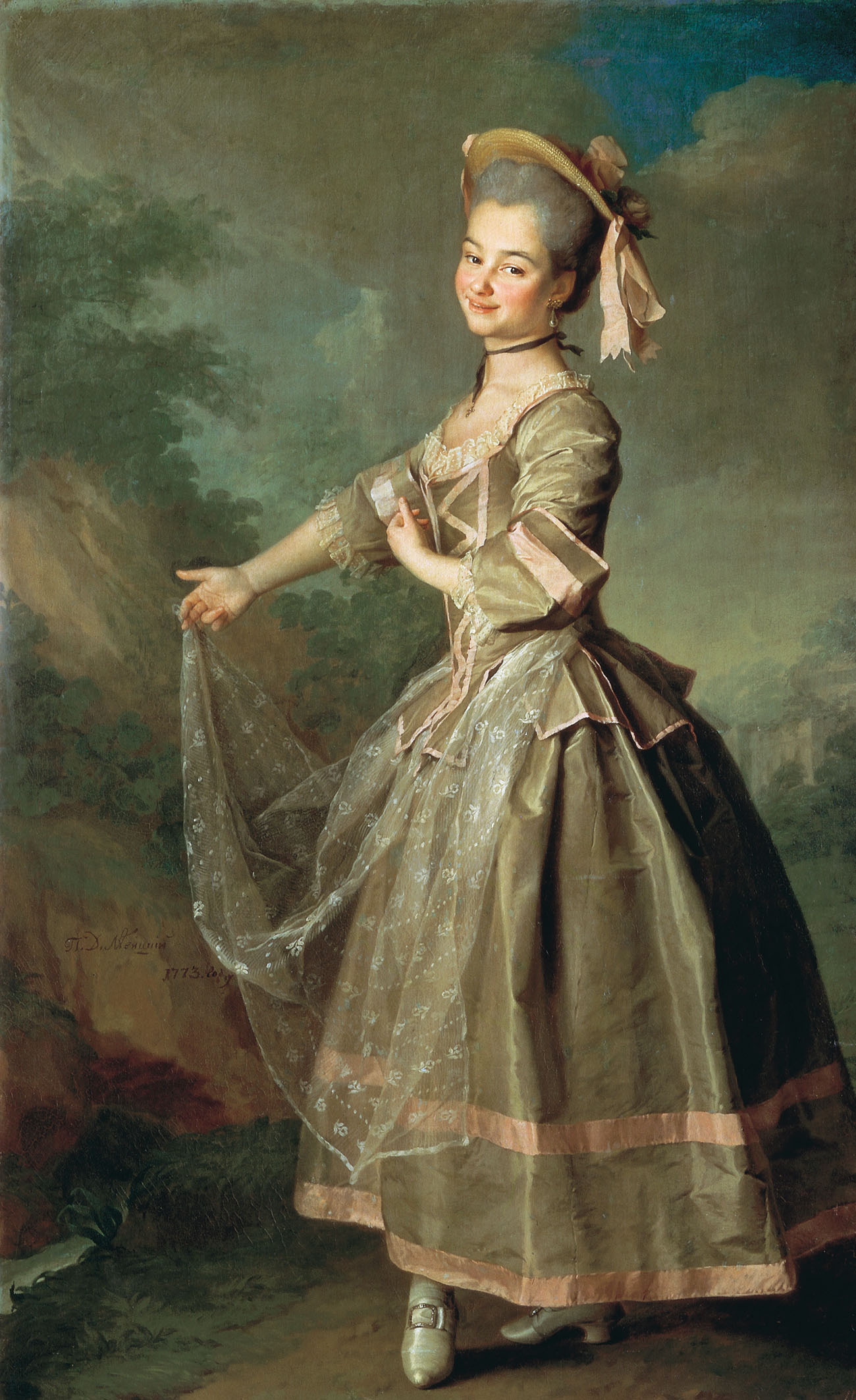
Portrait of Ekaterina Nelidova
The Small Woman Who Filled a Room
She was, by every account, plain. Small, slight, with none of the cold-marble beauty the Russian court prized—and yet Ekaterina Ivanovna Nelidova became the most talked-about woman at the side of the heir to the throne. The word her contemporaries always reached for was charm. Immortalized as a teenager in Levitsky's portrait—caught mid-curtsy, all wit and motion—she carried the stage into the corridors of Gatchina and Pavlovsk: talking brilliantly, arguing with a moral seriousness that startled men accustomed to flattery.
Her bond with Paul I—the volatile, perpetually wounded heir and later emperor—became the scandal of two reigns. Everyone assumed an affair. Nelidova insisted it was a friendship of souls, chaste and high-minded. The surviving evidence vindicates her. What she exercised was not seduction but influence—emotional, moral, at moments political—won by character alone.
The type is the ENFP: dominant extraverted intuition that saw possibility in people the court had written off; auxiliary introverted feeling that gave that vivacity a spine of private conviction she would not bend; tertiary extraverted thinking that let her organize and maneuver when a cause demanded it; and an inferior introverted sensing that surfaced, at the end, as a dignified retreat to the convent school where it had all begun.
Nelidova was the ENFP at the heart of a court that ran on beauty and fear—plain, penniless, and powerless on paper, and yet able to fill a room and steady a king through nothing but wit, warmth, and an unbending sense of who she would and would not be.
The Girl Who Played Every Part
Ne — dominant
Dominant extraverted intuition is the mind that reads a room instantly, improvises to fill it, and finds the latent possibility in whatever it touches. At Smolny, where the students performed French comedies before the whole court, the plain Nelidova became their unlikely star. Levitsky's portrait captures the Ne temperament exactly: not a beauty posing, but a personality performing—quick, expressive, alive to the audience.
That theatrical readiness migrated from the stage to the court itself. Where others saw in Paul only a difficult, paranoid man best avoided, Nelidova saw possibility. Ne addresses the latent figure rather than the present one; she talked to him as no one else dared—playfully, frankly, sometimes scoldingly. The court, raised on slow intrigue, could not read someone who operated by such visible animation, and called her a seductress. It was simply the way her mind met the world.
The Line She Would Not Cross
Fi — auxiliary
Auxiliary introverted feeling is the conscience beneath the charm—a private, non-negotiable code that the Ne surface ultimately serves. In Nelidova it produced the most extraordinary fact of her life: the insistence, against an entire empire's disbelief, that her bond with Paul was chaste. Fi does not care whether the world believes it. Nelidova could answer to herself, and said so to anyone who pressed her.
This inner code was the source of her real authority. She was not a flatterer but a moral mirror—one who could withdraw warmth in a way that wounded Paul more than any courtier's disgrace. Surrounded by people who feared him, he found in Nelidova the one person whose regard had to be earned. She did not enrich herself or build a clientele. Her quarrel with the Kutaisov–Lopukhina faction was a quarrel between two theories of what a favorite could be. Hers cost her everything.
The Alliance Against the Faction
Te — tertiary
Tertiary Te gives the ENFP an underrated capacity to organize and leverage when a cause demands it. The clearest example was Nelidova's reconciliation with Maria Feodorovna. Former rivals divided by jealousy, the two women recognized a worse danger in the Kutaisov–Lopukhina faction and made common cause, pooling influence and coordinating their approach to Paul. Values identify the enemy; thinking supplies the tactics.
What tertiary Te could not do was win a war of pure intrigue. The faction she opposed practiced exactly the patient, amoral machinery of court maneuver that her own nature was least equipped to match. Her Te was an auxiliary weapon wielded by a woman whose true strengths lay elsewhere, and against opponents who had nothing else, it was not quite enough.
The Walk Back to Smolny
Si — inferior
Inferior introverted sensing is the quiet undertow beneath the ENFP's forward motion—a buried pull toward stability, surfacing when the expansive life finally exhausts itself. When Lopukhina supplanted her, the inferior function chose Nelidova's exit. She did not fight past the point of dignity, did not cling, did not intrigue for restoration. She withdrew to Smolny—the one fixed place in a life otherwise spent at the volatile center of power.
She outlived Paul by nearly four decades, witnessing his murder in 1801 and the long reign of his son Alexander I. The inferior function, so often the source of an ENFP's late unease, here resolved into something almost serene: a quiet old age in the one place that had always been home.
Why ENFP Over INFP
Why not INFP?
The INFP shares Nelidova's moral seriousness and refusal to be defined by others' readings. But the INFP's feeling turns inward; it guards an inner world and engages the social arena reluctantly. Nelidova did the opposite: she was a performer who thrived in the most public theater in Russia and drew her vitality from contact with people. Her conviction (Fi) was real, but it rode on top of an outward, improvisational energy (Ne) that an introvert simply does not generate.
The order of functions is the whole argument. In the ENFP, extraverted intuition leads and feeling supports; in the INFP, the arrangement reverses. The court met Nelidova's charm first and found the conscience underneath. That sequence—wit outward, conviction within—is the ENFP's exactly.
Connected Figures
Further Reading
- Paul I of Russia: The Life of an Autocrat — Roderick E. McGrewThe standard English-language biography of Paul I, covering his court relationships including Nelidova's role.
- Catherine the Great: A Profile — Marc Raeff (ed.)Essays on Catherine's court and its institutions, including Smolny, which shaped Nelidova.
- The Romanovs: 1613–1918 — Simon Sebag MontefioreCovers Paul I's reign and the court factions that surrounded him, including the Nelidova years.
