 Historical Figure MBTI
#263 · 3-25-26 · Catherinian Russia
Empress Elizabeth
Empress · Daughter of Peter · Builder of the Baroque Court
1709 — 1762
5 min read
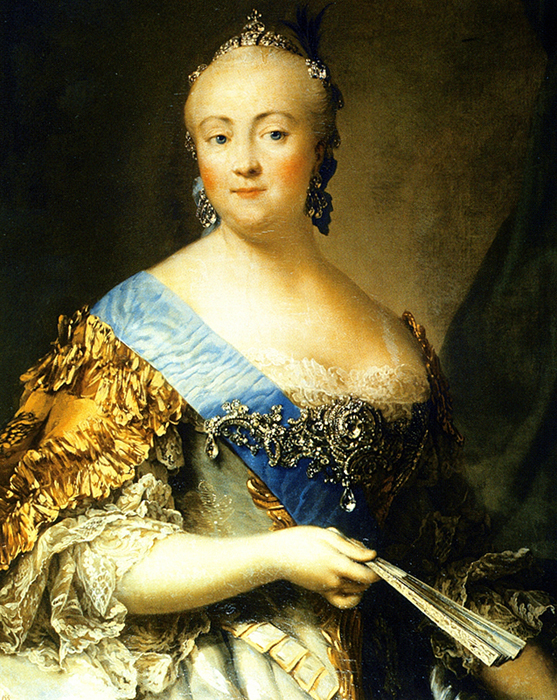
Portrait of Empress Elizabeth
The Empress of the Present Moment
She came to the throne in the small hours of a winter night in 1741, surrounded by grenadiers who adored her, without spilling a drop of blood. Elizabeth Petrovna—daughter of Peter the Great—had spent years dancing past her own political danger while the regency of an infant tsar floundered. Then she walked into the barracks, reminded the guards whose daughter she was, and let them carry her to the Winter Palace—not through years of plotting but on charm, nerve, and the loyalty she had banked simply by being delightful to be near.
For twenty years she reigned over a Russia she made spectacular—fifteen thousand gowns, Baroque palaces by Rastrelli, the enduring love of the Cossack singer Alexei Razumovsky. To the censorious she was a frivolous sensualist who let ministers run the state; beneath the silk was a shrewd reader of people who very nearly humbled Frederick the Great and made—and kept—a vow to execute no one. The psychology that unifies the gowns and the grenadiers is the ESFP's: dominant sensation for the vivid present, auxiliary feeling that bound people through loyalty, inferior intuition that left her uneasy with the long view. She governed not by design but by presence.
Elizabeth ruled the way she danced—by reading the room, trusting her instinct, and committing to the moment so completely that twenty years of improvisation looked, in retrospect, almost like a plan.
The Court as a Feast for the Senses
Se — dominant
Elizabeth refused to be seen twice in the same gown and banned any woman at court from wearing her colors; the present, for an Se dominant, is a stage to be composed. In Rastrelli she found an artist who could translate that impulse into stone—the Winter Palace, Tsarskoye Selo, Smolny Cathedral: rooms designed to overwhelm the eye with ornament. She filled her court with theater, opera, and dancing past dawn, tireless in pleasure and notoriously restless with administration.
Even her coup was Se in action. Where a planner would have built a conspiracy over months, Elizabeth read the immediate situation—an unpopular regency, a guard regiment that loved her, a window of opportunity—and acted on the night, in person, on her feet. The Se dominant is most formidable in the live moment, where perception and action collapse into a single decisive gesture. That night made her empress, and it was made of nerve rather than design.
The Vow She Refused to Break
Fi — auxiliary
Fi is a private value system—not socially negotiated ethics but quiet inner conviction about what one will and will not do. Elizabeth's most famous expression of it was her pledge, made on the night of her coup, that she would put no one to death. Against every cynical expectation she kept it: death sentences were commuted, and Russia went two decades without a state execution. It was a personal line she had drawn, and her sense of herself depended on not crossing it.
Her loyalties ran the same way—deep and stubborn. Her devotion to Alexei Razumovsky, a Cossack of no birth whose likely secret marriage to her brought nothing strategic, is the clearest case. Her piety—pilgrimages on foot, endowed churches—was the same: inward conviction rather than display. The woman beneath the gowns had values she would not sell.
Shrewdness Beneath the Frivolity
Te — tertiary
Tertiary Te has a practical competence about getting things done through other people. Elizabeth found capable ministers—the Shuvalov brothers, Bestuzhev-Ryumin—and kept them, delegating government while she preserved her energy for what she cared about. Russian armies defeated Frederick at Kunersdorf and briefly occupied Berlin; Frederick was saved only by Elizabeth's death in 1762—the “Miracle of the House of Brandenburg”—when her successor reversed policy. Moscow University (1755) and the Academy of Arts (1757) outlasted her by centuries. She governed by knowing whom to trust—a humbler effectiveness, but real.
The Blind Spot of the Long View
Ni — inferior
Inferior Ni is the ESFP's weakest corner: the capacity to read how the present will unfold. Elizabeth named as her heir Peter III—a Prussophile misfit who idolized Frederick—then imported a German princess to marry him: the future Catherine the Great. She grasped Catherine's charm but did not foresee what that intelligence would become. Within months of Elizabeth's death, Peter III had reversed her war and been overthrown by his wife in a coup that echoed Elizabeth's own. She had assembled, through her blind spot, the precise human materials for the next seizure.
Why ESFP Over ISFP
Why not ISFP?
The ISFP shares Elizabeth's sensory richness and private Fi conviction, but leads with feeling and turns inward—a quieter sensibility that recoils from the glare of the crowd. Elizabeth was the opposite of reserved: a performer who needed a stage, a coup-leader who worked a room of grenadiers by sheer presence. Her gift was extraverted—reading and commanding the live moment. The Fi is real, but it sits second beneath a dominant Se that was loud, social, and insatiably out in the world.
The ISFP's dominant feeling makes for a soul felt before it is seen; Elizabeth's dominant sensation made her a phenomenon to be witnessed. An ISFP empress would have ruled quietly. Elizabeth ruled the way an ESFP does—in the open, on instinct, with the room as her instrument.
Connected Figures
Further Reading
- Elizabeth: Empress of Russia — Philip LongworthThe most accessible English-language biography of Elizabeth, covering her coup, court, and reign.
- The Romanovs: 1613–1918 — Simon Sebag MontefioreVivid dynastic narrative with substantial coverage of Elizabeth's court, favorites, and the world she handed to Catherine.
- Catherine the Great: Portrait of a Woman — Robert K. MassieFollows Catherine from her arrival at Elizabeth's court through her own reign — essential context for understanding Elizabeth's succession choices.
- Russia in the Age of Peter the Great — Lindsey HughesGrounds Elizabeth's reign in the Petrine legacy she inherited and deliberately invoked.
