 Historical Figure MBTI
#265 · 3-25-26 · Catherinian Russia
Stanisław Poniatowski
King · Last Monarch of Poland · Catherine's Former Lover
1732 — 1798
5 min read
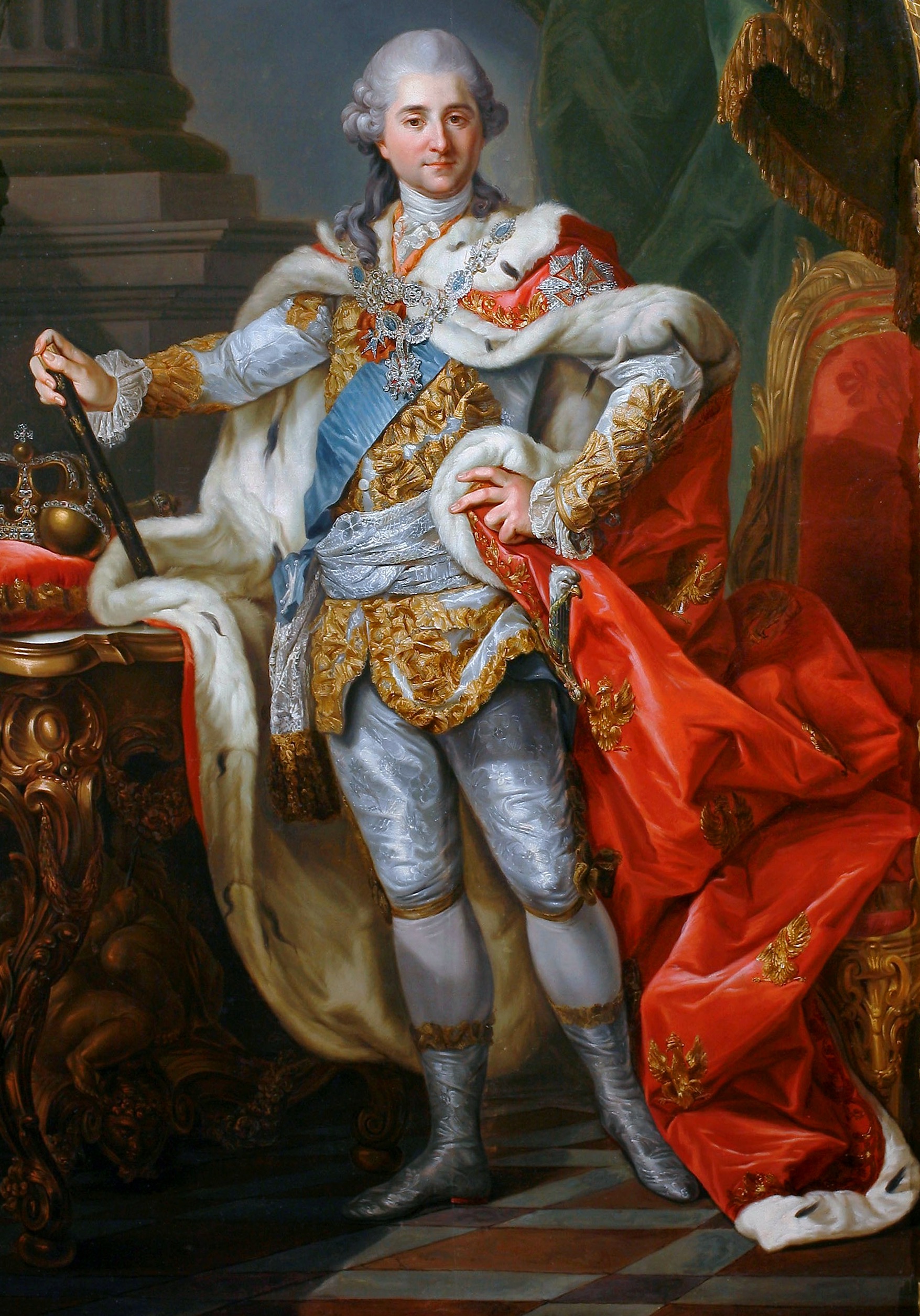
Portrait of Stanisław Poniatowski
The King Who Was Too Gentle to Reign
Stanisław August Poniatowski arrived in St. Petersburg as a young Polish nobleman—a reader of French philosophy, a connoisseur of painting, a conversationalist who could make a grand duchess feel she was the only mind in the room. That grand duchess was the future Catherine the Great, and she fell for him with a completeness she would never quite repeat. In 1764, now an empress, she reached across the border and made her former lover a king.
She expected a puppet. She got something more poignant: a man of genuine conviction without the will to enforce it. Poniatowski built the Polish national theater, founded the Knights' School, blessed the May 3, 1791 Constitution—and presided, helplessly, over the dismemberment and total erasure of his nation from the map of Europe.
The type that explains this beautiful failure is the INFP: dominant Fi holding an unshakable private vision, auxiliary Ne generating ideas for how to reach it, tertiary Si anchoring him to the comforts of his past, and inferior Te leaving him fatally unable to command when the survival of everything he loved required it.
Poniatowski was the INFP on a throne—a man of impeccable values and exquisite taste who could imagine the better country he wished to build but could never summon the ruthlessness to fight for it.
The Private Vision of the Good
Fi — dominant
Dominant Fi does not argue; it simply knows what is worthy and what is base. Poniatowski's reign was an expression of a private moral vision held with absolute sincerity and almost no capacity to impose on others. He genuinely believed Poland could be made better—more rational, more cultured, more just—and he pursued that belief with the devotion of a man tending a private garden, regardless of the political weather.
A ruthless monarch would have spent his capital buying off magnates or raising an army. Poniatowski spent it on a theater, a school, a porcelain manufactory, and his Thursday Dinners—intimate gatherings of writers and artists. These were the priorities of a man following an inner sense of what made a nation noble. Dominant Fi also does not release old attachments easily: for years he could not see the empress who had once loved him as the predator she had become, half-believing she might relent—a loyalty that hopelessly compromised his judgment of the most dangerous person in his world.
The Patron of Possibilities
Ne — auxiliary
Auxiliary Ne gave Poniatowski his most productive quality: a generative imagination for what might be. He was a patron in the most literal sense—a man whose gift was recognizing possibility and creating conditions for it to flower. He imported artists and ideas from across Europe, founded the first Polish arts newspaper, and turned his court into a laboratory of cultural experiment. The May 3, 1791 Constitution was the same impulse writ large: a near-utopian redesign of the Polish state, replacing noble-republic anarchy with a modern constitutional monarchy. But Ne is an exploratory function, not an executive one. Poniatowski could conceive a regenerated Poland in dazzling detail. What he could never do was impose it against men with cannons.
The Comforts He Could Not Renounce
Si — tertiary
Tertiary Si gave Poniatowski his attachment to familiar comfort—and it became a subtle trap. For a man whose formative happiness had been the cultivated salons of Paris and St. Petersburg, Si meant a lifelong fondness for the beautiful and the gracious. A leader who wants his world pleasant is poorly equipped for an age that demands he make it grim and resolute. His relationship with Elżbieta Szydłowska, his longtime companion and likely morganatic wife, endured because it offered the steady, familiar intimacy his Si craved. The same function that made him a faithful friend made him reluctant to break with people he ought to have broken with. He kept building, kept hosting his dinners, as if the cultivated life he had assembled were insulation. It was not.
The Will That Would Not Come
Te — inferior
Inferior Te is the wound at the center of Poniatowski's life. Kingship is, above all else, an exercise of Te—issuing commands, marshaling force, imposing will on a recalcitrant reality. This was the one thing Poniatowski could not do.
When Catherine and her generals—men like Grigory Potemkin, who understood power as Poniatowski never could—moved to carve up his country, he protested, wept, and wrote letters. The First Partition in 1772, the Second in 1793, the obliteration of 1795: at each stage he denounced the injustice and signed what he was told to sign. The May 3 Constitution collapsed within a year because he could not fight the Russian-backed confederates to the end. He abdicated in 1795 and spent his last years in St. Petersburg as a pensioner of the very court that had destroyed his kingdom—possessed of every quality except the cold, organizing will his position actually required.
Why INFP Over ENFP
Why not ENFP?
Poniatowski was warm, cultivated, and charming—qualities that can look like the ENFP from the outside. But the ENFP leads with extraverted intuition, an outward force that pulls others into motion. Poniatowski's imagination was always subordinated to a deep, inward moral core. When the world turned hostile, he retreated inward, into letters and dinners—the dominant-Fi signature, not the dominant-Ne one. His catastrophic weakness was Te—command, force, decisive coercive action—the INFP's blind spot, not the ENFP's.
Connected Figures
Further Reading
- The Partitions of Poland, 1772, 1793, 1795 — Jerzy LukowskiThe clearest scholarly account of the political forces that erased Poland — essential context for Poniatowski's reign.
- Catherine the Great: Portrait of a Woman — Robert K. MassieThe definitive modern biography of Catherine; covers her affair with Poniatowski and her role in his election and Poland's destruction.
- The Last King of Poland — Adam ZamoyskiThe principal English-language biography of Poniatowski himself — sympathetic, richly detailed, indispensable.
- Poland: A History — Adam ZamoyskiBroader national history that places the Poniatowski era and the partitions within the long arc of Polish statehood.
