 Historical Figure MBTI
#331 · 3-29-26 · The Enlightenment
Thérèse Levasseur
Rousseau's Companion and Wife · Mother of His Children · The Faithful Constant
1721 — 1801
6 min read
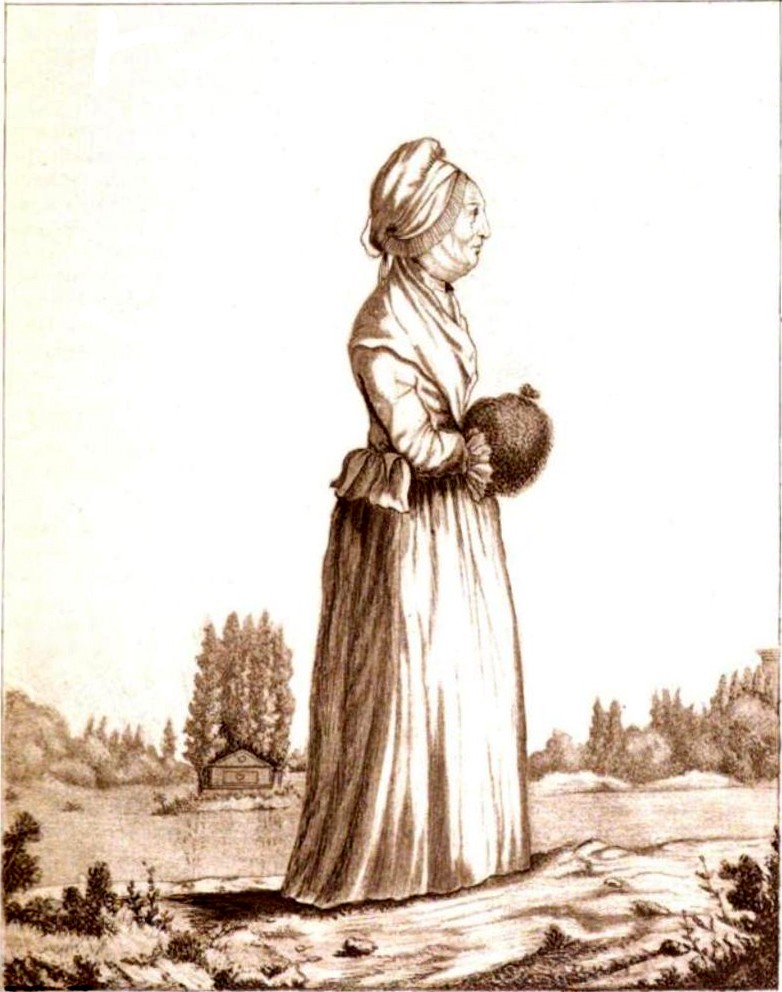
Portrait of Thérèse Levasseur
The Woman Who Outlasted Every Friend
She was a laundry-maid who could barely read, and when the Paris philosophes described her they reached for words like coarse, dull, stupid—a millstone around a great man's neck. Diderot said so to Rousseau's face for decades. And yet when every one of those friends had quarreled with Rousseau and been cast out—and he quarreled with all of them—Thérèse Levasseur was still there. She met him in 1745 at the Paris lodging-house where she worked; she stayed thirty-three years, through exile and a paranoia that curdled at the end into something close to madness; and she closed his eyes when he died in 1778. The cleverest woman in France could not have done it. She did it because she was constant.
She left no letters, no memoir. We know her almost entirely through Rousseau's idealization and his friends' contempt. They had five children, every one of whom he carried to the Paris foundling hospital; he married her at last in a plain ceremony in 1768, after twenty-three years together. To take her seriously is to notice what kind of strength it takes to anchor a man like Rousseau—restless, suspicious, incapable of compromise. That is not the profile of a fool. It is the profile of the ISFJ, whose gift is not brilliance but the patient, daily work of keeping another human being alive.
Thérèse Levasseur was the ISFJ in its quietest form—dominant introverted sensing that made a home of constancy, paired with an auxiliary extraverted feeling that gave thirty-three years of devoted care to the most unlivable-with heart of the age. What his clever friends mistook for stupidity was simply a different kind of intelligence: the kind that stays.
The Constancy of the Daily Round
Si — dominant
Dominant introverted sensing is the faculty of the steady and the reliably repeated. Trained as a linen-maid and seamstress, Thérèse extended that competence over Rousseau when she joined his life. Through every flight and exile—Montmorency, Geneva, Neuchâtel, England—she provided the ordinary domestic order that let a man who could manage nothing practical go on living.
The famous story of the clock is usually told to show how stupid she was: Rousseau tried for years to teach her to read a clock face and name the months in order, never succeeding. But Si knows the day directly—by light, by hunger, by the bread that needs baking and the hour her companion likes his meal. She lived inside the concrete reality the abstraction only points at. That is not the absence of intelligence; it is intelligence of a wholly embodied kind, the kind that never once let the household fail while the philosophers were busy admiring their own clocks. He was the storm; she was the house that did not move.
The Care of a Difficult, Suffering Man
Fe — auxiliary
Auxiliary extraverted feeling in the ISFJ is quieter and more particular than the broad sociability of an Fe-dominant—focused on the concrete needs of the few actually in one's care. Thérèse gave that attention to a man almost impossible to live with: suspicious, self-absorbed, convinced in his last years that all of Europe conspired against him. She nursed him through illness real and imagined, absorbed his moods, stayed when every friend who could not absorb them had departed.
The philosophes treated her as an embarrassment. James Boswell, who escorted her to Rousseau in England in 1766, is said to have seduced her on the journey—a story repeated to her discredit ever after and never to his. She made no defense, because Fe of this kind does not defend itself; it goes on tending. Five times she bore a child, five times Rousseau carried the infant to the foundling hospital. Of her grief we have almost nothing. She stayed with the man who made those choices—not from weakness, more likely, but because it was the only form love took in a life that had given her very little room.
The Plain Practical Sense Beneath the Plainness
Ti — tertiary
Tertiary introverted thinking in the ISFJ is a quiet capacity to size things up and hold to a plain judgment—unrecorded in Thérèse because no one expected a seamstress to have opinions worth setting down. But the faculty was there. She ran a household on next to nothing for decades, managed a sponging mother and siblings, navigated the practical chaos of a man who could not keep an appointment. The ISFJ's Ti works below the waterline: in shrewd, unspoken assessments of people, in knowing whom to trust. A woman who kept Rousseau ordered for thirty-three years was not without judgment—only without eloquence.
The Abstractions She Was Never at Home In
Ne — inferior
Inferior extraverted intuition is the ISFJ's blind side—the realm of the abstract and the symbolic. The clock and calendar are inferior-Ne stumbling blocks: arbitrary grids opaque to a mind that knew the year as a felt succession of seasons and tasks. To Rousseau and his friends, who lived in ideas, this looked like stupidity. Rousseau was a man of soaring intuition, forever spinning feeling into politics, education, and the dream of a restored humanity. Thérèse was his exact complement: rooted in the actual, unable to follow him into the airy country where his mind lived, and not needing to. Between the two of them they made, almost, one whole functioning life—which may be the truest reason he could never leave her.
Why ISFJ Over ESFJ
Why not ESFJ?
The ESFJ shares Si and Fe but leads with extraverted feeling, which points outward: organizing the social fabric, bringing warmth into a room and arranging it. Thérèse did the opposite. Her devotion was private, domestic, and self-effacing. She left no circle of friends, no managed household of dependents, no trace of the ESFJ's sociable reach. She tended one man, in the background, almost invisibly—dominant Si serving auxiliary Fe, the introvert's ordering of those same two functions.
We have no evidence of Thérèse as a presence in society—no salon, no correspondence, no network she sustained. An ESFJ leaves a wider social wake; she leaves almost none. The ISFJ is the type of the one who simply stays.
Connected Figures
Further Reading
- Jean-Jacques Rousseau: Restless Genius — Leo DamroschThe most readable modern life of Rousseau, giving Thérèse fuller treatment than most earlier biographies and taking her constancy seriously.
- Rousseau: A Free Spirit — Maurice CranstonA three-volume scholarly biography; the first two volumes cover in detail the years Thérèse and Rousseau spent together before his death.
- The Confessions — Jean-Jacques RousseauRousseau's own memoir is the primary source for Thérèse's daily life with him — invaluable and inevitably partial, since she could not write her own account.
- Rousseau and the Republic of Virtue — Carol BlumExamines the moral and political philosophy Rousseau preached against the private life he lived — the tension Thérèse inhabited daily without any say in his public arguments.
