 Historical Figure MBTI
#332 · 3-30-26 · Frederician Prussia
Frederick the Great
King of Prussia · Military Genius · Philosopher-King of Sanssouci
1712 — 1786
8 min read
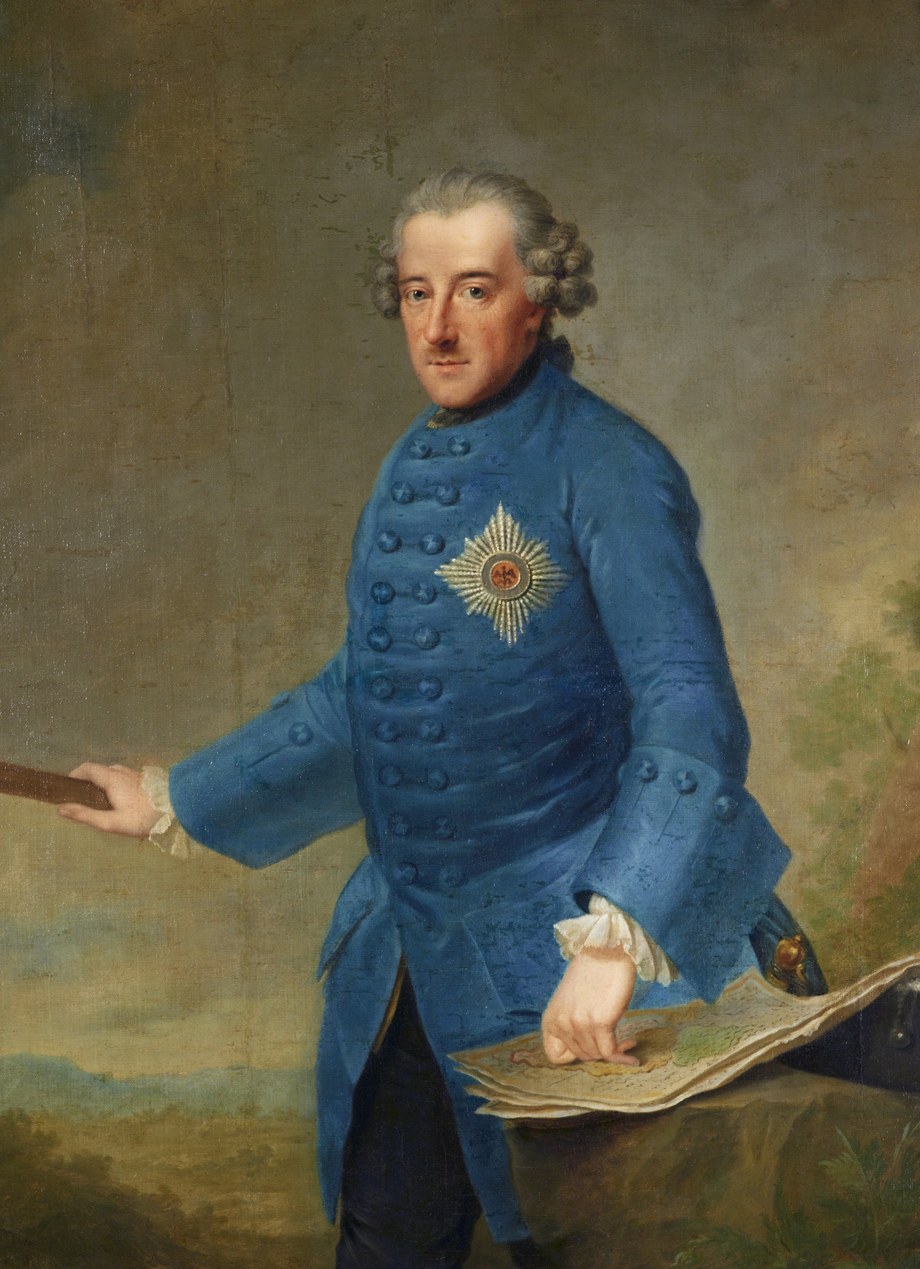
Portrait of Frederick the Great
The Boy His Father Broke, and the King Who Never Forgave the World
When he was eighteen, Crown Prince Frederick tried to run away. His father, Frederick William I—the “Soldier King,” who beat his son in public and called him an effeminate fop—had become unendurable. In 1730 the boy plotted an escape to England with his closest friend, Hans Hermann von Katte. The plot was discovered. Frederick William chose a precise punishment: he had Katte beheaded in the fortress courtyard at Küstrin and forced the prince to watch. Frederick fainted before the sword fell. He emerged sealed shut—outwardly the dutiful heir, inwardly a man who had learned that the world takes what you love and that safety lies in a will no one can read.
Thirty years on, the same man sat alone at Sanssouci—the small rococo pavilion he had named, in French, “without care.” He had become the most feared soldier in Europe, had ripped Silesia from the Habsburgs within months of his accession, and had fought Austria, France, and Russia to a standstill across seven years of war that nearly destroyed him. He wanted none of the company his rank demanded. He shunned the court, ignored the wife he had never lived with, kept no mistress, and gave his real tenderness to his Italian greyhounds, beside whom he asked to be buried.
That mind—holding a strategic vision steady through catastrophe, imposing it by cold will, retreating into armored solitude—is the INTJ in its starkest royal form. Frederick saw where Prussia had to go decades before anyone else, executed the plan with a discipline that spared neither his subjects nor himself, and protected a wounded private self behind a sarcasm cold enough to keep all comers at arm's length.
Frederick was the INTJ crowned and armored—a dominant introverted intuition that fixed on a single long vision for Prussia and never wavered, fused to an auxiliary extraverted thinking that imposed that vision on an army and a state with relentless, joyless will.
The Vision That Outran the Map
Ni — dominant
When Frederick came to the throne in 1740, Prussia was a scattered second-rank kingdom, rich in disciplined soldiers and poor in almost everything else. He saw, with a clarity no one around him shared, that it had to become a great power or be devoured. While Europe expected the flute-playing philosopher-prince to be a man of peace, he marched into Silesia and seized the richest province of the Habsburg crown. The gamble was not impulsive—it was the first executed move of a picture he had already drawn in his mind.
Ni is most visible when the world turns against it and it does not flinch. The Seven Years' War (1756–1763) combined Austria, France, and Russia against him—a coalition that should have erased Prussia from the map. He fought on interior lines against overwhelming numbers, won masterpieces of maneuver at Rossbach and Leuthen, lost catastrophically at Kunersdorf, and carried poison through the worst nights rather than abandon the long vision. He was saved by a single contingency: the death of Empress Elizabeth in 1762 and the withdrawal of Peter III— the “Miracle of the House of Brandenburg.” He did not improvise Prussia into a great power. He intuited it whole, decades early, and spent his life making the world catch up.
The First Servant of the State
Te — auxiliary
Frederick called himself le premier serviteur de l'État, the first servant of the state, and he meant it as a job description. He rose before dawn, annotated reports from every corner of his administration, reformed the bureaucracy, codified the law into the Allgemeines Landrecht, abolished judicial torture in his first year, and built an army whose drill became the model Europe scrambled to copy. Te governance: not charm, but the relentless construction of structures that run.
On the battlefield the same function shows as iron operational will. His victories were not bursts of inspiration but products of obsessive preparation. The oblique order at Leuthen— where he concentrated his outnumbered army against one wing of a vastly larger Austrian line—was a maneuver drilled until his troops could execute it like a single mechanism. His enlightened reforms ran on the same engine. “Every man must get to heaven in his own way” was as much a Te calculation as a humane conviction: a tolerant state attracted skilled immigrants and ran more smoothly. He needed the orders carried out, not the admiration of the men carrying them.
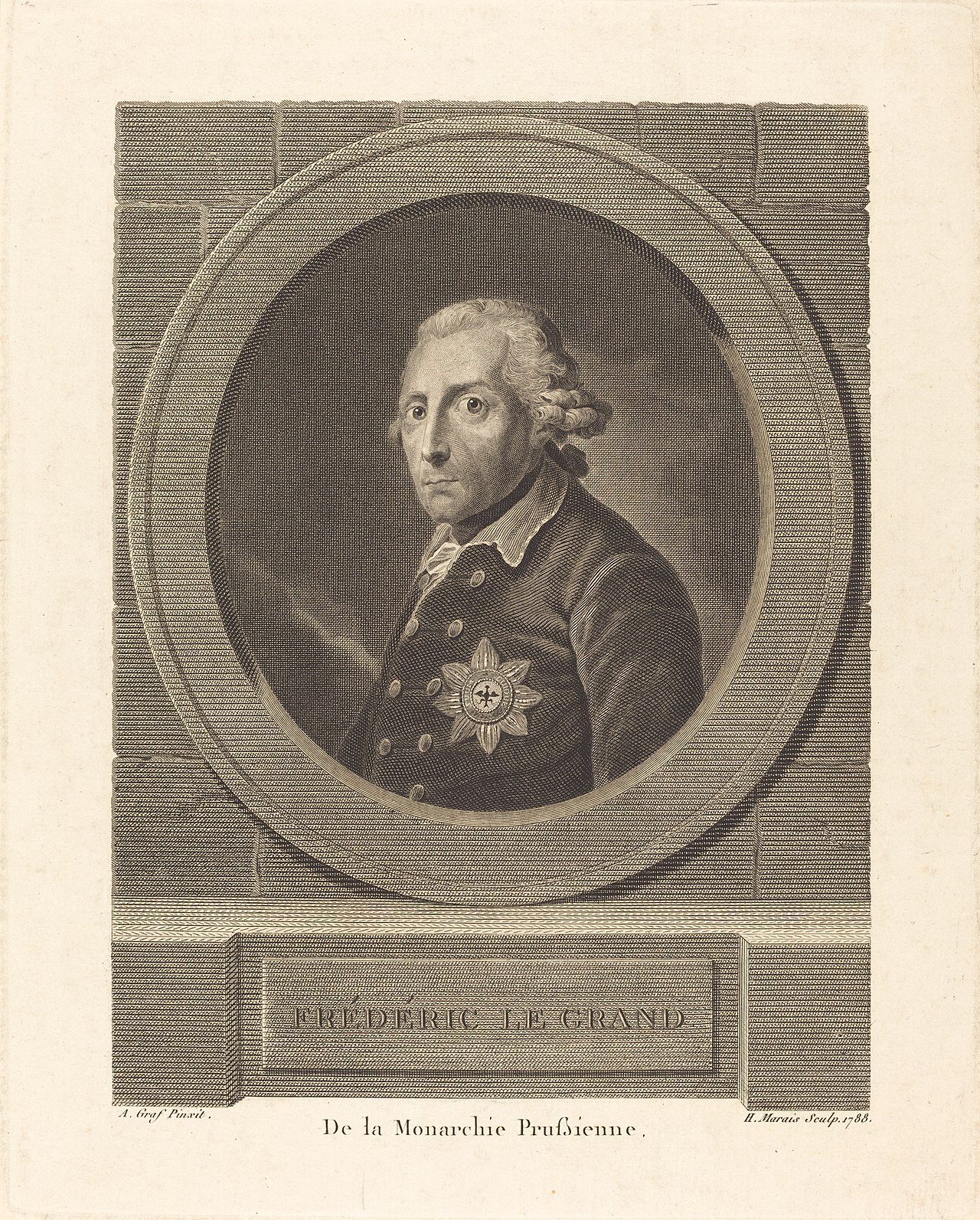
The Flute, the Dogs, and the Wound Beneath the Armor
Fi — tertiary
Contemporaries took Frederick for a man of pure ice. The ice was a wall, not the whole. Behind it lived a serious musician who composed sonatas and played the transverse flute with genuine artistry, a reader who corresponded with the leading minds of Europe in French because he found his native German coarse, and a writer who produced the idealistic Anti-Machiavel—a young prince's repudiation of cynical statecraft that the king would spend his reign quietly contradicting. Showing what he loved meant exposing it to destruction; Küstrin had taught him that.
The clearest window onto his Fi is the company he chose when no obligation compelled him: his Italian greyhounds. He let them sleep in his bed, grieved their deaths genuinely, called them the only honest creatures he knew, and asked to be buried among them at Sanssouci. Fi also shows as a private, self-authored code obeyed more rigorously than any external rule. His austerity and contempt for hypocrisy were not borrowed from church or class—he was a religious skeptic who despised much of his nobility. He worked himself to exhaustion not for glory but because his interior standard of what a king owed his state would not let him rest.
Mastered on the Field, Never Enjoyed
Se — inferior
Frederick lived with an ascetic plainness astonishing in a king—a soldier's coat worn until threadbare, spartan rooms, indifference to luxury and bodily comfort. He built Sanssouci as a refuge for the mind, not a pleasure-house for the senses. Yet in one arena he mastered Se completely: war. The battlefield demands exactly what inferior sensing usually denies the INTJ—reading terrain in real time, seizing the fleeting tactical moment, commanding under fire. Frederick supplied all of it. He exposed himself recklessly in battle, had horses shot from under him, and pressed his army into maneuvers of split-second precision.
But mastery is not enjoyment, and Frederick never enjoyed it. He fought superbly and called war a horror; he conquered and felt no joy; he could command the physical moment with genius and then return to his austere rooms wanting only quiet. His Se was an instrument he wielded with deadly skill when duty demanded it, and a region of life he otherwise refused to inhabit.
Why INTJ Over ENTJ
Why not ENTJ?
The iron executive will tempts an ENTJ reading—the cleanest rebuttal is to set Frederick beside the cluster's actual ENTJ, Catherine the Great. Catherine led with dominant Te turned outward: gregarious, charming, ruling through people and performance, gathering favorites and needing the room to govern. Frederick was her opposite at every point—withdrawn, austere, solitary, contemptuous of the company his crown forced on him. He fled the court to Sanssouci with his books and his greyhounds, shunning even his wife. His power flowed from an inner Ni certainty imposed by cold will, not from outward mastery of a crowd. The ENTJ commands the room; Frederick escaped it.
Both were enlightened autocrats who corresponded with the same philosophes; both subordinated their ideals to power. But Catherine ruled because she loved to rule. Frederick ruled because his inner certainty would permit nothing less and his sense of duty would not let him stop. The empress needed the world to see her. The king wanted only to be left alone with the future he had already seen.
Connected Figures
Further Reading
- Frederick the Great: A Life in Deed and Letters — Giles MacDonoghA comprehensive biography drawing on Frederick's own voluminous correspondence and writings.
- Frederick the Great: King of Prussia — David FraserA military and political biography by a soldier-historian, particularly strong on the Seven Years' War campaigns.
- The Enlightened Despots — Geoffrey BruunPlaces Frederick alongside Catherine and Joseph II — essential for understanding the reforming-monarch tradition he exemplified.
- Frederick the Great on the Art of War — Jay Luvaas (ed. and trans.)Frederick's own military writings, including his Instructions to His Generals and tactical essays.
- Anti-Machiavel — Frederick the Great (ed. Voltaire)Frederick's own youthful political treatise — the idealistic manifesto he spent his reign quietly contradicting.
