 Historical Figure MBTI
#333 · 3-30-26 · Frederician Prussia
Wilhelmine of Bayreuth
Margravine of Bayreuth · Composer and Memoirist · Frederick's Beloved Sister
1709 — 1758
6 min read
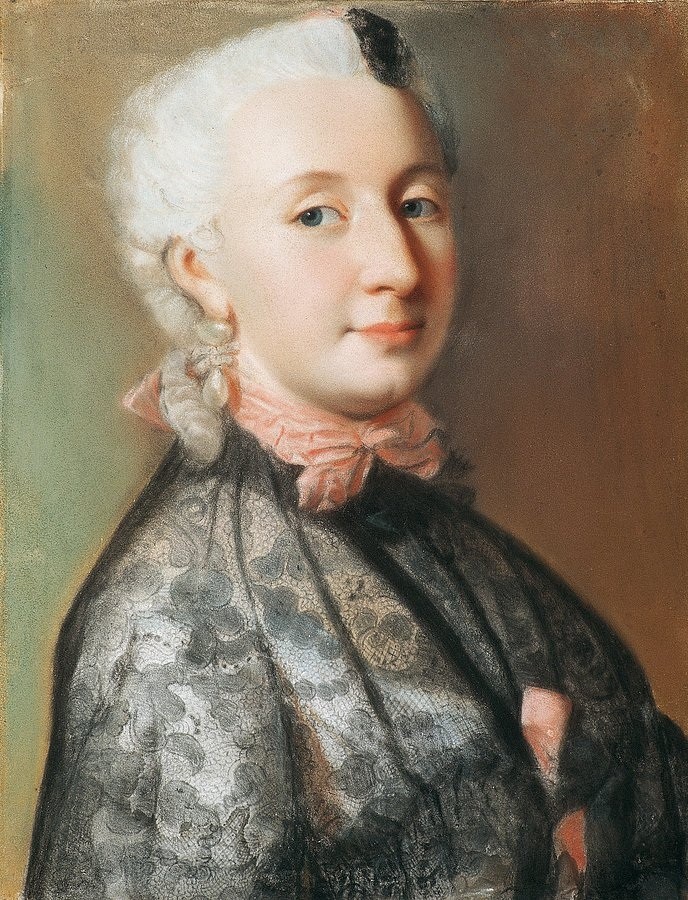
Portrait of Wilhelmine of Bayreuth
The Two Children Who Survived Their Father
Their father was Frederick William I of Prussia, the “Soldier King”—a raging disciplinarian who dragged his daughter by the hair, beat his son before the court, and regarded French books and music as effeminate weakness to be flogged out of his heirs. The girl, Wilhelmine, born in 1709, was the eldest; the boy, three years younger, was the future Frederick the Great. In that court of fear they clung to each other—hiding the forbidden flute, whispering over smuggled verse—and formed the deepest bond either would ever know.
The same furnace produced two opposite metals. Frederick came out sealed shut—an INTJ who buried his feeling so deep that Europe took him for ice. Wilhelmine came out the other way: sensitive, melancholic, her hurt tended rather than walled off. After an English match fell through in court intrigue, she was married off to the minor Margrave of Bayreuth and did what her temperament demanded: poured her whole interior into making it a jewel—composing an opera, building a ravishing theater, founding a university, writing the Mémoires.
Wilhelmine was the INFP raised in a house of terror—a dominant introverted feeling that guarded a private, brooding self no one was permitted to wound twice, fused to an auxiliary extraverted intuition that turned that inner depth into music, palaces, gardens, and one unforgettable book.
The Self She Would Not Surrender
Fi — dominant
Dominant Fi is not warmth on display—it is a fiercely private inner life organized around felt personal truth that the world is rarely allowed to see. Wilhelmine's sensitivity was so acute that her father's cruelty left lifelong marks, yet beneath all her outward submission the inner verdict stayed hers. She bowed when she had to, but she never let anyone tell her what she felt or who she was.
Nowhere is that Fi clearer than in the Mémoires—not a chronicle but a reckoning. She settles scores, mourns betrayals, ridicules the grotesques of her father's court: truth filtered through a self that refuses to pretend its own feeling does not count as evidence. Wilhelmine wrote not to record what happened but to record what it was like to be her.
A Whole Court Conjured Out of an Inner World
Ne — auxiliary
Auxiliary Ne is how the INFP's private feeling reaches the world—not through one medium but through many. Handed an impoverished margraviate, Wilhelmine treated it as raw material: composing the opera Argenore, building the Margravial Opera House (now a UNESCO World Heritage Site), founding the university at Erlangen, and designing the Eremitage with its grottoes and follies.
The contrast with Frederick is instructive. His Ni converged: one fixed vision of Prussian greatness, imposed by cold will. Her Ne diverged—an opera here, a garden there, a memoir, a theater, a university. Where his intuition narrowed the future to one line and marched down it, hers kept opening doors. The childhood that taught him to aim taught her to dream, and to build the dream wherever she was allowed to stand.
The Past She Carried, the Brother She Kept
Si — tertiary
Tertiary Si shows up as a powerful relationship to memory—rooting the self in a remembered past. Wilhelmine's whole emotional life is anchored backward. Her devotion to Frederick is, at bottom, devotion to their shared childhood—the private Eden of music and mutual rescue against their father that she never stopped living inside.
The Mémoires are themselves a Si act: an ailing woman returning in sensory detail to the scenes that formed her, as if rendering them precisely could finally master them. Because Si sits tertiary, it serves Fi—loyalty and nostalgia in the service of felt inner truth. Wilhelmine was an innovator, but the ground she stood on was always the remembered past.
At the Mercy of Other People's Politics
Te — inferior
Inferior Te is the INFP's weakest country: external systems, leverage, impersonal power. Wilhelmine's life is largely the story of having none of it. Her fate was decided by other people's calculations—her father's tyranny, the collapsed English marriage, the dynastic logic that disposed of her into Bayreuth. She could see the chessboard clearly and move no piece on it.
Frederick ran Prussia as a machine and imposed his will on Europe by force; his stack put executive thinking near the top, hers buried it at the bottom. Inferior Te leaked as strain—chronic ill health, deepening melancholy. She had every gift but the cold will to seize power. That she made Bayreuth luminous anyway, out of feeling alone, measures how much she did with how little leverage she was ever given.
Why INFP Over ENFP
Why not ENFP?
Her creative range tempts an ENFP reading, since both types share auxiliary Ne. But the ENFP leads with intuition turned outward: gregarious, exuberant, energized by people. Wilhelmine was the opposite—inward, melancholic, easily wounded, her creativity flowing from a private, brooding depth rather than outward sparkle. The ENFP charms a room and spills into it; Wilhelmine withdrew into a guarded inner world and sent her art out from there.
The tell is the emotional weather. An ENFP's creativity reads as joy; Wilhelmine's reads as longing. Her art was the compensation of a sensitive introvert building beauty against disappointment. The Mémoires settle the matter: bitter, proud, inward-facing. The ENFP performs outward; the INFP guards a hidden truth and lets only her art carry it across the wall.
Connected Figures
Further Reading
- Frederick the Great: King of Prussia — Tim BlanningThe authoritative modern biography of Frederick; treats Wilhelmine as a central figure and the siblings' bond as formative to Frederick's character.
- Mémoires de Wilhelmine, Margrave de Bareith — Wilhelmine of BayreuthHer own account of life in Frederick William I's court — one of the most candid royal memoirs of the eighteenth century, available in French and German editions.
- The Enlightened Despots — Geoffrey BruunA concise study of the enlightened monarchs of eighteenth-century Europe, placing Frederick's Prussia — and by extension Wilhelmine's Bayreuth — in its broader context.
