 Historical Figure MBTI
#317 · 3-27-26 · The Enlightenment
Jean d'Alembert
Mathematician · Co-Editor of the Encyclopédie · Philosophe
1717 — 1783
5 min read
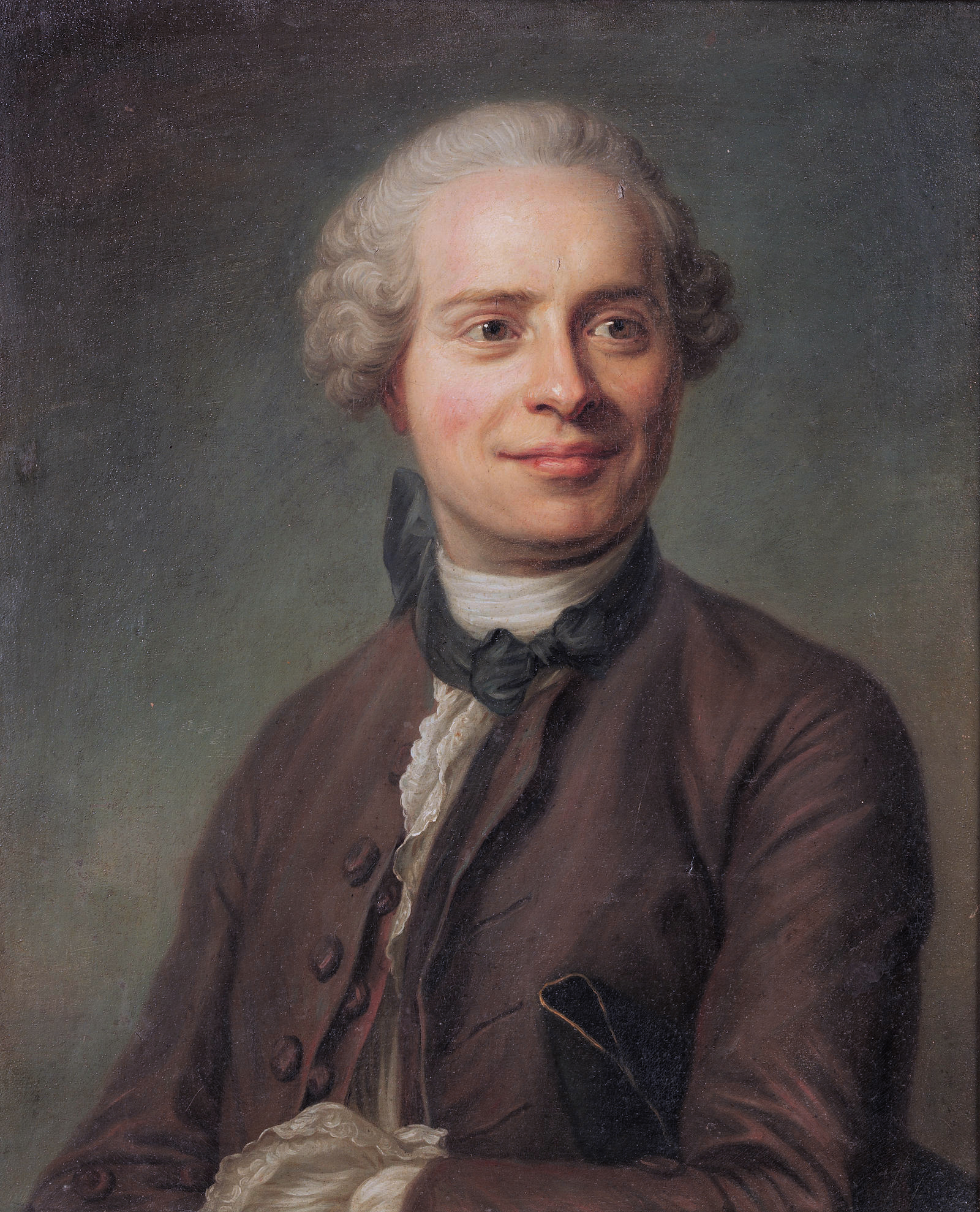
Portrait of Jean d'Alembert
The Foundling Who Mapped Knowledge
He was left on the steps of a Paris church in November 1717 and took his first name from the building that sheltered him. His mother, the salon hostess Claudine de Tencin, never acknowledged him. He was raised by a glazier's wife in a cramped artisan's house — and stayed there, by choice, for nearly half a century after he had become one of the most famous minds in Europe.
His Traité de dynamique (1743) gave mechanics the law that still bears his name; his 1747 paper on the vibrating string produced the wave equation. Then, with Denis Diderot, he wrote the Encyclopédie's Preliminary Discourse — an essay that charted the entire structure of human knowledge by showing how every science branched from a few root operations of the reasoning mind.
That is the INTP signature — dominant Ti reducing a vibrating string and the whole tree of knowledge to clean axioms, with Ne ranging restlessly across every field to find the connections no specialist could see.
Reducing the World to Its Skeleton
d'Alembert's principle is Ti compression in its cleanest form: he showed that if you treat a body's resistance to acceleration as just another force, every problem of motion collapses into a problem of equilibrium — dynamics becomes statics. Not more data, but the single reframing that makes a whole class of problems trivial. The same drive made him uneasy with the loose foundations of the calculus he used so fluently. Infinitesimals offended his logic, and he was among the first to insist the calculus rest on the rigorous idea of a limit. The tools came a century later — but the demand was his.
The Preliminary Discourse is Ti turned on knowledge itself: rather than list the sciences, d'Alembert tried to derive them — to show that the entire encyclopedia was one logically connected tree, not a heap of articles. Not to know more things, but to know why the things hang together.
Told that students balked at the shaky logic of the infinitesimal, he is supposed to have said: “Go forward, and faith will come to you.” He trusted that a rigorous foundation existed before he could build it — the Ti conviction that the logic is there to be found.
The Web of Everything
d'Alembert was never a specialist. He wrote on dynamics and the calculus, but also on music theory, the philosophy of probability, grammar, and — late in life — literary eulogies for half the dead men of the French academies. The Encyclopédieitself is Ne made into architecture: knowledge as a single connected web, every article cross-referenced so a reader could watch one field bleed into the next. He drew the famous “figurative system” branching all human understanding from three faculties — exactly the move of a mind that sees fields as connected rather than walled.
In the salons he was famous for wit and mimicry — the man who reduced motion to equilibrium in private was, in company, the lightest and most mischievous mind at the table. The difference between him and Diderot was that Diderot wanted to keep opening doors, and d'Alembert eventually wanted to close some.
Loyal to the Small Known World
The abandoned child who was raised by a glazier's wife went on living in her humble house long after the courts of Europe were competing for him. When his biological mother tried to claim him, he is said to have replied that she was only his stepmother; the glazier's wife was his real mother. Frederick the Great offered him the presidency of the Berlin Academy. Catherine the Great — who drew Diderot and Grimm into her orbit — offered him a fortune to tutor the Russian heir. He turned both down, preferring his modest pension, his Paris, his settled routine.
The instinct had a darker side. When his article on Geneva ignited a scandal, d'Alembert did not fight — in 1758 he simply withdrew from the editorship and left Diderot to carry the burden alone. Where Diderot pressed into danger, d'Alembert pulled back toward the known and secure. It was prudent. It was also, his friends felt, a kind of desertion.
The One Equation He Could Not Solve
Julie de Lespinasse was the living soul of the salon he frequented — quick, warm, magnetic — and he loved her with a devotion that lasted the rest of his life, organizing his existence around hers, certain he was her closest companion. He read the situation the way an inferior function always reads its domain: through an idealized picture rather than the messy data of what other people actually feel.
After her death in 1776 he discovered, among her papers, letters revealing she had spent those years consumed by passionate secret love affairs with other men — he had been the confidant, never the beloved. The man who could see the hidden structure of a vibrating string had completely misread the one relationship that mattered most to him. Fe sits at the bottom of the INTP stack, and under pressure it produces not coldness but blindness: an enormous need for connection paired with almost no instrument for measuring whether the connection is real.
Why INTP Over ENTP or INTJ
Why not ENTP?
The salon wit tempts an ENTP read — Voltaire genuinely was one. But an ENTP leads with Ne, performing and provoking in public. d'Alembert led with Ti and used Ne in service of it: the dazzle sat on top of a depth-first mind that wanted to close questions, not keep them spinning. When heat rose, the extravert engages; d'Alembert withdrew to his desk.
Why not INTJ?
INTJs run on Ni and Te — a converging vision executed through institution-building. d'Alembert was offered Berlin and St. Petersburg and refused both, preferring open-ended exploration across a dozen fields to executive control of any one. His logic was Ti (internal coherence for its own sake), not Te, and his thought branched outward with Ne rather than narrowing toward a single endpoint.
The tell is what he did with power: he gave it back. An INTJ accumulates leverage to realize a vision; an ENTP turns every room into an audience. d'Alembert wanted neither — only the freedom to reduce hard problems to clean principles, guarding his independence of mind against anything, even a crown, that might cost him it. That is INTP to the core.
Connected Figures
Further Reading
- Jean le Rond d'Alembert: Science and the Enlightenment — Thomas L. HankinsThe standard English-language biography; covers both his mathematical work and his role in the Encyclopédie.
- The Encyclopédie of Diderot and d'Alembert: Selected Articles — John Lough (ed.)Includes d'Alembert's Preliminary Discourse and key articles; essential for understanding what he was actually building.
- The Business of Enlightenment: A Publishing History of the Encyclopédie, 1775–1800 — Robert DarntonPlaces the Encyclopédie in its commercial and political context — the pressures d'Alembert was fleeing when he withdrew.
- Julie de Lespinasse — Benedetta CraveriReconstructs the salon world and d'Alembert's place in it; illuminates the emotional drama of his final decades.
