 Historical Figure MBTI
#318 · 3-27-26 · The Enlightenment
Julie de Lespinasse
Salonnière · Conductor of the Philosophes · The Anguished Heart of the Enlightenment
1732 — 1776
6 min read
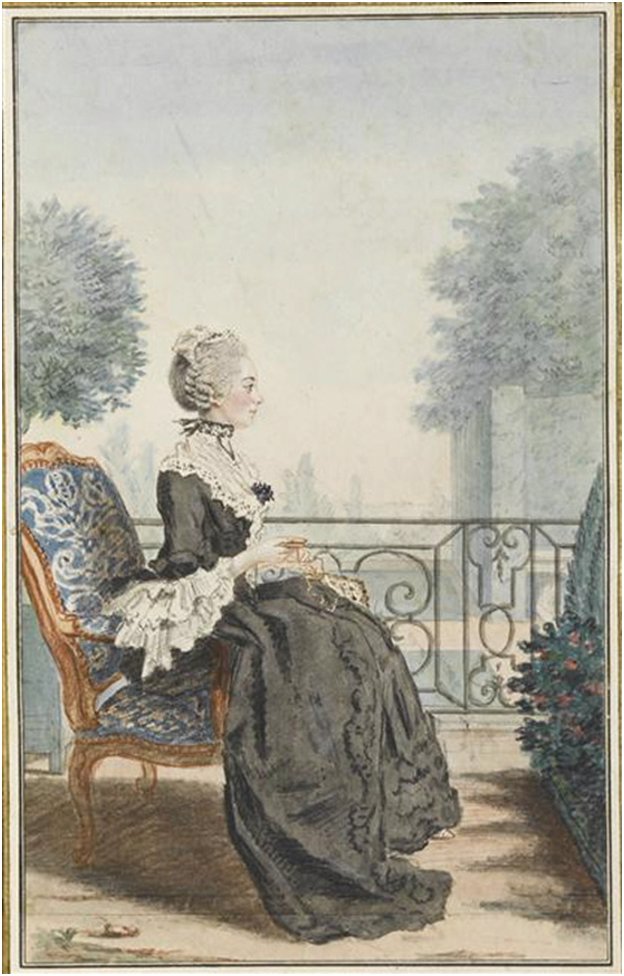
Portrait of Julie de Lespinasse by Carmontelle
The Woman With No Name
She was born with nothing the eighteenth century recognized — no legitimate name, no inheritance, no rank to trade on. The illegitimate daughter of the Comtesse d'Albon, Julie de Lespinasse entered the world in Lyon in 1732 as a problem to be managed. And yet within thirty years she would preside over the most important room in Enlightenment Paris, the salon where the Encyclopédie was effectively run — loved by the philosophes not for its furniture or its dinners, but for what happened when she got people talking.
She wrote no treatise, edited no journal, held no title. Her medium was the living conversation, and her instrument was other people's minds. When she died at forty-four in 1776 — worn down by illness, grief, and opium — she left behind only letters. They turned out to be enough to make her immortal.
That's the ENFP signature: Ne improvising a roomful of minds into a single live current, Fi burning underneath it with a private intensity no one fully saw — brilliance turned outward toward people, devotion turned inward toward a few.
The Conductor They Arrived Early to See
Around 1754, Julie became companion to the blind and formidable Madame du Deffand, whose salon was among the most celebrated in Paris. The arrangement should have kept Julie in the shadows. It did the opposite. The guests — d'Alembert, Turgot, the rising men of the Enlightenment — began arriving an hour before du Deffand received, so they could talk to Julie first. She had no fortune and no standing, but she had the one thing the salon economy actually ran on: she could make a conversation catch fire.
This is Ne as a social art. She did not lecture or perform; she threaded. She heard the unspoken connection between what one man had just said and what another believed, named it, and handed the room a question it could not stop chewing on. People left feeling cleverer than they had arrived — the surest sign of a dominant extraverted intuition that delights less in being right than in setting other minds in motion.
When the inevitable rupture came — du Deffand, jealous of the companion who had eclipsed her, forced a break in 1764 — Julie opened her own salon on the rue Saint-Dominique. It became the unofficial headquarters of the Encyclopédie. Condorcet, Turgot, Marmontel, Chastellux, and d'Alembert himself gathered there daily. She presided not as a hostess but as a conductor, pulling a coherent music out of a dozen restless, competitive intellects.
Her genius was not in any idea she held but in the electric space between ideas — the live current that runs through a room when someone with real Ne is steering it.
The Fire No One Fully Saw
Beneath the public dazzle ran a private intensity that made the salon look like the smaller of her two lives. Her great attachments were the Spanish Marquis de Mora, who died of tuberculosis in 1774, and the Comte de Guibert, a dashing military writer who married elsewhere. She loved both at once and neither halfway.
The letters she wrote to Guibert are her real monument — a masterpiece of what the age called sensibility and what we would simply call feeling pushed to its absolute limit. They are jealous, exalted, self-lacerating, defiant. "From every moment of my life," she wrote, "I have loved you." This is Fi without a mask: emotion held to a fierce inner standard, measured against no one's approval, refusing to soften itself for the comfort of the man receiving it. She gave the salon her wit and kept her anguish for the page.
Running the Encyclopédie's Drawing Room
A salon was not magic; it was logistics. Someone had to keep the schedule, manage the egos, hold the daily gathering together year after year, and keep a household running on a modest pension. Julie did all of it. The tertiary Te shows in the operational competence underneath the sparkle: the salon did not merely happen to her, she built and maintained it.
She did not just enjoy clever talk; she pointed it at the great collaborative project of the century, making her drawing room the place where the Encyclopédie's contributors could actually coordinate. But tertiary Te is a servant, not a master. It could run the room and never run her grief. When her emotional life demanded the cold logic that might have saved her, the function was not strong enough to override the Fi storm. She managed everything except herself.
The Body That Kept the Score
The inferior function is where a type breaks, and Julie broke exactly where an ENFP does — in the body, and in the grip of a past that would not let go. Her final years were a slow physical collapse: insomnia, wasting illness, a growing dependence on opium. Mora's death did not recede; it lodged. She could not metabolize the loss, could not let the present salon or the present love displace it. For a function-stack built to live forward — toward the next possibility, the next mind — being chained to an irretrievable yesterday was a particular kind of torture.
When she died in 1776, d'Alembert — who had lived in her household and loved her with total devotion — discovered only then, sorting her papers, how completely her heart had belonged to other men. The most attuned reader of other people's minds had never seen the one closest to her. It is the cruelest footnote to a life spent in conversation.
Why ENFP Over INFP or ENFJ
Why not INFP?
The letters tempt an INFP read — scorching Fi, idealized loves, self-examination raised to an art. But an INFP leads with the inner fire and treats the social world as something to withdraw from. Julie did the reverse: her primary mode was the room. She came alive conducting other minds. The anguish was real, but it was the auxiliary running hot beneath an extravert, not the core.
Why not ENFJ?
An ENFJ manages the salon's emotional climate the way she managed its conversation — reading the group's mood, smoothing friction, tending harmony. That is Fe, and Julie did not run on it. Her feeling was Fi: fierce, private, indifferent to consensus, at times tactless because it answered only to her own standard. Her letters do not attune to Guibert's comfort; they assert her truth at his expense.
The essential ENFP moves by reaching outward into people and ideas, anchored to a private core it will not compromise. Julie embodied both halves to their extreme. She reached outward more brilliantly than almost anyone of her century, and held her inner fire so absolutely that it consumed her. The gift and the wound were the same function-stack, pointed in opposite directions.
Connected Figures
Further Reading
- Julie de Lespinasse: Genius of the Heart — Carolyn Lougee ChappellThe major English-language study of her life and her place in Enlightenment salon culture.
- Letters of Julie de Lespinasse — Julie de Lespinasse (trans. Katharine Prescott Wormeley)Her correspondence with the Comte de Guibert — the primary source and literary masterpiece on which her reputation rests.
- The Salons of Paris — Alan Charles KorsPlaces her salon in the wider Enlightenment network of philosophes, patrons, and ideas.
- Women and the Public Sphere in the Age of the French Revolution — Joan LandesCrucial context for understanding the structural position — and the limits — of women like Julie who wielded influence through sociability rather than formal authority.
