 Historical Figure MBTI
#316 · 3-27-26 · The Enlightenment
Madame du Châtelet
Mathematician · Physicist · Translator of Newton · Voltaire's Equal
1706 — 1749
6 min read
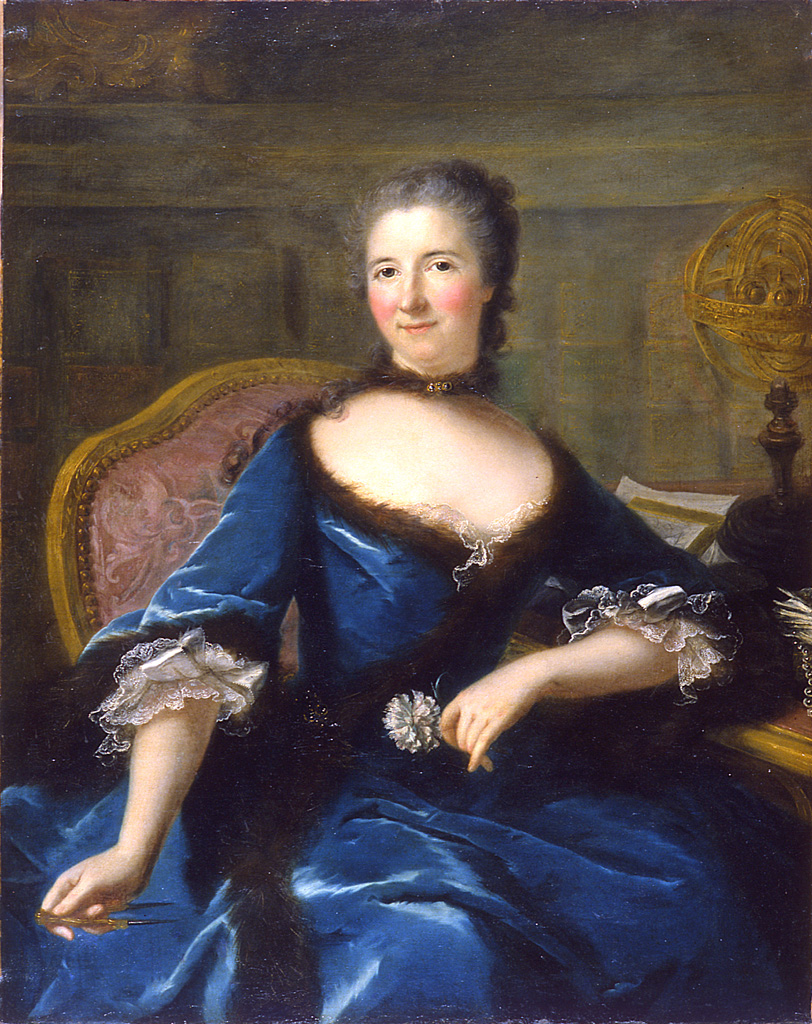
Portrait of Madame du Châtelet
The Woman Who Finished the Race Against Death
In the spring of 1749, a forty-two-year-old woman worked through the nights at Lunéville on a desk piled with mathematics. Heavily pregnant and convinced, with cold accuracy, that she would not survive the birth, she drove herself to finish the one thing that mattered: a complete French translation of Newton's Principia Mathematica, recast from antique geometry into the new calculus. Gabrielle Émilie du Châtelet deposited the manuscript with the royal librarian, gave birth, and died days later. The translation remained the standard French Principia for two and a half centuries. She had been right about the deadline, and right about the work.
For fifteen years she had been Voltaire's lover and intellectual superior in the exact sciences—a partnership played out at Cirey, which they converted into a private research academy. She wrote the Institutions de Physique (1740), fusing Newton's physics with Leibniz's metaphysics; she intervened in the vis viva debate, arguing that a body's force scaled with velocity squared—anticipating kinetic energy by a century; and in 1738 she entered the Academy's prize on the nature of fire, secretly, against Voltaire himself. What organized this life was not the inward mind of the pure theorist but the outward, results-driven intelligence of the ENTJ—a commander who happened to be born into a century that did not know what to do with her.
Madame du Châtelet was the ENTJ in a field that barred her at the door—a Te-driven systematizer who organized people, instruments, and rival frameworks toward a public result, guided by an Ni vision of the single mathematical order beneath the surface of physics.
The Builder Who Wanted to Be Judged
Te — dominant
Dominant Te is not contemplation but output: the manuscript deposited, the system made legible to others. She recast Newton's antique proofs into the analytical calculus and appended a commentary that walked readers through the mathematics—a deliberate engineering of access rather than private appreciation. The same instinct turned Cirey into a functioning institution: instruments procured, experimental program organized, heat-and-light investigations run with a discipline Voltaire cheerfully admitted he lacked. When the Academy announced its 1738 fire prize, she entered secretly, against Voltaire himself, because the point of work was to be submitted and ranked. She wrote that she wished to be “judged for my own merits” and meant it as a demand. Te builds in order to be seen building.
The Order Beneath the Systems
Ni — auxiliary
If Te supplied the drive to publish, Ni supplied the vision of what was worth building. In an age when Newtonians and Leibnizians regarded each other as irreconcilable, she alone set out in the Institutions de Physique to weld them into a single coherent physics—teaching Newton's mathematics on a Leibnizian metaphysical foundation, because she intuited that the rivalry was two angles on one structure.
Her intervention in the vis viva debate shows the same intuition cutting a level deeper. Where the Cartesians measured a body's force by momentum, she argued that the conserved quantity scaled with velocity squared—groping toward kinetic energy a century before it was formalized, guided by a conviction that the true law lay just beneath the surface of the measurements. That is Ni: the felt certainty that the right answer is hiding one level down. She applied it to her own death too: she did not merely fear childbirth; she foresaw it as fixed, reorganized her final months around that certainty, and turned it into a deadline.
The Appetite for the World
Se — tertiary
Tertiary Se gives du Châtelet a character her caricature—the bluestocking buried in equations—entirely misses. She loved fine clothes, high-stakes gambling, and rich food with frank intensity; on one occasion she lost a fortune at cards and, characteristically, retreated not to despair but to mathematics, devising a probabilistic scheme to recover. The Cirey program was correspondingly hands-on: prisms, candles, furnaces, the actual burning of substances, the weighing of heated metals. Her prize essay on fire rested on observation; she was willing to test received opinion against what the apparatus showed. Se grounds the Te-Ni structure in the contact of instrument and matter.
Her loves bore the same stamp: not discreet arrangements but consuming passions— first Voltaire, then the headlong romance with the young poet Saint-Lambert that produced the pregnancy of her final year. She pursued desire with the same directness she brought to a proof, and in the ENTJ, Se is the function that refuses to let the systematic mind float free of the world it is trying to master.
The Private Worth She Demanded
Fi — inferior
Inferior Fi is the buried register of personal value that the dominant Te can neither articulate nor suppress. Du Châtelet's appears most nakedly in the autobiographical fragment opening her translation of Mandeville's Fable of the Bees: a woman denied men's education making a personal case that exclusion, not deficiency, holds women back. The demand to be “judged for my own merits” is at bottom an Fi cry—a defense of the inner self's worth against a world that refused to see it.
Because the function is inferior, it ran hot. The same woman who dissected Newton with serene precision was capable of jealous fury in her love affairs; her letters in the Saint-Lambert affair are possessive and exposed in a way her science never is. Yet the inferior Fi was also the moral engine that gave her Te its direction: the conviction that women possessed equal minds was not reasoned but felt. The translation finished against death, the prize entered in secret, the textbook published under her own name— each was Te machinery in the service of an Fi insistence that she mattered, and would be measured as such.
Why ENTJ Over INTJ
Why not INTJ?
The INTJ and ENTJ share Ni's vision of underlying order and Te's drive to systematize. But the INTJ leads with introverted intuition and prefers to perfect an internal model over competing publicly for recognition. Du Châtelet did the reverse: she entered prize competitions against her own lover, organized Cirey as a functioning institution, and drove herself dying to deposit the Newton translation so it would exist for everyone after her. The INTJ's ambition is to have understood. Hers was to have built, published, won, and been acknowledged. That is the ENTJ's signature.
Connected Figures
Further Reading
- Émilie du Châtelet: The Woman Who Invented Science — David BodanisAccessible biography tracing her scientific career and partnership with Voltaire; strong on the vis viva debate and the Newton translation.
- Passionate Minds: The Great Love Affair of the Enlightenment — David BodanisA parallel narrative of du Châtelet and Voltaire at Cirey, emphasising the intellectual and romantic dynamics of their collaboration.
- Châtelet, Newton, and the Transmission of Mechanics — Judith ZinsserScholarly essay examining how the Institutions de Physique synthesised Newton and Leibniz and what the translation of the Principia achieved technically.
- La Dame d'Esprit: A Biography of the Marquise du Châtelet — Judith ZinsserThe standard full-length scholarly biography; the most thorough account of her life, science, and intellectual network.
