 Historical Figure MBTI
#451 · 4-12-26 · Capetian France
Charles of Anjou
King of Sicily · The Saint's Ruthless Brother
1226 — 1285
8 min read
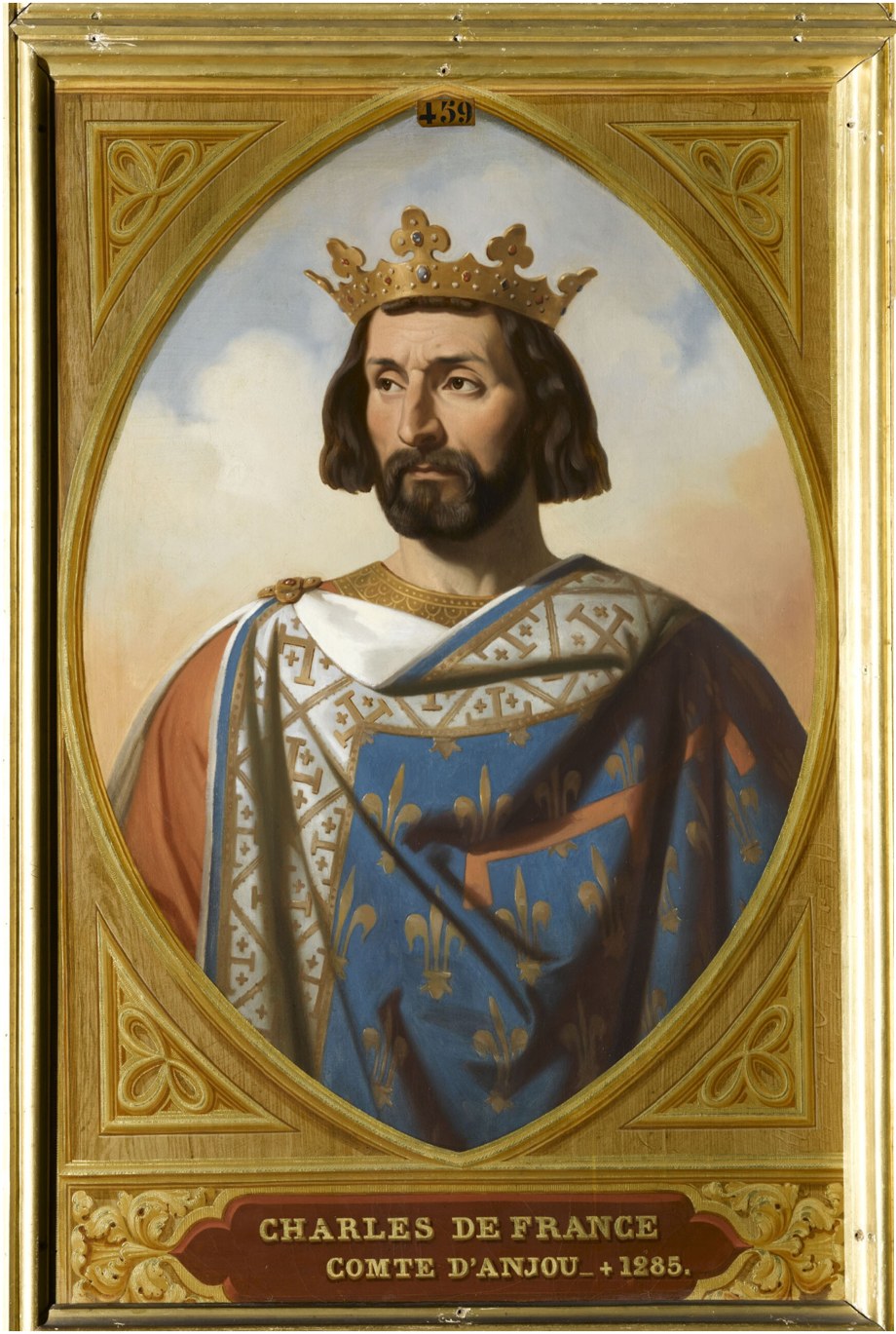
AI-assisted Portrait of Charles of Anjou
The Dark Mirror of the Saint
Every saint needs a shadow, and Louis IX had one in the family. The youngest brother of France's sainted king, Charles of Anjou was carved from the same Capetian stock and trained in the same court—yet where Louis washed the feet of lepers and dispensed justice under an oak tree, Charles counted revenues, raised armies, and reached for crowns. Count of Anjou and Provence by his early twenties, he spent his life assembling something his pious brother never wanted: a personal empire, pieced together across the Mediterranean by conquest, calculation, and a will that never bent.
When the papacy needed a strongman to break the Hohenstaufen grip on southern Italy, it found its instrument in Charles. He took the offer, marched south, and in 1266 destroyed King Manfred—the brilliant bastard son of the Emperor Frederick II—on the field at Benevento. Two years later he captured the boy-prince Conradin, the last legitimate Hohenstaufen heir, and had him beheaded in the marketplace of Naples. The line that had ruled an empire was extinguished by a single stroke of Angevin steel. Charles now held Sicily and Naples, claimed the crown of Jerusalem, eyed Albania and Constantinople, and stood as the most feared prince in Europe—the dynast his canonized brother could never have been.
Charles of Anjou was the ENTJ as conqueror—dominant Te marshalling armies and revenues into a machine of conquest, harnessed to an Ni vision of Angevin dominion stretching from Palermo to the gates of the East. Where his brother sought heaven, Charles built an empire.
The Engine of Conquest
Te — dominant
Dominant Te is the executive faculty—the drive to impose order on the external world through systems, command, and measurable results. In Charles it expressed itself as raw machinery of conquest. He did not merely win a battle and call himself king; he organized a kingdom. He levied taxes with a thoroughness southern Italy had not seen since Frederick II, staffed his administration with French officials he could control, garrisoned fortresses, built fleets, and ran his new realm like a balance sheet. The crown was an instrument; the instrument had to pay.
Benevento (1266) shows the Te commander at work. Manfred's army was larger and held the ground, but Charles read the field, struck at the seam where the enemy cavalry was weakest, and pressed the advantage until Manfred—abandoned and surrounded—rode into the melee to die. Charles then refused the dead king burial in consecrated ground: an excommunicate forfeited the privilege, and Charles was nothing if not literal about the terms of his mandate. Two years later, when the captured Conradin lay at his mercy, the same cold accounting governed the verdict. A living Hohenstaufen heir was a permanent liability on the ledger; Charles eliminated the liability. The public beheading of a teenager shocked even a hard age—but to the Te conqueror it was simply the removal of a future claim.
What made Charles distinct from a mere warlord was that the conquest never stopped at conquest. Each acquisition became the platform for the next administrative consolidation: Provence funded Italy, Italy funded the fleet, the fleet projected power toward Albania and the Byzantine East. He was a builder of governing apparatus, relentless and joyless, the kind of ruler who is admired by his treasury and hated by everyone under it.
The Map of an Empire
Ni — auxiliary
If Te supplied the engine, auxiliary Ni supplied the destination. Charles did not conquer at random. Behind the campaigns lay a single coherent design: a Mediterranean dominion with the Angevins at its center, the crowns of Sicily and Naples as its core, and a horizon that ran east through the old Norman claims toward Constantinople itself. He held himself King of Jerusalem, pressed claims in Albania and Achaea, and negotiated marriages and alliances that pointed, link by link, toward the dismemberment of the restored Byzantine Empire. This was not the opportunism of a soldier taking what the day offered. It was a strategist's long arc.
Ni is the function of convergence—of seeing how disparate pieces serve one eventual end. Charles assembled his empire the way a chess player assembles a position: Provence and Anjou as the base, the papal commission as the pretext, Sicily and Naples as the prize, the Adriatic outposts as the bridge to the East. By 1281 he had the pope's blessing for a grand expedition against Constantinople and a coalition stitched together to support it. The whole edifice of his power was bent toward that one design, decades in the building.
And it is precisely the rigidity of the Ni vision that explains his fall. So fixed was Charles on the eastern prize that he treated Sicily—the foundation stone—as a province to be squeezed for the campaign rather than a people to be governed. The vision was grand and the foundation was rotting beneath it, and Charles, eyes on Constantinople, did not look down.
Force as a First Resort
Se — tertiary
Tertiary Se in an ENTJ shows up as a taste for decisive physical action—the readiness to settle a question with force, in the open, now. Charles led from the front at Benevento and at Tagliacozzo, and he understood power as something to be displayed: the body of a rival denied burial, a prince beheaded before a crowd, French troops billeted on Sicilian towns as a standing reminder of who ruled. He governed by visible domination, trusting that a hard enough hand would hold what the sword had taken.
That instinct served him on the battlefield and destroyed him everywhere else. The occupation of Sicily was brutal, extractive, and openly contemptuous of the islanders— French officers, French taxes, French insolence pressed onto a proud people with no outlet for their resentment. On Easter Monday of 1282, an incident outside a church in Palermo— a French soldier's insult to a Sicilian woman—detonated the whole accumulated rage at once. The Sicilian Vespers became a general massacre of the French across the island, thousands cut down in a spasm of fury that Charles, for all his fleets and garrisons, could not contain. The Se ruler had mistaken the suppression of force for the presence of consent.
The Conscience He Did Not Keep
Fi — inferior
Inferior Fi is the ENTJ's buried interior—the private register of values, mercy, and personal feeling that the dominant Te routinely overrides in the name of results. In Charles it is most visible by its absence. The defining moral test of his career was the fate of Conradin: a boy of sixteen, captured in fair war, who posed no immediate threat and whose execution served only the cold logic of dynastic security. A ruler with any living Fi might have stayed his hand, or at least flinched. Charles convened jurists, secured a verdict, and watched the axe fall. The deed appalled Christendom and stained his name for centuries— a stain he seems never to have felt.
The contrast with his brother is the whole point. Where Louis IX governed from an interior of conscience—his Fi externalized into a famous and exhausting justice—Charles governed from the ledger and the field. He was not a sadist; cruelty for its own sake would have been a waste of effort, and Charles wasted nothing. He was something colder: a man for whom the human cost of an action simply did not enter the calculation. The inferior function, starved and unintegrated, left him a brilliant instrument with no inner brake—and it was the people of Sicily, finally, who supplied the brake he lacked.
Why ENTJ Over ESTP
Why not ESTP?
The ESTP reading is tempting—Charles was a frontline commander with a taste for decisive force, and his tertiary Se gave him exactly that battlefield boldness. But the ESTP is an opportunist of the moment, taking what the situation hands him; Charles pursued a continent-spanning imperial design assembled over decades, from Provence to Naples to the gates of Constantinople. That long-range convergence—Te marshalling resources toward a fixed Ni vision—is the mark of the strategist, not the gambler. He was a builder of empire, not a battlefield improviser.
The distinction is between tactics and architecture. An ESTP wins the engagement in front of him; Charles won engagements as moves inside a structure he had been building since his twenties. Even his ruin was strategic in shape—he lost Sicily not by misjudging a battle but by subordinating an entire kingdom to a grand eastern design, the foundation sacrificed to the spire. That is an ENTJ failure: the visionary system pursued so single- mindedly that the human ground beneath it gives way.
Connected Figures
Further Reading
- Charles I of Anjou: Power, Kingship and State-Making in Thirteenth-Century Europe — Jean DunbabinThe standard modern scholarly study of Charles as ruler and empire-builder — essential on his administration and ambitions.
- The Sicilian Vespers — Steven RuncimanThe classic narrative of the 1282 uprising and the collapse of Charles's Mediterranean design — vivid and authoritative.
- Saint Louis — Jacques Le GoffThe definitive life of Charles's sainted brother; the indispensable counterweight for understanding the family and the contrast.
