 Historical Figure MBTI
#983 · 7-20-26 · The Pacific War
Chesty Puller
Marine Colonel · Most Decorated Marine · Guadalcanal's Defender
1898 — 1971
5 min read
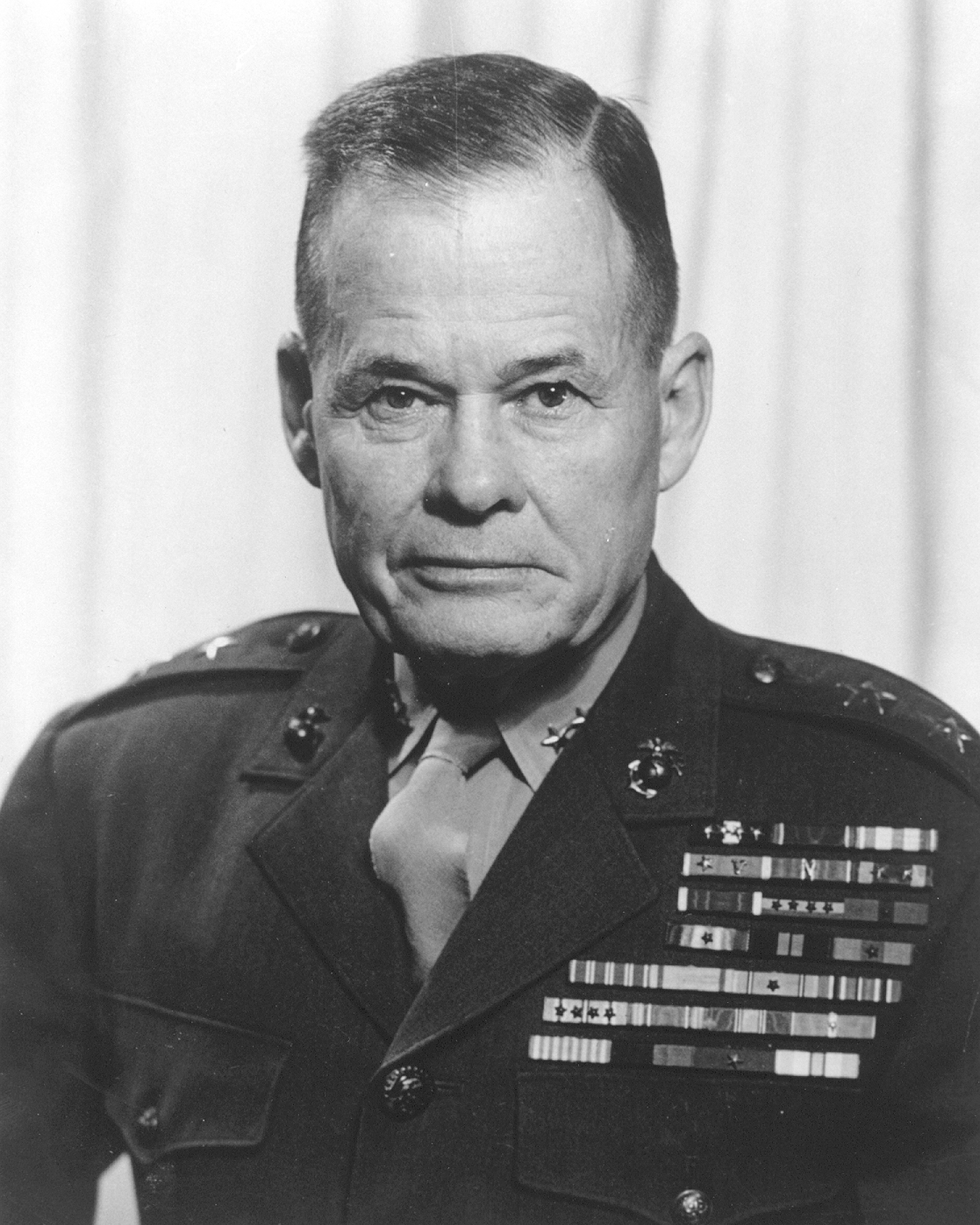
Portrait of Chesty Puller, USMC
A Bulldog Named Chesty
Lewis "Chesty" Puller did not command from a map table. On the ridge above Henderson Field in October 1942, with a Japanese regiment throwing itself against his line in the dark and rain, he was where the fighting was loudest — walking the position, correcting a gun crew's aim, cursing the enemy and encouraging his own men in the same breath. He fought in Haiti and Nicaragua as a young officer, in six campaigns of the Second World War, and again in Korea, and at every stop the pattern held: an appetite for combat that never dimmed, a nose for where the line was about to break, and a complete indifference to comfort or rank when there was a fight worth being part of. By the time he retired he was the most decorated Marine in the Corps's history, with five Navy Crosses to his name.
None of that reads like planning. Puller was not a theorist of war; he barely wrote about strategy at all. What he left behind is a catalogue of moments — a battalion held together by profanity and presence, a gun line reinforced because he happened to be standing next to it when the mortars started falling short. He is the case for a kind of leadership that lives entirely in the present tense, and for a type built to dominate it.
Puller was ESTP down to the marrow — a man whose dominant Se made the battlefield itself his native language.
The Foxhole, Not the Rear
Extraverted sensing is the ability to read a physical situation instantly and act inside it — and Puller's career is one long demonstration of that skill under the worst possible conditions. At Guadalcanal he moved along his lines under fire rather than directing them from a command post, because he trusted his own eyes over any report relayed to him. When his battalion held the ridge against repeated night assaults, he adjusted the defense in real time, shifting men and guns to whichever stretch of line was closest to breaking, often in total darkness with rounds impacting nearby.
This was not recklessness for its own sake; it was where Puller's judgment actually worked. He distrusted abstraction — plans drawn up far from the ground they described — and put his faith in what he could see, hear, and touch. The men who served under him remembered a commander who never asked them to go anywhere he wasn't already standing, and who could smell a collapsing position before the paperwork caught up to it.
A Tactician's Private Logic
Beneath the profanity was a sharp, unsentimental tactical mind. Puller's auxiliary Ti showed up not as doctrine memorized from a manual but as an internal, self-built model of how ground, weapons, and exhausted men actually behaved under stress — and a willingness to improvise the moment textbook procedure failed to match what he was seeing. He redistributed ammunition, repositioned machine guns, and rewrote his own battalion's defensive plan mid-battle when the original scheme stopped fitting the facts on the ground.
He had little patience for officers who reasoned from rank or reputation rather than the problem in front of them, and he said so bluntly — a habit that cost him promotions but preserved his credibility with the men who watched his tactical instincts prove out again and again in combat.
Cursing Them Into Courage
Puller's tertiary Fe is the reason his name became legend rather than merely his record. He was loud, profane, and unmistakably present — a leader who managed his men's morale in real time, through jokes, insults, and blunt encouragement delivered face to face rather than through written orders. His one-liners ("We've been looking for the enemy for some time now. We finally found him. We're surrounded. That simplifies things.") were not performance for its own sake; they were a tool for keeping frightened men functioning under fire.
This expressive, group-facing warmth is what separates him from a purely technical operator. Puller needed his men to feel something — solidarity, defiance, even dark humor — and he supplied it constantly and instinctively, in public, at volume.
No Patience for the Far Horizon
Where Puller's type ran thin was in long-range vision. His inferior Ni left him ill-suited to grand strategy or institutional politics — he clashed repeatedly with superiors over promotions and postwar policy, and his instinct in those disputes was blunt confrontation rather than patient maneuvering toward a distant goal. He thrived when the horizon was the next ridge line, not the next decade of Marine Corps doctrine.
That narrowness of focus is inseparable from his greatness. A commander constantly weighing the campaign five years out might have hesitated on that Guadalcanal ridge; Puller never did, because the only future he was built to see was the one arriving in the next five minutes.
Why ESTP Over ISTP
Why not ISTP?
An ISTP would share Puller's cool, hands-on tactical instinct, but ISTPs lead quietly, through demonstrated competence rather than performance. Puller's loud, expressive, morale-driving public persona — the one-liners, the profanity, the constant visible presence among his men — is Fe, not Ti-Se turned inward. He needed an audience for his courage, not just a problem to solve.
Puller over ISTP comes down to volume and audience. Both types can fight brilliantly with their hands and eyes; only the ESTP needs the men around him to feel what he's feeling, and says so, loudly, in the middle of the fight.
Connected Figures
Further Reading
- Marine!: The Life of Chesty Puller — Burke DavisThe standard biography, drawing on interviews with Puller and those who served with him.
- Chesty: The Story of Lieutenant General Lewis B. Puller — Jon T. HoffmanA more rigorously sourced military biography that separates legend from documented record.
- Guadalcanal Diary — Richard TregaskisContemporary war-correspondent account of the campaign where Puller's legend was forged.
- Helmet for My Pillow — Robert LeckieA Marine's memoir of the Pacific War, including firsthand impressions of Puller's frontline command style.
