 Historical Figure MBTI
#982 · 7-19-26 · The Second World War
Richard O'Connor
General · Operation Compass · The Forgotten Victor
1889 — 1981
4 min read
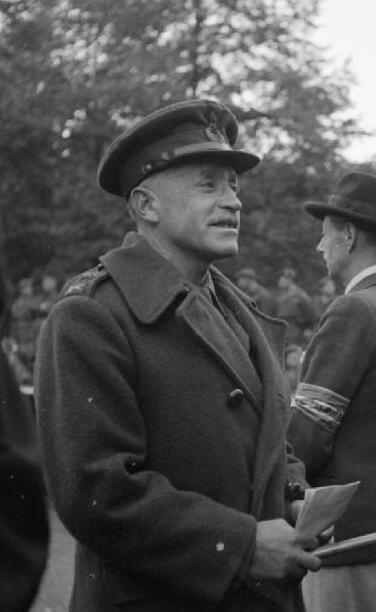
Portrait of Richard O'Connor, 1944
Ten Weeks of Perfection, Then Nothing
Between December 1940 and February 1941, Richard O’Connor took two divisions — one of them Australian, neither of them at full strength — and destroyed an Italian army of ten divisions across five hundred miles of Libyan desert. Operation Compass took 130,000 prisoners for fewer than two thousand British casualties, and ended at Beda Fomm with a British armoured force of a few dozen tanks positioned across the coast road, cutting off and forcing the surrender of an entire retreating field army. Measured as a ratio of results to resources, it is among the most complete victories any British general has ever won.
Almost nobody has heard of him. Two months later he was captured on a night road near Derna by a German motorcycle patrol — sent forward to advise the commander who had replaced him just as Erwin Rommel arrived in Africa — and spent nearly three years in an Italian prison castle while the desert war acquired its famous names. He was an ISTP of exceptional precision who was removed from the board before the board became famous, and the reputation went to the men who were still on it.
An ISTP whose dominant Ti built the cleanest campaign plan of the desert war — and whose place in its history was decided by a wrong turn on a dark road.
The Engineering of a Rout
Compass began as a five-day raid and became a campaign because O’Connor kept finding that the mechanism he had built still had run left in it. The initial attack at Sidi Barrani exploited a precise structural fault — a gap between fortified camps too wide to be covered by mutual fire, with the camps’ defences facing the wrong way — and the assault went in through the gap and struck the positions from the rear. He rehearsed it in a full-scale exercise beforehand, on ground chosen for its resemblance to the objective, without telling most participants what it was for.
Beda Fomm is the purest statement of the same mind. With the Italian Tenth Army retreating along the coast, O’Connor sent a small armoured force straight across the unmapped interior of the Cyrenaican bulge — bad going, no water, vehicles falling out the whole way — to arrive on the road ahead of them. It was a calculation, not a gamble: he had worked out the relative speeds, accepted the mechanical attrition as a known cost, and understood that a blocking force did not need to be strong if it was in the right place. The entire army surrendered to a force a fraction of its size.
Forward, and Then Too Far Forward
Auxiliary Se made him a commander who ran his campaign at the front edge of it — small headquarters, constant movement, orders given face to face and adjusted on the spot as the situation changed hourly. It is why Compass never stalled: at each point where a conventional headquarters would have paused to re-plan, O’Connor was already there, looking at the thing itself, and pushed on. He argued afterwards, with some justice, that had he been allowed to continue he could have taken Tripoli and closed the North African campaign before the Germans ever landed.
The same habit ended his war. In April 1941, with Rommel driving east and the British command in Cyrenaica disintegrating, O’Connor was flown forward to steady the situation and was travelling by night in a staff car when it ran into a German patrol. A general who commanded from the front had finally gone forward one road too many. He escaped from Italian captivity at the third attempt in 1943, and later commanded a corps in Normandy under Bernard Montgomery — competent, respected, and by then a supporting figure in someone else’s war.
Why ISTP Over ESTP
Why not ESTP?
Compass looks superficially like a Rommel campaign — fast, mobile, opportunistic — which invites the Se-dominant reading. But the two men ran their battles in opposite directions. Rommel improvised first and rationalised afterwards; O’Connor worked the problem out first, rehearsed it, and then executed at speed. The Beda Fomm march was a calculated interception, not an instinct, and he was famously quiet, undemonstrative and reluctant to put himself in front of correspondents — the exact opposite of the ESTP’s natural command presence. Ti leads; Se is the instrument that delivers the answer quickly.
The contrast is the cluster’s central lesson. O’Connor had the tactical results Rommel is celebrated for and none of the theatre and none of the publicity, while Rommel had a nickname supplied by his enemies. Being right is not the same as being remembered, and in the desert war the difference was largely a matter of who was still in the field when the journalists arrived.
Connected Figures
Further Reading
- The Forgotten Victor: General Sir Richard O'Connor — John BaynesThe standard biography, and the book that gave him his usual epithet.
- Wavell's Command / Operation Compass 1940 — Jon LatimerOsprey campaign study of Compass with maps of Sidi Barrani and Beda Fomm.
- The Desert Generals — Correlli BarnettPlaces O'Connor's campaign alongside Wavell's and Auchinleck's in the revisionist case.
- The Mediterranean and Middle East, Vol. I — I. S. O. PlayfairThe British official history — the detailed operational record of Compass.
- An Army at Dawn: The War in North Africa, 1942–1943 — Rick AtkinsonThe later phase of the campaign whose opening act O'Connor wrote.
