 Historical Figure MBTI
#978 · 7-19-26 · The Second World War
Erwin Rommel
Field Marshal · The Desert Fox · Tactical Improviser
1891 — 1944
11 min read
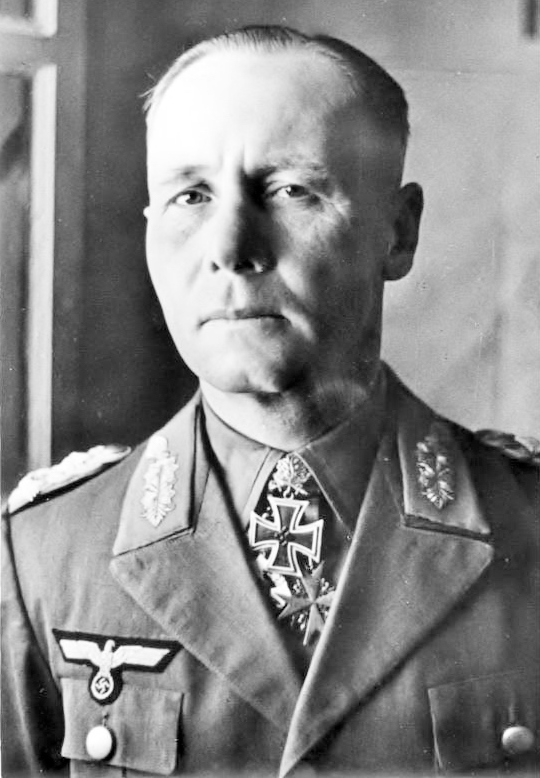
Portrait of Erwin Rommel (Bundesarchiv, 1942)
The Man Who Could Not Stop Winning Battles — Or Start Winning Campaigns
He commanded from the front, which is the first and last thing worth knowing about him. While other army commanders sat behind map tables reading situation reports that were four hours old, Erwin Rommel was somewhere forward in a command vehicle with the dust of the battle on him, close enough to be shot at and repeatedly close enough to be shot at effectively. He was hit, stranded, cut off, and once nearly captured by his own carelessness. He also saw things no staff officer could see — the exact seam where a British line had thinned, the precise hour a counterattack had spent itself — and he acted on those things within minutes rather than days. That was the whole method. It won him a reputation that outlived the empire he served.
It also broke him. Rommel is the great case study in a specific kind of military brilliance: the kind that operates superbly inside the frame of a battle and barely operates at all outside it. In North Africa he beat larger, better-supplied armies again and again with improvised combinations of anti-tank guns, armour, and sheer speed. Then he lost the campaign anyway, because the campaign was a logistics problem — fuel, water, shipping across a contested Mediterranean, a supply line stretched a thousand miles from Tripoli — and logistics is a problem you solve months in advance, in your head, on paper, in an argument with people in Berlin who bore you. He was not equipped for that argument, and he lost it.
The legend that grew around him — the chivalrous Desert Fox, the good German, the honourable enemy — is a real historical phenomenon, but it is at least as much a fact about his opponents as about him. He was an ESTP general fighting a war of production, and he was mythologised by the losing side because a magician is a more flattering explanation for defeat than a shortage of tanks.
An ESTP whose dominant Se made him the finest battlefield reader of his war and the worst possible steward of its supply lines — a man who could see everything in front of him and almost nothing beyond the horizon.
The Battlefield as a Live Instrument
Rommel’s first fame came in 1940, not 1942. Given the 7th Panzer Division in the invasion of France — an armoured command he had not previously trained for — he drove it across the Meuse and then across northern France so fast that the German high command repeatedly lost track of where it was. It became known as the Ghost Division, and the nickname is exact: Rommel was moving faster than the reporting system built to describe him. He was not executing a plan so much as reading a road, a river crossing, a hesitation in the defenders, and pressing wherever the resistance gave. When a French column blocked him, he went through it rather than around it, on the entirely sensory judgement that troops being shot at while retreating do not fight well.
In the desert the same instinct had more room. His signature act at Sidi Rezegh and again during the Gazala battles was to appear personally at the decisive point, take over whatever units were there regardless of their formal chain of command, and use them immediately. The famous improvisation — swinging 88mm anti-aircraft guns down to fire horizontally at British armour — was less an invention than a refusal to be limited by what a weapon was labelled for. An Se-dominant sees an object’s properties, not its category: a high-velocity gun with a flat trajectory is a tank-killer whatever the manual says.
It made him almost impossible to script against. British commanders planned against the German order of battle and found themselves fighting a man who had already discarded it. But the same faculty made him structurally incapable of sitting still while a situation matured. Twice he launched offensives — after Tobruk in June 1942 most damagingly — because the opportunity in front of him looked irresistible, and drove deep into Egypt on a supply line he had already been warned could not sustain him. The moment was real. The month afterwards was not survivable.
The Mechanic’s Logic
What separates Rommel from a merely brave front-line officer is the analytical edge underneath the aggression. Before the war he wrote Infanterie greift an — Infantry Attacks — a cool, technical dissection of his own First World War actions in the Alps and at Caporetto, where as a junior officer he had taken thousands of prisoners with a handful of men. The book is not a memoir of glory; it is a manual of principles extracted from experience, argued in the pared-down, cause-and-effect register of someone taking a machine apart to see what makes it work. Ti is the function that builds an internal model from first principles and trusts that model over doctrine, and Rommel’s whole tactical repertoire is that model applied at speed.
The desert battles are full of it: the anti-tank screen deliberately used as bait, drawing British armour onto a gun line rather than meeting it tank-to-tank; the reverse-slope positioning; the calculated decision at Gazala to accept encirclement in the Cauldron and fight outward, which looked like recklessness and was in fact an accurate reading of where his opponents’ command structure would fail to concentrate against him. These are not lucky improvisations. They are a consistent, internally coherent theory of combined arms, executed by a man who could hold the whole mechanism in his head while it was moving.
Ti also explains his notorious difficulty as a subordinate. He argued with superiors, ignored instructions he judged unsound, and treated the Italian command structure nominally above him as an obstacle rather than an authority. Internal logic outranked hierarchy. It served him brilliantly at divisional and corps level, where the model he built matched the reality in front of him, and served him badly at theatre level, where the relevant variables — shipping tonnage, Ultra decrypts he did not know existed, the strategic priority of the Eastern Front — lay entirely outside his sensory reach and could not be reasoned to from the ground.
The Legend and Its Manufacturers
Rommel had a genuine feel for how he appeared. He courted war correspondents, understood the propaganda value of the photograph of the general in goggles among his men, and cultivated — sincerely, as far as anyone can tell — a code of conduct in the desert war that made him a figure his enemies could respect. He is credibly reported to have ignored the Commando Order requiring captured special-forces troops to be shot, and the Afrika Korps’ treatment of prisoners was, by the standards of that war, decent. Tertiary Fe is not empathy in the deep sense; it is a keen, somewhat performative sensitivity to the impression one is making, and Rommel had it in abundance.
But the Desert Fox was co-produced. The British needed him. A run of humiliating defeats in 1941 and 1942 demanded an explanation more flattering than incompetence, and a brilliant, gentlemanly, almost superhuman opponent supplied one — while also guaranteeing that the eventual victory over him would count for something. Churchill told the House of Commons that across the havoc of war he might say of Rommel: a great general. Auchinleck, less romantically, had to circulate an order to his own commanders instructing them to stop talking about Rommel as if he were a supernatural force, because the myth was corroding their willingness to attack. That order is the best evidence that the legend was operating as a British psychological fact, not merely a German one.
Both propaganda machines fed it, for opposite reasons, and it survived the war because postwar West Germany needed an untainted soldier and the Western allies needed a German they could honourably have fought. The man underneath was more ordinary and more compromised: a professional soldier who owed his early advancement to Hitler’s personal favour, commanded the Führer’s escort battalion, and served the regime loyally through most of the war without visible moral crisis.
The Horizon He Reached Too Late
Inferior Ni arrives suddenly, totally, and usually as doom. Rommel spent two years unable to think past the next fortnight’s fuel, and then, somewhere in 1943 and 1944, arrived at a single overwhelming conclusion and would not be moved from it: the war was lost. He said so to Hitler’s face at a level of bluntness few field marshals attempted. Given command of the Atlantic Wall defences in France, he built the same conviction into concrete — the invasion had to be stopped on the beaches in the first day, because after that nothing could be stopped at all. His argument with Gerd von Rundstedt and the panzer reserve dispute was, at bottom, an argument between a man who thought there would be a long campaign to fight and a man who was certain there would not.
Then July 1944. Rommel’s connection to the plot against Hitler was real but peripheral and is still disputed: he was known to and courted by conspirators, appears to have favoured arresting Hitler and negotiating rather than assassination, and was strafed and gravely wounded in Normandy days before the bomb went off. Under interrogation his name surfaced. The regime could not afford to try its most famous soldier, so it offered him the arithmetic instead: take cyanide, and your wife keeps her pension, your son is left alone, and the state buries you with a hero’s funeral and a fiction about wounds.
He took the poison in a car on a road outside Herrlingen on 14 October 1944, having told his family what was about to happen. Germany was informed he had died of his injuries and given him a state funeral. It is the one moment in his life that has nothing sensory about it — no improvisation, no reading of the ground, no way out — only a man calculating a future he could not touch and paying for it with his life. The inferior function, when it finally speaks, speaks once.
Why ESTP Over ESFP
Why not ESFP?
The surface case for ESFP is real: the personal magnetism, the photogenic showmanship, the physical courage, the warmth his soldiers felt. But an Fi-auxiliary directs that sensory energy inward toward values and outward toward expression, and Rommel’s energy went almost entirely into problems. What he did with a battlefield was solve it — gun lines, baited armour, reverse slopes, an internally consistent theory of mobile warfare he had written a book about before the war. His conflicts with superiors were arguments about whether a plan was sound, not about whether it was right, and his moral reckoning with the regime came astonishingly late for a man supposedly steered by personal values. The showmanship was Fe in the tertiary position: image management, not self-expression.
The ESTP reading holds because it explains the failure as neatly as the success. Se-Ti gives you a commander who is unbeatable in the frame of a battle and helpless in the frame of a campaign — who repeatedly wins the engagement in front of him at a cost to the war behind him, and who cannot bring himself to fight the boring, abstract, months-in-advance fight over tanker sailings and port capacity that would actually have decided North Africa. A different type with half his tactical gift and twice his patience might have done better in Libya. Nobody with his gift would have been half as interesting to write about, which is precisely why the legend took.
Connected Figures
Further Reading
- The Rommel Papers — Erwin Rommel, ed. B. H. Liddell HartRommel's own campaign notes and letters — the primary source, and also the founding document of his legend.
- Infantry Attacks (Infanterie greift an) — Erwin RommelHis 1937 tactical treatise on First World War infantry actions; the clearest window into how he analysed combat.
- Rommel: The End of a Legend — Ralf Georg ReuthRevisionist German biography arguing the Desert Fox was substantially a propaganda construction.
- Rommel's Desert War: The Life and Death of the Afrika Korps — Samuel W. Mitcham Jr.Operational history of the North African campaign with close attention to the supply problem he never solved.
- An Army at Dawn: The War in North Africa, 1942–1943 — Rick AtkinsonPulitzer-winning narrative of the Allied side of the campaign that finally closed the trap.
- Alamein — Jon LatimerDetailed account of both Alamein battles, useful for separating Auchinleck's stand from Montgomery's victory.
