 Historical Figure MBTI
#974 · 7-18-26 · The Second World War
Erich von Manstein
Field Marshal · Strategic Mastermind · Architect of the "Clean Wehrmacht" Myth
1887 — 1973
9 min read
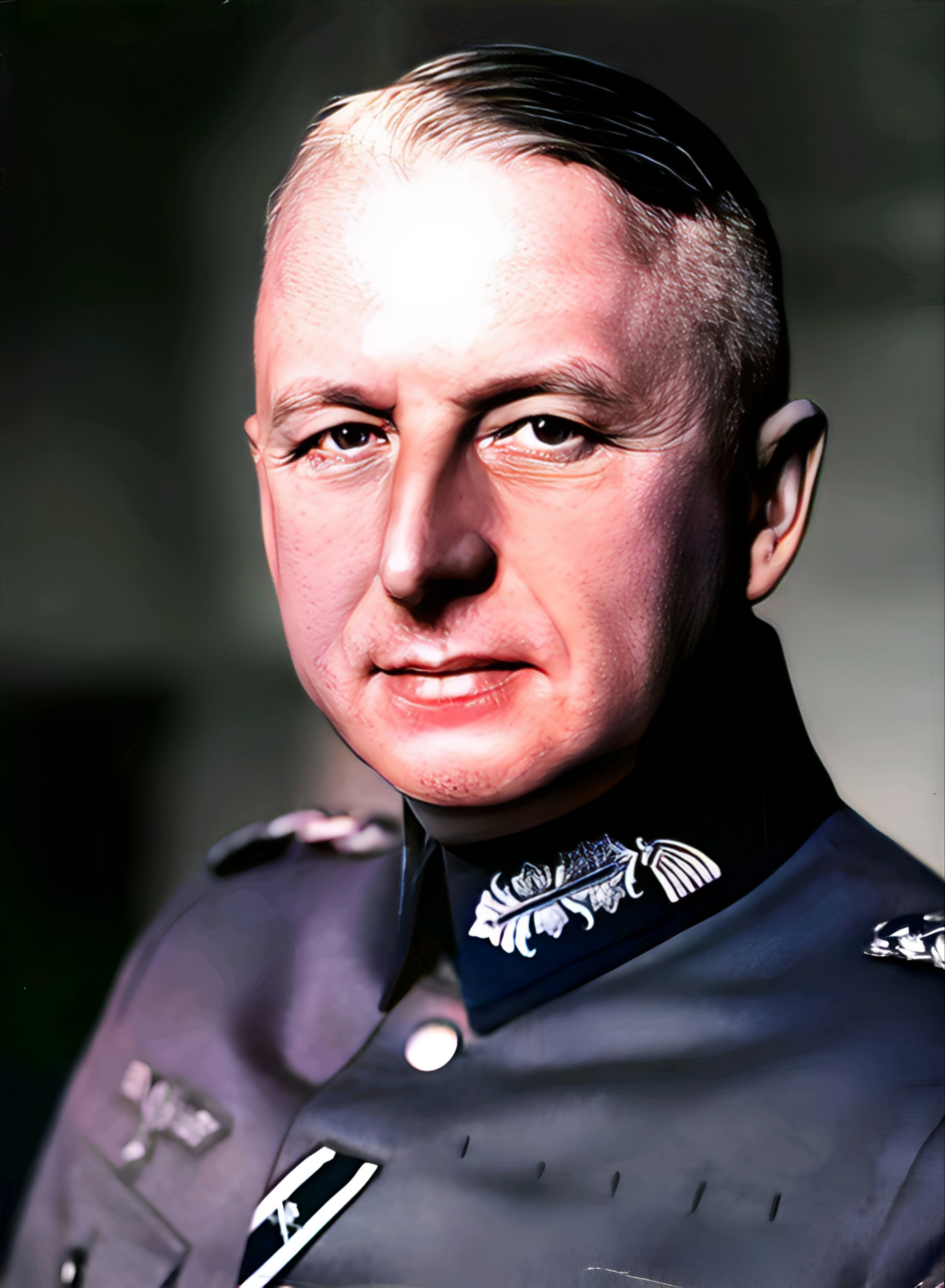
Portrait of Erich von Manstein
The Map Room and the Alibi
He was the general other generals studied — the man who saw, in the winter of 1939, that the whole weight of the Wehrmacht could be poured through a forested corner of Belgium and Luxembourg that every staff college in Europe had ruled impassable to armor. The Sickle Cut severed the French and British armies from each other in ten days and ended the Third Republic in six weeks. Erich von Manstein spent the rest of the war doing variations on that trick: the storming of Sevastopol, the armored thrust toward the encircled Sixth Army at Stalingrad, and above all the backhand counterstroke at Kharkov in 1943, when he let a triumphant Soviet advance overrun itself and cut it apart at the moment of maximum overextension.
And on 20 November 1941, as commander of the Eleventh Army in the Crimea, he signed and circulated an order to his troops declaring that the Jewish-Bolshevik system must be wiped out once and for all, and that the German soldier must therefore show understanding for the harsh measures being taken against Jewry. Behind his lines, Einsatzgruppe D murdered tens of thousands of people with his army's logistical cooperation. He transmitted the Commissar Order. He was tried by a British military court at Hamburg in 1949, convicted on nine counts of war crimes, and walked free in 1953 after his sentence was cut. Two years later he published Lost Victories, the most effective document ever produced in support of the picture of an apolitical, honorable officer corps that had merely lost a war to an amateur in Berlin. Historians have since taken that book apart page by page: it is not a record of the war, it is a brief for the defense. The faculty that let him hold a campaign in his head as one moving shape let him hold his own life as one defensible shape — and edit it until it was.
Manstein is the archive's cleanest case of an INTJ at full power: dominant Ni seeing one campaign-shaped answer years before anyone else could argue with it, and the same singular vision turned, after 1945, on the reconstruction of his own record.
The Ardennes, Seen Before It Existed
The original plan for the invasion of France was a heavier, duller thing — a right hook through the Low Countries, essentially the 1914 scheme with tanks, promising a partial victory and a long war. Manstein, then chief of staff to Rundstedt's Army Group A, saw not a plan to be improved but a wrong answer to be replaced. His alternative depended on a claim nobody else would make: that the Ardennes was passable, that the Meuse could be crossed beyond it, and that an armored mass driving northwest to the Channel would trap the best Allied armies where they stood. It was a single image of the whole campaign, arrived at whole, then reverse-engineered into orders.
That is the signature of dominant introverted intuition — the conviction that arrives complete and then spends months looking for its justification. Manstein submitted the idea repeatedly; the General Staff repeatedly buried it, and had him transferred to an infantry corps command to get him out of the argument. He got his hearing only through a chance breakfast with Hitler in February 1940, and the plan was adopted almost as written. He treated that not as luck but as evidence that he had been right and the institution slow, which is exactly how this function metabolizes a win.
The same faculty produced Kharkov in February and March 1943. With Stalingrad lost and the southern front apparently disintegrating, Manstein did the thing only a mind working from a projected future rather than a present position can do: he gave ground on purpose, let the Soviet spearheads run out of fuel and flank protection, then struck a hundred miles behind them and retook a city everyone else had written off. He was reading a shape that had not happened yet. It is worth saying what that brilliance bought — the war in the East continued for two more years, and everything the occupation was doing behind the lines continued with it.
Vision Rendered as Orders
Vision without machinery is daydreaming, and Manstein's auxiliary extraverted thinking was the machinery. He wrote operational orders of famous clarity — objectives, sequencing, the precise allocation of scarce armor — and stripped away anything that did not serve the shape he had in mind. At Sevastopol in 1942 he ground through the heaviest fortress system in Europe with a methodical, resource-marshalling siege that had nothing intuitive about it at all; it was pure engineering, and it earned him his marshal's baton.
Te also explains the moral shape of the November 1941 order. It was written in the register of operational necessity — partisan warfare, security of the rear areas, the requirements of the campaign — which is precisely how an efficiency-first judging function launders an atrocity into a task. The historians who have examined his command most closely, from Oliver von Wrochem to Benoît Lemay, do not argue that he was an ideological Nazi. They argue something better documented: that he treated the extermination apparatus operating in his rear as a logistical fact of the theater and cooperated with it, because obstruction would have cost him friction he preferred to spend elsewhere. The same instrument later built the memoir — Lost Victories is organized like an operations order, clean causal chains, every reversal traced to interference from above, the criminal orders simply absent. That is Te.
A Private Code, Privately Enforced
Manstein's values were real, deeply held, and entirely internal — the tertiary Fi problem in its purest form. He believed in a Prussian officer's honor, in the oath, in the separation of the soldier from the politician. He grieved with terrible privacy when his eldest son Gero was killed on the northern front in October 1942. None of this ever extended outward into a judgment that could inconvenience him.
When the conspirators of the German resistance approached him — repeatedly, because his prestige would have carried the army — he refused, in a phrase he is said to have used more than once: Prussian field marshals do not mutiny. That is a value statement, a self-image statement, and a decision. He kept the code and let the consequences fall on other people.
Blind to the Room He Was Standing In
For a man who read maps better than anyone alive, Manstein was strikingly bad at reading the room he was standing in — the tell of inferior extraverted sensing. His confrontations with Hitler were technically correct and politically suicidal: he lectured, he pressed for a unified operational command in the East with himself effectively in charge, and he could not perceive that the man across the table heard every one of these arguments as a bid for power. He was relieved in March 1944 and never held another command. The same blindness runs through the postwar performance: he appears genuinely not to have grasped, in the dock at Hamburg, that the documents bearing his signature were the case against him. He had built a world on paper and assumed the world would take the paper. It did, for about forty years.
Why INTJ Over ENTJ
Why not ENTJ?
The ENTJ case rests on command presence, and Manstein simply did not have much of it. His decisive contributions were made alone, on paper, in silence: a memorandum written and rewritten over months, submitted through channels, ignored, resubmitted. He did not build a faction, he did not win the General Staff over by force of personality, and when the plan finally reached Hitler it did so by accident rather than by campaigning. Compare Guderian, who spent a decade loudly and publicly bulldozing the army bureaucracy into accepting armored doctrine — that is what dominant Te advocacy looks like, and Manstein never did it.
The difference is where the idea lives before it becomes an order. Guderian argued his way to a doctrine in public and then drove it down a road himself. Manstein saw the finished shape first, in private, and only then reached for the machinery — aloof with subordinates, cold in staff meetings, most persuasive in writing. He converted people by handing them a document, not by holding a room. Introverted intuition leading, extraverted thinking serving.
Connected Figures
Further Reading
- Lost Victories — Erich von MansteinThe memoir itself — best read as the primary artifact of the clean Wehrmacht myth rather than as a record of events.
- Manstein: Hitler's Greatest General — Mungo MelvinThe fullest English biography; admiring on operations, unflinching on the Severity Order and the Hamburg trial.
- Erich von Manstein: Hitler's Master Strategist — Benoît LemayThe sharpest scholarly reckoning with Manstein's complicity in the war of annihilation in the East.
- The Myth of the Eastern Front — Ronald Smelser and Edward J. Davies IIHow German generals' memoirs shaped American understanding of the war, and why that picture was wrong.
- The Wehrmacht: History, Myth, Reality — Wolfram WetteThe standard account of the army's ideological entanglement with the regime it later claimed to have merely served.
- Hitler's Army: Soldiers, Nazis, and War in the Third Reich — Omer BartovDocuments how criminal orders like Manstein's reached and shaped the behavior of ordinary front-line units.
