 Historical Figure MBTI
#973 · 7-17-26 · The Eastern Front
Nikita Khrushchev
Political Commissar · Stalingrad Survivor · Future Soviet Premier
1894 — 1971
5 min read
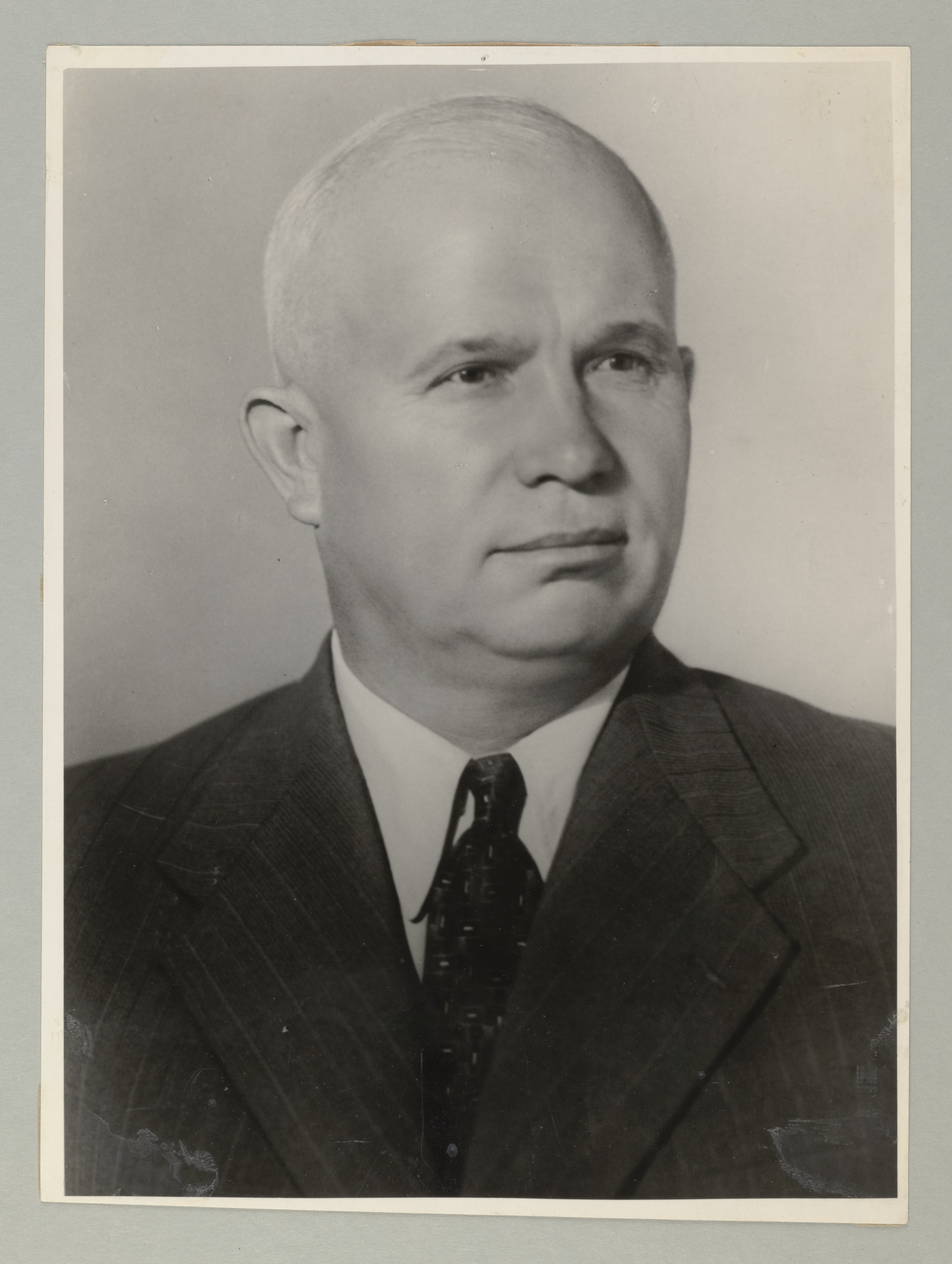
Portrait of Nikita Khrushchev, c. 1948
The Commissar Who Read the Room
Nikita Khrushchev arrived at Stalingrad already a survivor of Soviet politics' more treacherous currents, and he ran the front's political apparatus the way he'd run everything else in his career: bluntly, pragmatically, with an instinct for where power and danger actually sat rather than where doctrine said they should. As the senior political commissar attached to the Stalingrad Front, he was embedded with commanders like Vasily Chuikov, tasked with enforcing party loyalty and morale in an army fighting for its life in the ruins of the city — a job that rewarded street smarts over theory.
Khrushchev was no ideologue in the room where decisions got made; colleagues and later historians describe a coarse, earthy, quick-witted operator who sized up people and situations fast and adjusted accordingly, equally comfortable intimidating a hesitant officer or flattering a suspicious one. He built relationships and a reputation at Stalingrad that he would spend the rest of his career converting into political capital. That combination, sharp situational read, blunt improvisation, and an outward, people-facing style, is ESTP, not a theorist's psychology.
Khrushchev's Se wasn't about the battlefield's terrain — it was about reading the room, and at Stalingrad the room decided who survived the war politically.
Instinct Over Ideology
Khrushchev's effectiveness as a commissar came from reading real, immediate conditions rather than applying doctrine from Moscow mechanically. He moved among troops and officers at the front, gauging morale directly, and made snap judgments about which commanders needed pressure and which needed cover from political interference. This was hands-on, situational management, not abstract theorizing about socialist discipline.
He was also physically present in a dangerous environment by choice, part of the same front-line culture that produced Chuikov's "hugging" tactics, because Se types generally trust what they can see and verify over what they're told. That habit of direct, on-the-ground assessment served him for the rest of his career, long after Stalingrad's rubble was cleared.
A Private Calculation Underneath the Bluster
Beneath Khrushchev's crude, blustering public manner ran a sharper private logic about how Soviet power actually worked, who owed whom, which alliances mattered, which failures could be pinned on someone else. At Stalingrad he navigated the brutal internal politics of a Red Army leadership that Stalin was actively purging and terrorizing, and he came out of it with his standing intact and his network of useful relationships expanded, evidence of a shrewd internal accounting running beneath the earthy exterior.
This auxiliary Ti wasn't showy or theoretical; it showed up as pragmatic, often cynical calculation, deployed quietly rather than argued publicly, which fits the ESTP pattern of technical reasoning kept in service of immediate advantage rather than displayed as intellectual identity.
The Commissar's Charm
Khrushchev's job at Stalingrad was, in part, morale, and he was good at it in a way that was personal rather than administrative, cracking jokes, sharing danger visibly, projecting a rough solidarity with ordinary soldiers that made the party's presence at the front feel less like surveillance and more like camaraderie. That outward warmth, however calculated, is Fe doing real work.
It's the same instinct that, decades later, would make him a surprisingly folksy, publicly emotive Soviet leader on the world stage — banging a shoe, embracing foreign leaders, capable of genuine warmth as readily as genuine crudeness — a tertiary Fe comfortable operating in public in a way few Soviet leaders before or after him managed.
Not a Visionary, By Design
Khrushchev's inferior Ni meant he was never a systematic long-range strategist, even after he rose to the top of Soviet power. His signature moves, denouncing Stalin, pursuing agricultural reform, gambling on missiles in Cuba, tended to be bold, situational responses to an immediate problem rather than steps in a coherent long-term design, and several of them (Cuba chief among them) blew up for exactly that reason. At Stalingrad, this showed up more modestly: he was reactive and adaptive rather than a source of grand operational vision, content to let generals like Zhukov and Chuikov handle synthesis and strategy while he managed the human terrain in front of him.
Why ESTP Over ENTP
Why not ENTP?
An ENTP operator would have engaged Stalingrad's politics as an intellectual puzzle, generating theories and possibilities about the shifting power structure. Khrushchev's approach was concrete and situational instead: he read specific people and specific rooms, acted on immediate advantage, and rarely spoke in abstractions. That's dominant Se reading a physical and social present, not dominant Ne exploring conceptual space.
Khrushchev's Stalingrad was a proving ground for instincts that would carry him to the top of the Soviet Union: blunt pragmatism, a shrewd private calculation of advantage, and a rough public charm, exactly the ESTP toolkit, applied first to surviving a siege and later to surviving Stalin's death.
Connected Figures
Further Reading
- Khrushchev: The Man and His Era — William TaubmanThe standard biography; covers the Stalingrad commissar years and the postwar rise in full.
- Khrushchev Remembers — Nikita KhrushchevKhrushchev's own memoirs, self-serving but revealing of his instincts and voice.
- Stalingrad — Antony BeevorPlaces Khrushchev's role as front commissar in the wider battle.
- The Secret Speech — Nikita Khrushchev (1956 text)The 1956 denunciation of Stalin's crimes that defined Khrushchev's later legacy.
