 Historical Figure MBTI
#975 · 7-18-26 · The Second World War
Heinz Guderian
General · Father of Blitzkrieg · Panzer Doctrine
1888 — 1954
9 min read
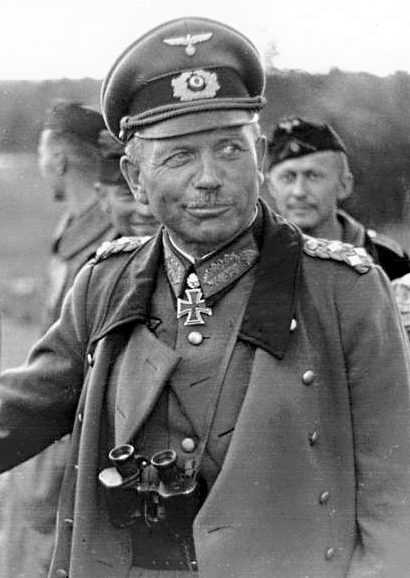
Portrait of Heinz Guderian (Bundesarchiv, Russland-Mitte, 1941)
The Man Who Argued a Doctrine Into Existence
Most military revolutions are written by staff officers and executed by someone else. Heinz Guderian did both, loudly, and made sure everyone knew it. Through the 1920s and early 1930s he was a mid-ranking officer in a small treaty-limited army, reading Fuller and Liddell Hart, running exercises with mock tanks of canvas and plywood, and assembling an argument the German army's traditionalists did not want to hear: that armor should not be parceled out to support infantry but massed into independent formations with their own motorized infantry, artillery, engineers and radios, working with aircraft as flying artillery, driven deep and fast to wreck the enemy's ability to make decisions rather than to grind down his troops. He published it in 1937 as Achtung — Panzer!. Then in May 1940 he took his corps through the Ardennes, crossed the Meuse at Sedan on the second day, and drove for the Channel so fast that his own superiors twice ordered him to stop — orders he evaded, argued with, and once answered by offering his resignation.
That is the story he told about himself in Panzer Leader in 1952, and much of it is true. What the book leaves out is the rest of his war. Guderian's Panzer Group 2 rolled into the Soviet Union in June 1941 carrying the criminal orders with it: the Commissar Order, requiring captured Soviet political officers to be shot rather than taken prisoner, and the Barbarossa jurisdiction decree, which stripped legal protection from Soviet civilians and pre-emptively exempted German soldiers from prosecution for what they did to them. Both were transmitted down through his command like any other order, and behind his advance the killing units did their work. In July 1944, the day after the bomb went off at the Wolf's Lair, Guderian accepted appointment as Chief of the Army General Staff — and sat on the Army Court of Honour, the panel that expelled implicated officers from the Wehrmacht so that Roland Freisler's People's Court could hang them. He also issued an order requiring General Staff officers to be model National Socialist leaders.
He was never tried. He wrote his memoir instead, with a friendly foreword from Basil Liddell Hart, and it became a founding document of the myth that the German army had fought a clean professional war for a regime it did not serve. The doctrine was genuinely brilliant, and the man who built it was fully inside the apparatus his brilliance served.
Guderian is dominant Te in its purest military form — an ENTJ who did not merely have a better idea about armored warfare but organized, published, lobbied and bullied it into becoming an institution, then got in a command tank and proved it on the road to the sea.
Klotzen, Nicht Kleckern
His own slogan — hit with the fist, not with the fingers — is a Te sentence: concentrate the resource, apply it at one decisive point, refuse to dissipate it into everyone's competing requirements. The German army of the 1930s wanted tanks distributed among infantry divisions, useful to everybody and decisive nowhere. Guderian wanted them in panzer divisions under their own command, with radios in every vehicle — an unglamorous procurement fight that mattered more in 1940 than any tank's armor thickness, because it was what let a division be steered at speed.
He won those fights the way extraverted thinking wins fights: by being relentlessly specific, by demonstrating in exercises what could not be denied afterward, by writing a book that went over his superiors' heads to a wider readership, and by being frankly unpleasant to obstruct. He quarreled with Beck, with Kleist, with Kluge — with Kluge to the point that the two men nearly fought a duel. Colleagues found him abrasive, self-promoting and impossible to shut up. He regarded that as the cost of getting something done, which is how the type usually regards it.
The same instrument served the regime with no visible friction. As Inspector-General of Armoured Troops from 1943 he rebuilt the panzer arm as a production and training system, working directly with Albert Speer's armaments ministry — two men who each later described themselves as pure technicians doing a job. Efficiency is morally neutral only in the abstract; applied, it belongs to whoever issues the objectives.
A Picture of a War Nobody Had Fought Yet
Guderian did not invent the tank, or mechanized theory, or air-ground cooperation; the British had written most of the pieces and failed to assemble them. What he had was auxiliary introverted intuition seeing how separate parts resolve into a single system, early enough to be dismissed as a crank. He came out of the signals branch, and it shows: his real insight was that the decisive commodity in a future war would be tempo, and that tempo was a communications problem before it was a horsepower problem. Break the enemy's ability to observe, decide and order faster than he can recover, and you can beat an army with more men and better tanks. In 1940 the French had both.
The intuition was auxiliary, though, not dominant. His great strategic argument of 1941 — that the panzer groups should drive straight for Moscow rather than turn south into the Kiev encirclement — was correct on its own terms and made with characteristic vehemence, but he was arguing for an axis, not designing a campaign the way Manstein did. Guderian's vision was a doctrine, a repeatable method, and once he had it he spent his life applying and defending it rather than generating new ones.
Commanding From the Front Vehicle
Almost every senior German commander of 1940 ran his battle from a headquarters with a map. Guderian ran his from a radio-equipped armored command vehicle inside his own advancing columns, close enough to the Meuse crossing at Sedan to be shelled and close enough to the front of the drive west to change its direction by voice. This followed logically from his doctrine — a commander whose weapon is tempo has to be where he can see the tempo — but it also reveals a real appetite for the immediate physical situation, the tertiary Se pleasure in being in it, moving, deciding on what is actually in front of him.
It made him formidable and hard to control. The pause orders of May 1940, imposed by superiors who feared an exposed flank, he treated as an obstacle to be worked around: he took his own removal on the chin, got reinstated, redefined his advance as a reconnaissance in force, and kept going. In the winter of 1941 the same reflex ended his first war — facing the Soviet counteroffensive before Moscow with troops freezing in summer uniforms, he pulled back against Hitler's stand-fast order, and Kluge had him relieved on Christmas Day.
The Wounded Pride That Wrote the Book
Inferior Fi in an ENTJ rarely looks like tenderness; it looks like a thin, easily inflamed sense of personal honor that surfaces under pressure and gets defended out of all proportion. Guderian offered his resignation over the halt order, nursed feuds with fellow generals for decades, and experienced his December 1941 dismissal not as a professional setback but as a personal injustice — the account of it in Panzer Leader still smolders eleven years later.
That wounded register drives the memoir as a whole, and it is why the book is so persuasive and so unreliable at once. It was written by a man who sincerely believed himself an honorable soldier badly used — which allowed him to describe the campaigns in exhaustive operational detail while omitting the orders his own headquarters passed down, his role on the Court of Honour, and his directives demanding National Socialist commitment from the officer corps. Russell Hart's reassessment and John Mearsheimer's work on Liddell Hart's collaboration with the German generals both trace how effectively this worked. Guderian did not have to lie often. He simply left out everything that did not belong to the version of himself he could bear.
Why ENTJ Over INTJ
Why not INTJ?
Guderian's originality makes the INTJ reading tempting — but he did not work like one. His method was public, combative and organizational: exercises staged to convince skeptics, a mass-market book published over his superiors' heads, procurement fights, quarrels with half the senior officers in the army, a decade of campaigning to create a branch of service that did not exist. The idea was never the private possession it was for Manstein; it was a program to be sold and built, and in the field he led from inside the advance rather than from a quiet map room.
Put the two men side by side and the difference is clean. Manstein produced a campaign-shaped intuition and needed the institution to accept it; Guderian produced a system and went to war with the institution until it adopted him. Extraverted thinking leading, introverted intuition serving — the organizer with a vision, not the visionary with an organization.
Connected Figures
Further Reading
- Panzer Leader — Heinz GuderianThe 1952 memoir — indispensable, and to be read as an act of self-defense rather than a record.
- Achtung — Panzer! — Heinz GuderianThe 1937 doctrinal manifesto, written to win an argument inside the German army and to be read outside it.
- Guderian: Panzer Pioneer or Myth Maker? — Russell A. HartThe best short corrective, weighing the real doctrinal achievement against the reputation Guderian built for himself.
- The Blitzkrieg Legend: The 1940 Campaign in the West — Karl-Heinz FrieserShows how much of the 1940 victory was improvisation and Allied collapse rather than doctrine executing to plan.
- Liddell Hart and the Weight of History — John J. MearsheimerTraces how the British theorist and the German generals rehabilitated each other in print after 1945.
- The Myth of the Eastern Front — Ronald Smelser and Edward J. Davies IIHow memoirs like Guderian's built the clean Wehrmacht picture that dominated Western histories for forty years.
