 Historical Figure MBTI
#976 · 7-18-26 · The Second World War
Franz Halder
Chief of the Army General Staff · The Diarist · Dismissed by Hitler
1884 — 1972
7 min read
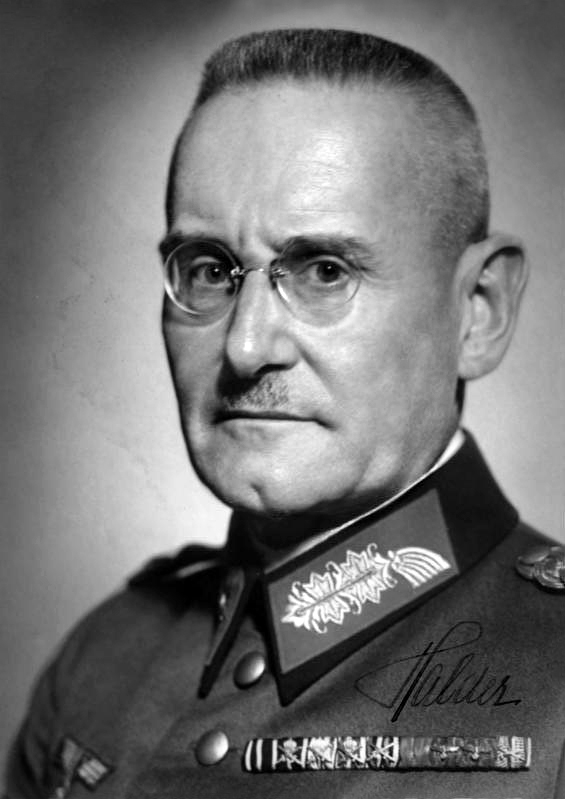
Portrait of Franz Halder (Bundesarchiv, 1939)
The Man Who Wrote It All Down
Almost everything historians know about how the German high command actually made decisions between 1939 and 1942 passes at some point through the handwriting of Franz Halder. A Bavarian artilleryman from a long line of Bavarian artillerymen, precise to the point of fussiness, he became Chief of the Army General Staff in September 1938 and kept — in the Gabelsberger shorthand he had learned as a young officer — a dense daily record of conferences, orders, troop states and arguments with Hitler. The Halder war diary is now a foundational primary source for the period: not a memoir written to a purpose afterward, but a working document compiled at the desk each evening by a man who could not stand for a thing to go unrecorded.
He planned the Polish campaign. He owned the original, unimaginative plan for the invasion of France and had to watch it replaced by Manstein's Ardennes scheme, which he had spent months suppressing and then executed with total professional competence. He supervised the staff work for Operation Barbarossa. And in that role he was central to the machinery that made the Eastern Front a war of extermination: the Commissar Order and the Barbarossa jurisdiction decree, which stripped Soviet civilians of legal protection, moved through his General Staff with his signature on the paperwork. Whatever else the final years of his life complicate, they do not touch that.
The ending, though, is genuinely complicated. Halder clashed with Hitler increasingly over the 1942 drive on Stalingrad and the Caucasus — arguing, correctly, that the army was being split between two divergent objectives it could not supply — and was dismissed that September. After the July 1944 bomb plot he was arrested, though he had not been part of it, and finished the war as a prisoner at Flossenbürg and Dachau.
Halder is a textbook ISTJ: dominant Si turning a world war into a filing system — procedure, precedent and the daily entry, made by a man who believed that if the record was kept properly, something in it would eventually be worth keeping.
The Diary as Character
The diary is not incidental to Halder; it is the clearest evidence of what he was. Nobody required him to keep it. Through the collapse of Poland, the fall of France and the opening of the largest land invasion in history, he sat down each evening and recorded what had been said and by whom, in shorthand, with the tone of a man reconciling an account. It is dry, granular, often petty, and enormously valuable precisely because it was not composed for an audience — which is why David Stahel and a generation of Barbarossa scholars use it as the check against which the generals' postwar memoirs are measured.
The same introverted sensing governs his professional method. Halder was the institutional memory of the German General Staff — the Moltke tradition, the staff-college procedure, the standardized order format, the meticulous handling of railway and supply tables. He was better at that than almost anyone alive, which is why the Wehrmacht's first campaigns ran with such uncanny smoothness, and also why the Manstein plan reached him as an irritant rather than an opportunity: a proposal that violated everything precedent said about armor and terrain, submitted by a subordinate outside the proper channel of dissent.
Competence as an Answer to Everything
Halder's auxiliary Te shows in how he fought: never on principle, always on feasibility. His resistance to Hitler was couched in force ratios, supply capacity, replacement rates and the arithmetic of frontage. He was very often right. He was also arguing inside a war he had planned, over objectives he had already accepted, which is what makes the disagreement technical rather than moral.
The dismissal in September 1942 was a collision of incompatible operating systems: a man who ran on staff estimates against a man who ran on will. Hitler told him he lacked the mental toughness for the situation; Halder by then was recording his chief's outbursts with the weary neutrality of a clerk logging a recurring fault. After the war he directed the U.S. Army's German operational history program, marshalling hundreds of former officers into a vast archive of campaign studies — the same Te instinct applied to memory, and, as Ronald Smelser and Edward Davies have shown, a program that quietly helped install the clean Wehrmacht picture in American military thinking.
The Coup He Could Not Quite Attempt
In the autumn of 1938, with war over Czechoslovakia apparently imminent, Halder was at the center of a genuine conspiracy to arrest Hitler if the order to attack was given. It was planned in the manner of a staff exercise, with troop assignments and a signal to trigger it — and it evaporated the moment the Munich agreement removed its precondition. He never came that close again, and for the rest of the war his opposition stayed inside the boundaries of an operational disagreement.
That is inferior extraverted intuition in its usual form: capable of imagining the alternative, incapable of trusting it enough to leap. What Halder could not do was act without the situation itself authorizing the act. The July 1944 plotters did leap, and it cost most of them their lives; Halder was swept up on suspicion afterward and spent the end of the war in a concentration camp — a strange and genuinely uncomfortable last chapter for a man who had helped plan the campaigns that filled such camps in the East. He died in Bavaria in 1972, an honored consultant to the U.S. Army.
Why ISTJ Over INTJ
Why not INTJ?
Halder occupied the most senior planning job in the German army, which makes the INTJ reading superficially plausible — but in five years at that desk he never originated a strategic conception. His plan for the West was the old scheme with better staff work; the idea that broke France came from a subordinate he tried to suppress. His strength was administering, sequencing and recording other people's plans with immense precision, and his objections to Hitler were always logistical rather than visionary. That is Si-Te executing, not Ni conceiving.
The contrast with Manstein is the cleanest test available: the same problem was put in front of both men in the winter of 1939, and only one saw a new answer. Halder's contribution was of a different and genuinely important kind — and by an irony he cannot have intended, the record he kept out of sheer procedural compulsion is now one of the sharpest tools historians have for taking apart the stories his colleagues told afterward.
Connected Figures
Further Reading
- The Halder War Diary, 1939–1942 — ed. Charles Burdick and Hans-Adolf JacobsenThe central primary source for German high-command decision-making, in English translation.
- Halder: Generalstabschef Hitlers 1938–1942 — Christian HartmannThe standard scholarly biography, and the basis for most modern assessments of his complicity.
- Operation Barbarossa and Germany's Defeat in the East — David StahelUses the diary extensively to show the 1941 campaign failing far earlier than the generals later admitted.
- Hitler as Warlord — Franz HalderHis own short 1949 tract blaming the defeat on Hitler's amateurism — an early brick in the clean Wehrmacht myth.
- The Myth of the Eastern Front — Ronald Smelser and Edward J. Davies IICovers Halder's postwar U.S. Army history program and how it shaped American views of the war.
