 Historical Figure MBTI
#977 · 7-18-26 · The Second World War
Walter Model
Field Marshal · Hitler's Fireman · The Defensive Specialist
1891 — 1945
7 min read
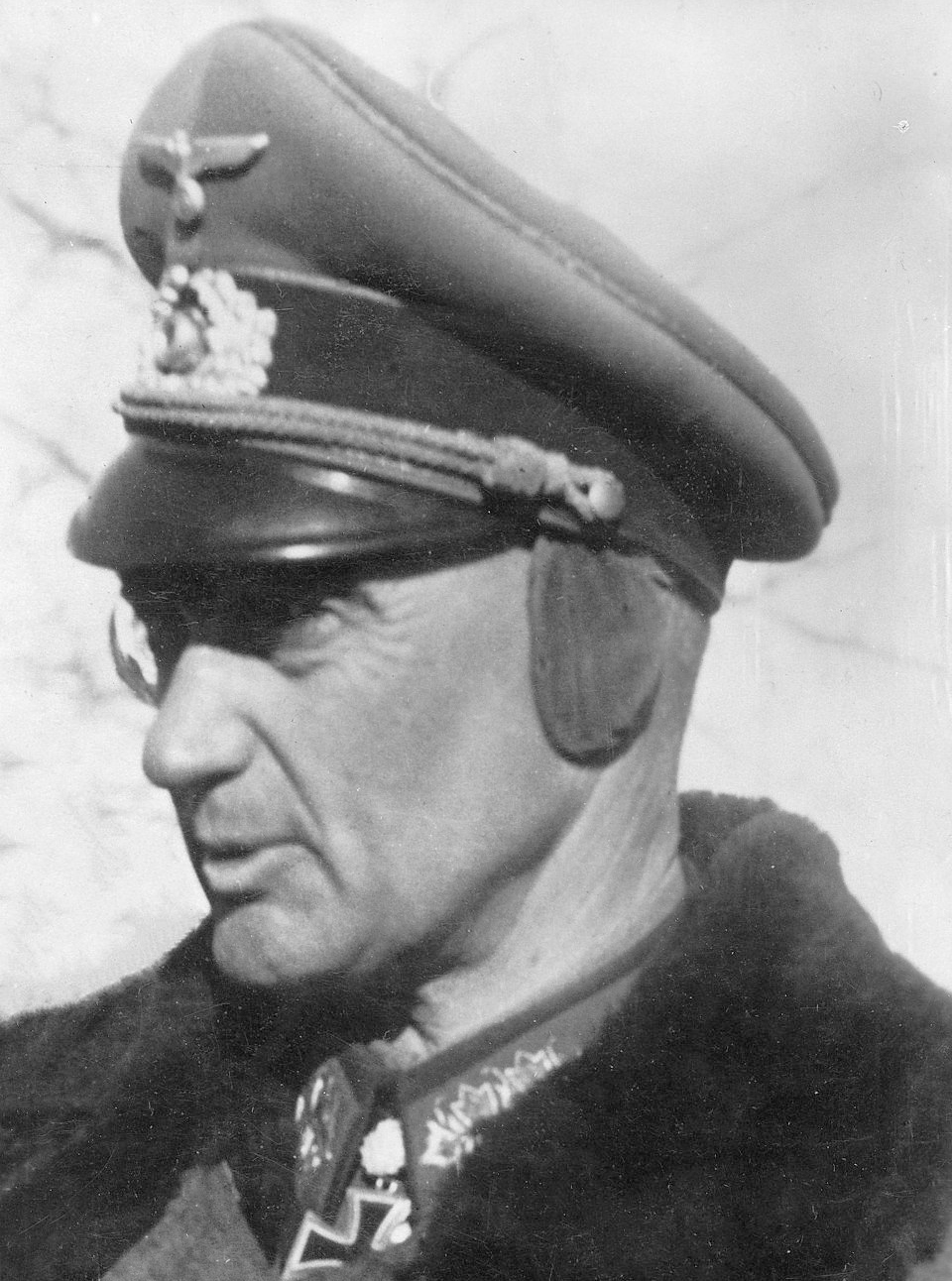
Portrait of Walter Model
The Man They Sent When It Was Already Lost
He arrived by light aircraft, usually alone, usually into a sector where the front had ceased to exist. Within hours he would be near the fighting in his greatcoat and monocle, shouting at a regimental commander, commandeering rear-echelon clerks and cooks into the line, and rewriting a corps commander's dispositions on the spot. Walter Model was called Hitler's Fireman because that is what he was used for: from the winter of 1942 onward, whenever a German front broke, Model was flown into it, and with disturbing regularity the front stopped breaking. He became a field marshal at fifty-three, the youngest in the army, and got there without a von in his name — a music teacher's son among Prussian aristocrats, which sharpened everything abrasive about him.
What he did was not elegant. Where Manstein answered a crisis with a conception, Model answered it with organization applied at maximum aggression: elastic defense in depth, immediate counterattacks against every penetration, ruthless stripping of quiet sectors, and a personal presence far enough forward that no subordinate could stall him with a report. He was also one of the more openly pro-Nazi senior commanders, and the criminal apparatus of the occupied East operated in his rear areas as it did everywhere else — mass deportation of civilians for forced labor and scorched-earth destruction were built into his celebrated withdrawals.
And he was one of perhaps three men who could contradict Hitler to his face and be listened to. In January 1942, arguing over where a panzer corps should be committed at Rzhev, he is said to have asked flatly who was commanding the Ninth Army — the Führer or himself. He got his way. It is the same narrow privilege Zhukov held with Stalin, and for the same reason: results delivered under conditions where nobody else was delivering any.
Model is dominant Te at its most physical — an ESTJ who fought crises the way a foreman fights a burning factory: by getting inside it, taking personal command of everything at once, and imposing an order that had no interest in whose feelings it trampled.
Order Imposed at Shouting Distance
Model's method was to go and see, then command everything he could reach. He bypassed the chain of command constantly, giving orders to divisional and even battalion commanders in front of their superiors, and removed officers who disappointed him at a speed that made him widely detested among his peers. Rundstedt reportedly said Model was the sort of man who would make a good sergeant-major — right about the register, wrong about the value.
The results are hard to argue with. At Rzhev through 1942 and into 1943 his Ninth Army held a salient under Soviet offensives of enormous weight — the battles the Red Army remembers as a slaughterhouse — by counterattacking every breach before it could be consolidated. In July 1944, handed the wreckage of Army Group Centre after Operation Bagration destroyed some thirty divisions, he stabilized a front that had evaporated over five hundred kilometers. Two months later, sent west, he reacted fast enough to break Market Garden at Arnhem, with his own headquarters practically inside the British landing zones.
The condition attached to that competence is the one this archive keeps returning to. Model's aggression was placed unreservedly at the service of the regime, his withdrawals left burned villages and emptied populations behind them, and the extra years men like him bought were more years of everything that was happening behind the lines. He escaped trial only by dying; the Soviet Union had named him a war criminal and would have wanted him.
The Craft Beneath the Shouting
Underneath the noise, Model was a technician of extraordinary precision, and that is auxiliary Si. He knew the actual condition of his units — real rifle strengths rather than paper establishments, which vehicles were running, how much ammunition had come forward that night — because he checked personally and remembered what he had been told the week before. His defensive system was built out of the same accumulated concrete detail: positions sited on ground he had walked, reserves held where the road net actually permitted a counterattack, lines prepared far to the rear before anyone admitted they would be needed.
Operation Buffalo in March 1943 is the clearest specimen. Withdrawing the Ninth Army out of the Rzhev salient shortened his front by hundreds of kilometers and freed some twenty divisions, executed over three weeks in a sequence so exact that the Soviets were slow to notice it had begun. It was also an act of deliberate devastation: roads mined, villages destroyed, tens of thousands of civilians driven west. The precision and the brutality were the same operation, planned by the same mind on the same staff paper.
The Pistol in the Woods
Inferior introverted feeling stays out of sight until the structure fails, and then it decides everything. In April 1945 Model's Army Group B was sealed into the Ruhr Pocket with some three hundred thousand men and no possibility of relief. He would not surrender — Paulus had done that at Stalingrad, and Model had absorbed the disgrace of it as a personal lesson — so he found a third answer that kept both the code and the men: he dissolved the army group out of existence, discharging its oldest and youngest soldiers and leaving the rest to surrender individually.
Then he walked into a wood near Duisburg with a small staff party and shot himself, on 21 April 1945. He had said that a field marshal does not become a prisoner. It was a private judgment, held absolutely and voiced almost never, and it arrived — as this function usually does in an ESTJ — at the exact moment when there was nothing left to organize.
Why ESTJ Over ISTJ
Why not ISTJ?
Model shared the ISTJ's appetite for concrete detail and procedure, but nothing about his manner was quiet or internal. He commanded by physical intrusion — flying into a collapsing sector, overriding the chain of command in person, dressing down officers in front of their staffs, and arguing his case to Hitler in a room where more cautious men said nothing. Compare Franz Halder, who made the same kind of technically sound objection and made it on paper, through channels, and was fired for it. Model imposed his judgment outward, at volume, on other people's organizations.
The pairing is instructive because both men were administrators of force rather than originators of strategy — Si-Te and Te-Si working the same material from opposite directions. Halder's competence lived in the record; Model's lived in the room he had just walked into.
Connected Figures
Further Reading
- Hitler's Commander: Field Marshal Walther Model — Steven H. NewtonThe fullest English-language biography, covering both the defensive craft and the political loyalty.
- Generalfeldmarschall Walter Model: Legende und Wirklichkeit — Marcel SteinA German reassessment that weighs the Fireman reputation against the documentary record.
- The Wehrmacht Retreats: Fighting a Lost War, 1943 — Robert M. CitinoPlaces Model's defensive battles inside the German army's broader collapse of operational options.
- The Rzhev Slaughterhouse — Svetlana GerasimovaThe Soviet side of the salient Model held, and the scale of the fighting there.
- A Bridge Too Far — Cornelius RyanStill the most vivid account of Model's improvised destruction of Operation Market Garden at Arnhem.
