 Historical Figure MBTI
#965 · 7-16-26 · The Eastern Front
Georgy Zhukov
Marshal of the Soviet Union · The Hammer · Only Man Who Argued With Stalin
1896 — 1974
9 min read
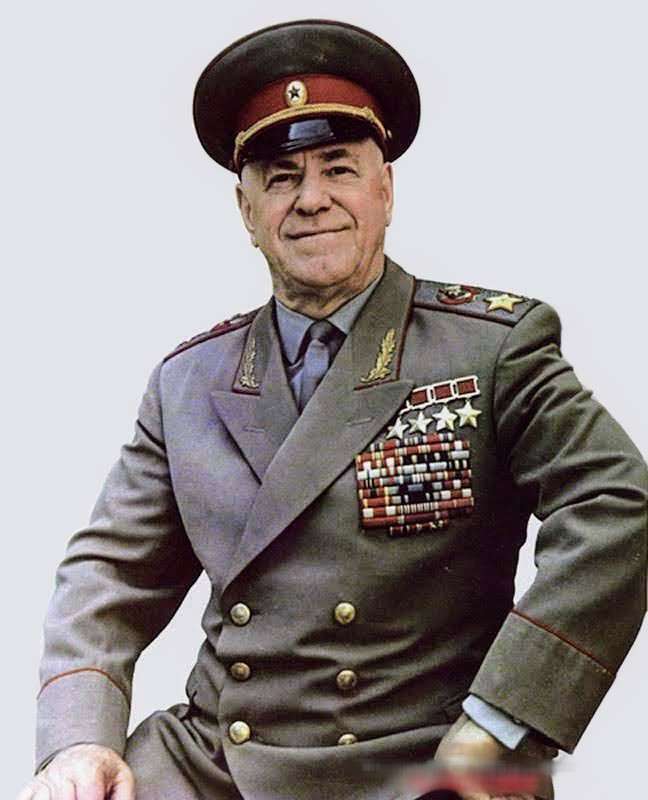
Portrait of Georgy Zhukov
The Hammer That Never Asked Permission to Fall
He did not look like a genius, and that was the point. Square-headed, thick-necked, a peasant boy apprenticed to a Moscow furrier before the Tsar took him for the cavalry, Georgy Zhukov spent his whole career being underestimated by men with better tailoring and worse results. What he had instead of elegance was an absolute, unembarrassed grip on the machinery of war — how many rifles, how many shells, how many hours of railway movement, how many men it would take and how many of them would not come back. He won the Second World War in the east not by outthinking the Wehrmacht but by out-organizing it, and by being willing to pay a price in Soviet lives that would have ended the career, and probably the sanity, of any Western general who proposed it.
The pattern was set at Khalkhin Gol in 1939, where he assembled an armored envelopment against the Japanese Sixth Army with a logistical effort — hundreds of miles of truck convoys across empty Mongolian steppe — that his opponents assumed was physically impossible, and therefore did not prepare for. It held through the catastrophe of 1941, when he was flung from crisis to crisis: Leningrad in September, Moscow in October, where he took over a front that had effectively ceased to exist, rebuilt a defensive line out of militia, cadets, and divisions railed in from Siberia, and refused to give ground on any axis he judged decisive. It held through Stalingrad, Kursk, and finally Berlin. Wherever the situation was worst, the Kremlin sent Zhukov, because Zhukov did not panic and did not require encouragement.
He was also, famously, the one man who would contradict Stalin to his face in front of witnesses and survive it. In the summer of 1941 he told the Boss that Kiev had to be abandoned; Stalin called the idea nonsense, Zhukov offered his resignation as Chief of the General Staff on the spot, and was removed from the post — and then, within weeks, given a front to command, because results were the only currency the dictator ultimately respected and Zhukov produced them. That exchange is the whole man in miniature: not a courtier, not a visionary, but an ESTJ executive who stated the operational fact, accepted the institutional consequence, and went back to work.
Zhukov is the ESTJ as instrument of state violence — dominant Te running the war as an accounting problem in men, matériel, and time, with the arithmetic always coming out in favor of the objective.
The Arithmetic of Force
Extraverted Thinking is the function that measures the world and then rearranges it, and Zhukov measured constantly. His characteristic act on arriving at a collapsing front was not to inspire but to audit: what units actually exist, where are they, who is lying to me about their strength, which commander is to be relieved this hour. At Leningrad in September 1941 he arrived, reversed the standing preparations for surrender, redeployed anti-aircraft guns to fire over open sights at tanks, stripped the Baltic Fleet of sailors for infantry, and issued orders promising execution for unauthorized withdrawal. The city held. None of that was inspiration; all of it was inventory converted into a defensive line inside about a week.
Before Moscow he did the same at larger scale, and with the coldness that defines him. He fed newly arrived formations into the line in the exact places where the German spearheads would have to pass, accepted that the counterattacks he ordered in November would be shredded, and ordered them anyway because their function was to buy days, not ground. When the December counteroffensive came it was not subtle — it was concentrated, echeloned, and unrelenting, and it drove Army Group Centre back a hundred miles and more. Te does not fall in love with a plan; it audits the plan against the objective and discards whatever is not paying for itself, including formations, including subordinates, including men.
The famous ruthlessness follows directly. Zhukov signed orders that treated casualty figures as an input rather than a verdict, and when Eisenhower asked him after the war how the Red Army cleared minefields, he replied that infantry were sent through them, since the losses were comparable to those from machine guns and the ground was taken. Western officers repeated the story as evidence of barbarism. It is more precisely evidence of a Te that had been given absolute authority, an inexhaustible supply of conscripts, and a state that punished failure to advance far more severely than it punished the cost of advancing.
Everything He Had Already Seen Once
Introverted Sensing gave Zhukov the enormous internal archive that made his Te credible. He came up through the cavalry from 1915, fought through the Civil War, spent the interwar years grinding through the Red Army school system and the mechanized formations, and read the German operational literature closely enough that the shape of the 1941 offensive surprised him far less than it surprised the Kremlin. In the January 1941 war games he took the German side and drove the Soviet defenders out of position — a rehearsal whose lessons he was still applying six months later, when the same corridors began filling with real panzers.
What he brought to each new crisis was not a new idea but a stored one, matched to circumstance. Khalkhin Gol supplied the template of massed armor on the flanks and a fixing attack in the center; the Moscow winter supplied the template of the reserve army held back until the enemy has overextended his logistics; Stalingrad and Kursk are both those templates again, at continental scale. He did not need novelty because he had precision recall of what had already worked and, more usefully, exactly what had gone wrong when it did not.
The Narrow Window of Alternatives
Tertiary Extraverted Intuition shows up in Zhukov as a limited but real willingness to entertain the unorthodox when the standard answer had visibly failed. At Kursk in 1943 the instinct of a pure force-maximizer would have been to strike first; Zhukov, with Vasilevsky, argued instead for the deliberately passive option — let the Germans attack into a defensive belt eight zones deep, let them exhaust themselves against prepared ground, and only then release the operational reserves. That is Ne in service of Te: an alternative considered, tested against the numbers, and adopted because it made the arithmetic better.
The same faculty appears in the small tactical improvisations he is remembered for — the searchlights blazed into German eyes at the Seelow Heights, the maskirovka programs that hid whole armies before Operation Uranus. But Ne in the tertiary slot is a tool, not a temperament. Offered a genuinely speculative concept, Zhukov tended to ask what it would cost and whether anything simpler would do, and the simpler thing usually won.
The Private Ledger of a Public Instrument
Inferior Introverted Feeling in an ESTJ is rarely warmth; it is a buried, inarticulate sense of personal rightness that surfaces mainly as stubbornness under pressure. Zhukov could not flatter, could not read a room, and could not be talked out of a position he believed operationally correct — which is why the Kiev confrontation with Stalin happened at all, and why it kept happening in different forms for four years. He was not brave in that room because he was defiant by nature; he was brave because the alternative was to assent to something his own judgment had already refused.
The other face of the inferior function is his relationship to fame. When the war ended, Zhukov took the German surrender, rode the white horse at the Victory Parade, and was promptly demoted to the Odessa Military District by a dictator who could not tolerate a rival myth — then rehabilitated, promoted to Defence Minister under Khrushchev, and dismissed again in 1957 for what the Party called Bonapartism. He spent his last years writing his memoirs and fighting censors line by line over which sentences of his own war he was permitted to keep. That fight, more than any battlefield, is where his Fi is visible: an old man insisting, against the state that made him, on his own version of the record.
Why ESTJ Over ENTJ
Why not ENTJ?
The ENTJ reading flatters him with a visionary streak he never displayed. Zhukov invented no doctrine: deep battle came from Tukhachevsky and Triandafillov before the purges killed them, operational art was Red Army orthodoxy by the mid-1930s, and what Zhukov contributed was the organizational will to execute known principles — concentration of force, echeloned attack, massed artillery, deception — at a scale and with a ruthlessness nobody else could sustain. An ENTJ builds a new strategic concept and pushes an institution toward it; Zhukov took the institution as given, mastered its manual absolutely, and applied it like a press. His creativity was in the application, not the conception.
The distinction matters because it explains both his effectiveness and his ceiling. A Ni-driven commander such as Manstein could conjure an operational solution out of an apparently lost position, and did so repeatedly — but he needed a rational master and never had one. Zhukov needed neither vision nor rationality from above; he needed authority, reserves, and a clear objective, and given those three he was very nearly unstoppable. Te-Si is the profile of a man who wins by making the known method work under conditions where every other commander would consider it inapplicable, and the Eastern Front was, for four years, exactly that condition.
Connected Figures
Further Reading
- Stalin's General: The Life of Georgy Zhukov — Geoffrey RobertsThe standard English-language biography, built on post-Soviet archival access.
- Marshal of Victory: The Autobiography of General Georgy Zhukov — Georgy ZhukovHis own memoirs, restored in later editions from the passages Soviet censors cut.
- Stalin's Wars: From World War to Cold War, 1939–1953 — Geoffrey RobertsPlaces Zhukov inside the command relationship that defined and constrained him.
- When Titans Clashed: How the Red Army Stopped Hitler — David M. Glantz and Jonathan HouseThe operational history of the Eastern Front from the Soviet side of the archives.
- Nomonhan, 1939: The Red Army's Victory That Shaped World War II — Stuart D. GoldmanThe Khalkhin Gol campaign that first revealed Zhukov's logistical method.
