 Historical Figure MBTI
#968 · 7-16-26 · The Eastern Front
Semyon Timoshenko
Marshal · Old Guard · Stemming the Initial Collapse
1895 — 1970
6 min read
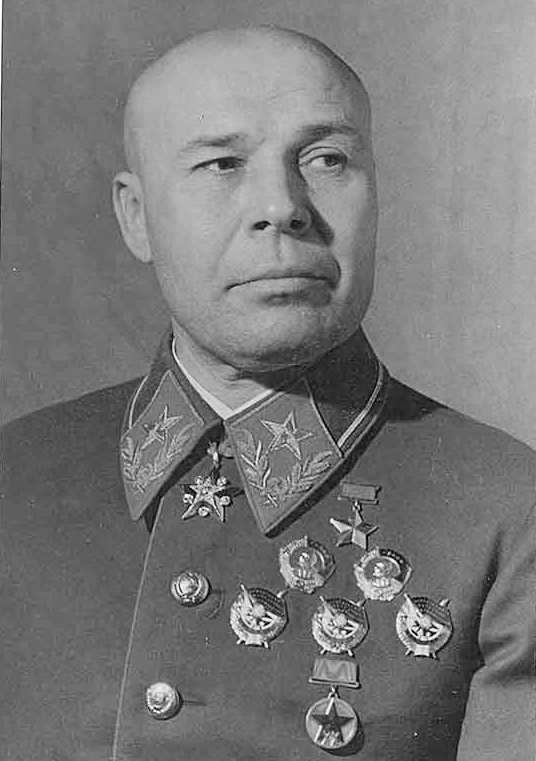
Portrait of Semyon Timoshenko
The Last Cavalryman
Semyon Timoshenko was a Bessarabian peasant who joined the Tsar's cavalry, rode with the First Cavalry Army through the Russian Civil War alongside Budyonny and a political commissar named Stalin, and spent the next twenty years being promoted for it. When the purge of 1937 to 1938 destroyed the Red Army's senior leadership — three of five marshals shot, most of the corps commanders with them — men like Timoshenko rose by default: survivors of the Civil War fraternity, personally trusted, doctrinally formed before tanks mattered. He was made People's Commissar for Defence in May 1940 after the Finnish war exposed just how bad things had become, and he took the job seriously.
He was, in fact, a genuine reformer within the limits of what he could imagine. He tightened discipline, restored realistic field training, rewrote the combat regulations, reorganized the mechanized corps, and told the December 1940 command conference in plain words that the Wehrmacht had demonstrated something the Red Army did not yet possess. But the reforms were mid-course when the invasion came, and Timoshenko's own frame of reference — massed formations, prepared defence, methodical counterattack — belonged to a war that no longer existed. In this archive that combination reads as ISTJ: conscientious, procedurally serious, and anchored to the accumulated experience of an army that had just been overtaken.
What followed was the worst assignment of the war. He was chairman of the Stavka in the first catastrophic weeks, then commanded the Western Direction through the summer, fought the long attritional battle around Smolensk that cost the Germans time they never recovered, and then took over the Southwestern Direction in September 1941 just in time to preside over the encirclement of four Soviet armies east of Kiev — the largest single military disaster in history by prisoner count. In May 1942 he launched the Kharkov offensive, which ended with his own attacking armies surrounded. After that he never again held a decisive command.
Timoshenko is the ISTJ at the hinge of an era — dominant Si reaching for the accumulated method of the Red Army in a summer when the accumulated method had nothing left to say.
The Manual He Had Written Himself
Introverted Sensing trusts what has been verified by experience, and Timoshenko's experience was deep, coherent, and about to expire. His reform program of 1940 to 1941 is the clearest expression of it: everything he fixed was something he had personally seen fail in Finland or in the Civil War — slack discipline, unrealistic training, poor march order, officers who could not read a map under fire. These were real defects and he corrected them with real thoroughness. What he could not do was correct a defect he had never experienced, and nobody in the Soviet system had experienced a panzer group.
So the summer of 1941 became a sequence of correct answers to the wrong question. The standing directives ordered immediate counterattack against any incursion; Timoshenko issued them, and mechanized corps drove piecemeal into German spearheads and burned. The doctrine assumed a continuous front and a deliberate battle; the Wehrmacht offered neither. At Smolensk he did eventually find something that worked — sustained, repeated, unspectacular counterattacks that traded lives for weeks — and that, too, is Si: not a new concept, but the old one applied with enough stubbornness to matter. Those weeks are arguably why Moscow held in December.
Orders, Regulations, and the Limits of Order
Auxiliary Extraverted Thinking made him an effective administrator of an army and an inadequate commander of one in freefall. As Defence Commissar he was excellent at the things that could be specified — new combat regulations, retrained officer courses, a rebuilt disciplinary code, the reconstitution of formations the purge had hollowed out. His Order No. 0362 restoring the death penalty for unauthorized retreat, and the general severity of his 1940 discipline reforms, show a Te that reached instinctively for the enforceable rule.
Kiev is where the method broke. Timoshenko arrived in the Southwestern Direction with the encirclement already forming; his own assessment and that of the General Staff was that the salient had to be abandoned, but the order to hold came from a supreme commander who would not concede the city, and Timoshenko — unlike Zhukov, who had already lost his post over exactly this argument — executed rather than fought. Roughly six hundred thousand men went into captivity. It is the defining limitation of a Si-Te officer under Stalin: the procedure said obey, and the procedure had never before been so lethally wrong.
Why ISTJ Over ESTJ
Why not ESTJ?
He held the outward roles of an ESTJ — Defence Commissar, marshal, front commander — but never the outward manner. Contemporaries describe a taciturn, physically imposing man who worked through written regulation rather than force of presence, who did not dominate conferences, and who yielded in argument to authority instead of pressing his own reading. Where the ESTJs of this day, Zhukov and Konev, drove their subordinates by sheer personal weight, Timoshenko governed by document and precedent. The dominance sits inward, on the remembered standard, not outward on the room.
The type also explains his eclipse better than any story about competence. Timoshenko was not a bad soldier; he was a soldier whose entire internal reference library described a war of fronts and masses, promoted into command of a war of penetration and encirclement, and honest enough to be visibly out of his depth. The younger men who replaced him — Zhukov, Rokossovsky, Konev — were not more conscientious. They were simply willing to fight a war their memories had not prepared them for.
Connected Figures
Further Reading
- When Titans Clashed: How the Red Army Stopped Hitler — David M. Glantz and Jonathan HouseThe standard operational survey of 1941, including Smolensk and Kiev.
- Stumbling Colossus: The Red Army on the Eve of World War — David M. GlantzThe state of the army Timoshenko inherited and tried to reform in 1940.
- Barbarossa: The Russian-German Conflict, 1941–45 — Alan ClarkNarrative account of the first catastrophic summer of the Eastern Front.
- Stalin's Wars: From World War to Cold War, 1939–1953 — Geoffrey RobertsHow the Kiev decision was actually taken, and who argued which side.
- Kharkov 1942: Anatomy of a Military Disaster — David M. GlantzThe failed offensive that ended Timoshenko's career as a front commander.
