 Historical Figure MBTI
#969 · 7-16-26 · The Eastern Front
Ivan Konev
Marshal · Zhukov's Rival · Race to Berlin
1897 — 1973
6 min read
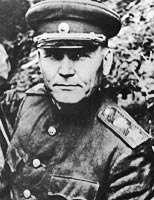
Portrait of Ivan Konev, c. 1945
Second Place, and Furious About It
Ivan Konev began the war one bad week away from being shot. In October 1941 the Western Front he commanded was torn apart at Vyazma, whole armies vanished into encirclement, and a commission arrived from Moscow to establish blame — the standard prelude to an execution. He was saved by Zhukov, who told Stalin that shooting Konev would solve nothing and asked to keep him as a deputy. Sixteen years later, when Zhukov was denounced and stripped of office by the Party leadership, Konev put his name to the article in Pravda that made the public case against him. The two facts are the whole relationship.
Between those bookends he became one of the two or three most effective front commanders in the Red Army: a lumberjack's son from Vologda, a Civil War commissar, hard-driving, foul-mouthed, indifferent to comfort, and utterly focused on the metric that mattered — ground taken, formations destroyed, the report that would reach the Kremlin tonight. At Korsun in early 1944 he trapped and annihilated a German pocket and was made Marshal of the Soviet Union for it. Through 1944 and into 1945 his First Ukrainian Front drove across Ukraine, Poland, and Silesia in a series of offensives whose defining quality was pace.
And then, in April 1945, the famous scene: Stalin summons Zhukov and Konev, hears both plans for the assault on Berlin, and draws the boundary line between their fronts on the map — stopping the line short of the city, a deliberate ambiguity that invited the two marshals to race for it. Konev swung his tank armies north and very nearly beat his rival to the Reichstag. That competitive drive, unashamed and structural, is what marks him as an ESTJ: a man for whom rank, results, and recognition were not distractions from the work but the point of it.
Konev is the ESTJ as career soldier — dominant Te measuring everything in kilometres gained and divisions destroyed, with Si supplying the hard-earned method and the long institutional memory of every slight.
Everything Measured in Ground
Extraverted Thinking organizes toward a result that can be counted, and Konev counted relentlessly. His fronts were run on tempo: artillery preparation on schedule, tank armies committed early rather than held back for the classical breakthrough moment, follow-on echelons pushed through gaps before the enemy could seal them. The Vistula-Oder operation in January 1945 is the pure expression — a lunge of roughly three hundred miles in under three weeks, planned to a timetable and executed by driving formations past the point where a cautious commander would have paused to consolidate.
He was hard on subordinates in a way that bordered on the punitive, and he was hard on the enemy without much interest in the distinction between military necessity and simple destruction — at Korsun he ordered the cavalry onto retreating columns, and the killing was extensive enough that even Soviet accounts describe it uneasily. What made him valuable to the Stavka was precisely this: a commander who would deliver the objective on the date given and treat any consideration that slowed him as an obstacle to be reported around rather than accommodated.
The same function governed his politics. Konev understood the Soviet hierarchy as a system with inputs and outputs, and he worked it accordingly — a well-timed report, a claim staked on a captured city, a signature on a denunciation when the leadership required one. It is unlovely and it is entirely consistent: Te takes the institution as it finds it and optimizes within its rules.
The Method and the Grudge
Auxiliary Introverted Sensing gave Konev his reliability and his repertoire. He did not invent an operational idea in the whole war; he executed the standing Soviet method — massive artillery density, deep echelonment, tank armies for exploitation — with a precision refined by each successive offensive. Korsun, Lvov-Sandomierz, Vistula-Oder, Upper Silesia and Berlin are recognizably the same operation performed at increasing scale by a man who had learned exactly where it tended to go wrong and closed each gap in turn.
Si is also where the rivalry lives. Konev kept accounts. He remembered Vyazma and who had held his career in his hands; he remembered every boundary line, every headline that named Zhukov and not him, every occasion on which he had arrived second at a city. That the memory eventually discharged itself in the 1957 attack on Zhukov, and again in 1961 when he was sent to command the Soviet forces in Berlin during the crisis that produced the Wall, says less about ideology than about a mind that stored slights the way it stored artillery tables.
Why ESTJ Over ENTJ
Why not ENTJ?
The ambition is ENTJ-scaled, but ambition is not a function. An ENTJ's drive is organized around a strategic conception he wants realized; Konev's was organized around position — rank, favour, the city entered first, the name in the communiqué. His operations are textbook applications of Soviet deep-battle doctrine performed faster and harder than anyone else could perform them, not departures from it. Where Rokossovsky argued the Stavka out of its own plan on the strength of a private vision, Konev asked for a wider sector and a firmer deadline.
He and Zhukov are the same type running at each other, which is why the rivalry was so durable and so sterile: two Te-dominants with the same doctrine, the same ruthlessness, and only one Berlin between them. The difference was weight of authority rather than kind of mind. Zhukov got the Reichstag, the surrender, and the white horse; Konev got Prague, a lasting grievance, and eventually the pen with which he tried to settle it.
Connected Figures
Further Reading
- Year of Victory — Ivan KonevHis own account of 1945, including the race for Berlin as he chose to tell it.
- The Fall of Berlin 1945 — Antony BeevorThe competing fronts, the boundary line, and the final assault.
- When Titans Clashed: How the Red Army Stopped Hitler — David M. Glantz and Jonathan HouseOperational context for Korsun, Lvov-Sandomierz, and Vistula-Oder.
- Stalin's Generals — Harold Shukman, ed.Biographical essays placing Konev among his peers and rivals.
- Stalin's Wars: From World War to Cold War, 1939–1953 — Geoffrey RobertsThe command politics that made the Zhukov rivalry useful to the Kremlin.
