 Historical Figure MBTI
#967 · 7-16-26 · The Eastern Front
Konstantin Rokossovsky
Marshal · From NKVD Cell to Moscow's Savior
1896 — 1968
6 min read
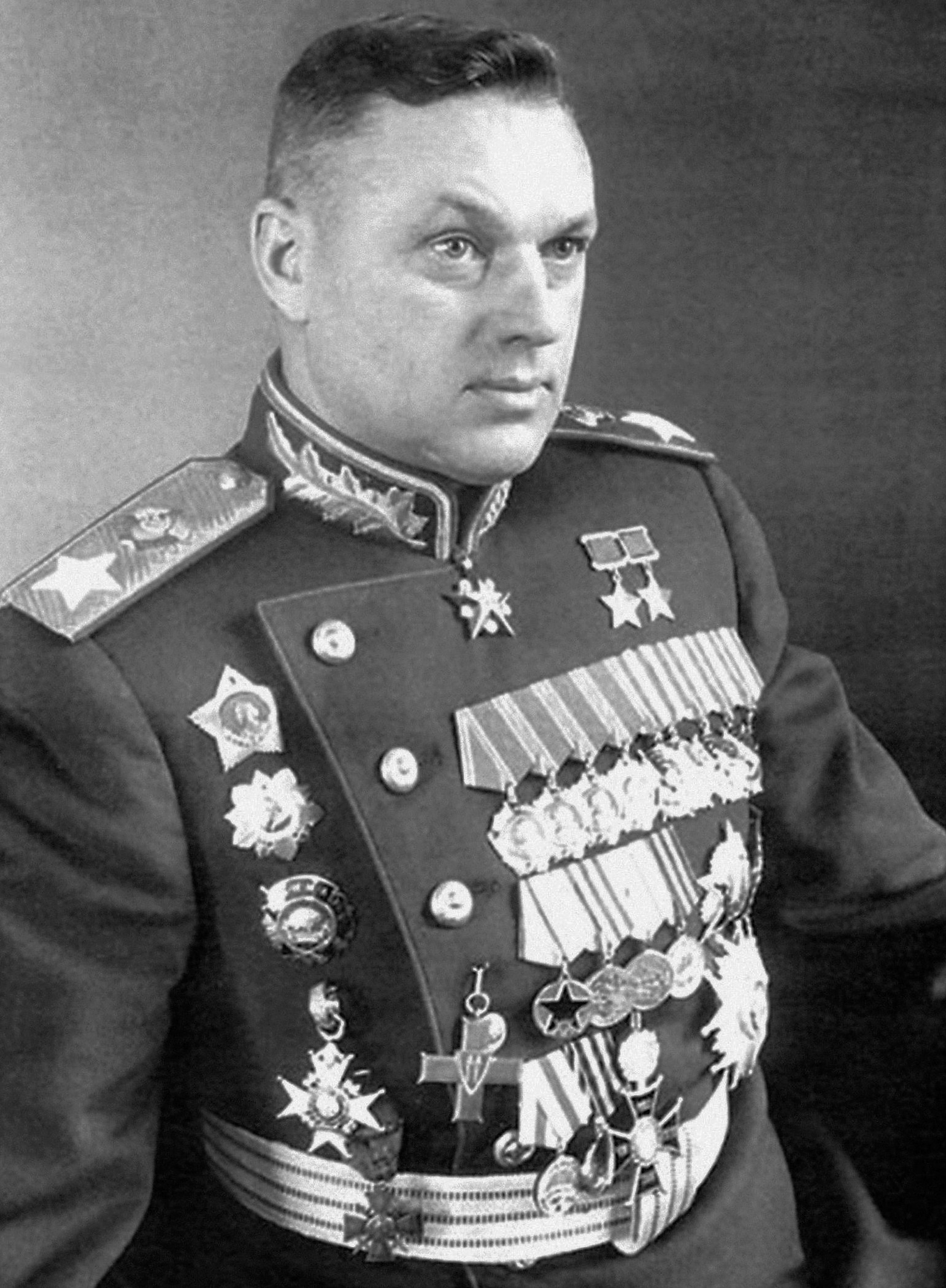
Portrait of Konstantin Rokossovsky
They Broke His Fingers, Then Gave Him an Army
In August 1937 the NKVD arrested a corps commander of Polish descent named Konstantin Rokossovsky on charges invented by his own service — espionage for Poland and Japan, on the testimony of a man who had been dead for years. He was held for nearly three years. He was beaten; teeth were knocked out, fingers were broken with a hammer, ribs were cracked. He was twice taken out for mock execution, marched to a wall and made to stand while other prisoners were shot beside him. He signed nothing and named no one. In March 1940, with the Red Army visibly wrecked by its own purge and the Wehrmacht visibly coming, the state that had done this to him let him out, sent him to a sanatorium to recover, restored his rank, and handed him a mechanized corps.
Nothing in what followed suggests that he ever allowed the experience to govern him. Within eighteen months he was fighting a delaying action toward Smolensk, then holding the Volokolamsk axis in front of Moscow with a scratch army improvised from broken formations, and by 1942 he had one of the two fronts whose armies met at Kalach to seal the German Sixth Army inside Stalingrad — the surrender of Paulus was taken in his sector. Then Kursk, then Bagration, then Poland and the Baltic coast. He is one of the very few men in this archive who was tortured by his own government and then went on to save its capital.
What makes him unusual among Soviet commanders is not only the survival but the manner. His soldiers and staff describe a tall, courteous officer who did not shout, did not threaten, listened to subordinates before deciding, and issued fewer punitive orders than almost any front commander of comparable rank. That combination — decisive, forward-driving command married to genuine consideration for the men executing it — is the mark of a ENTJ whose ambition was aimed at the objective rather than at the people in the room.
Rokossovsky is the ENTJ under a state that had every reason to make him small — dominant Te commanding hard and forward, with a Ni that kept insisting on the operation that would actually end the war rather than the one that would please the Kremlin tonight.
Command Without Terror
Extraverted Thinking organizes the field, and Rokossovsky organized his by delegation rather than intimidation — a rare method in an army where fear was the standard management tool. He gave army commanders their objectives and left them the how; he inspected constantly; he relieved officers who could not perform but did so without the denunciations that would have sent them to the cellars he had come out of. The result was a front that functioned when its commander was absent, which is the only real test of a Te structure.
It showed in the mechanics of the great encirclements. At Stalingrad his armies formed the inner ring and then spent two months methodically compressing it, refusing the temptation to storm and instead reducing the pocket by starvation, artillery, and sequential attacks — a slow, arithmetic operation that ended with ninety thousand prisoners and the surrender of a field marshal. At Bagration in 1944 he ran the southern wing that broke Army Group Centre open, and the organizational feat there was as much engineering as tactics: he insisted on attacking through the Pripet marshes that the Germans had written off as impassable, and built the corduroy roads to make it true.
The Two Main Blows
The clearest single demonstration of his auxiliary Ni came at the planning conference for Bagration, where the Stavka doctrine of a single concentrated main effort collided with Rokossovsky's conviction that the marshy Bobruisk sector required two simultaneous main blows on divergent axes. Stalin twice sent him out of the room to reconsider. He came back both times with the same answer. He was allowed to do it his way, and the double thrust tore the German southern flank apart — one of the few occasions in the war when a front commander overruled the supreme command by simply outlasting it in argument.
That episode is Ni in its practical form: a picture of how the battle would unfold that was clearer to him than any authority's preference, and stable enough to be worth risking a return to prison over. It recurs in his willingness to see, in the autumn of 1942, that the Stalingrad pocket would not break out and did not need to be stormed; and in his handling of the long approach to the Vistula, where he consistently planned for where the front would be in a month rather than for the ground in front of him.
What He Refused to Become
Inferior Introverted Feeling is usually the quietest thing about an ENTJ, and in Rokossovsky it is visible mainly as a line he would not cross. He had every excuse to become cruel and did not; asked after the war about his imprisonment, he deflected with a joke rather than a grievance, and he kept a revolver in his desk in case they ever came for him again rather than making a career out of proving his loyalty at other men's expense. The refusal to denounce, under torture and afterward, is not softness. It is a private standard held so firmly that the state could not reach it.
Why ENTJ Over ESTJ
Why not ESTJ?
The ESTJ reading captures the drive and the organizational competence but misses what he actually argued for. Rokossovsky's memorable moments are not applications of established procedure — they are departures from it: two main blows where doctrine demanded one, an offensive routed through marshes the manual called impassable, a pocket reduced by patience where the Kremlin wanted assault. An ESTJ optimizes the accepted method under pressure; Rokossovsky repeatedly staked his neck on a picture of the campaign that the accepted method did not contain.
Set him beside Zhukov, who had once been his subordinate in the prewar cavalry and became his superior in the war, and the contrast sharpens. Zhukov is Te-Si: overwhelming force applied by known method, argument won by weight. Rokossovsky is Te-Ni: force applied along an axis he had seen before anyone else did, argument won by refusing to be moved off a vision. Both were formidable. Only one of them was remembered by his own soldiers with something close to affection.
Connected Figures
Further Reading
- A Soldier's Duty — Konstantin RokossovskyHis memoir, written under censorship and silent on the years in prison.
- When Titans Clashed: How the Red Army Stopped Hitler — David M. Glantz and Jonathan HouseOperational context for Moscow, Stalingrad, and Bagration.
- The Great Terror: A Reassessment — Robert ConquestThe purge machinery that swallowed the Red Army officer corps, Rokossovsky included.
- Stalingrad: The Fateful Siege, 1942–1943 — Antony BeevorIncludes the reduction of the pocket and the surrender taken in his sector.
- Belorussia 1944: The Soviet General Staff Study — David M. Glantz and Harold S. OrensteinThe Bagration plan, including the two-main-blows dispute.
