 Historical Figure MBTI
#964 · 7-15-26 · The Pacific War
James Doolittle
Aviator · The Tokyo Raid · Calculated Risk
1896 — 1993
8 min read
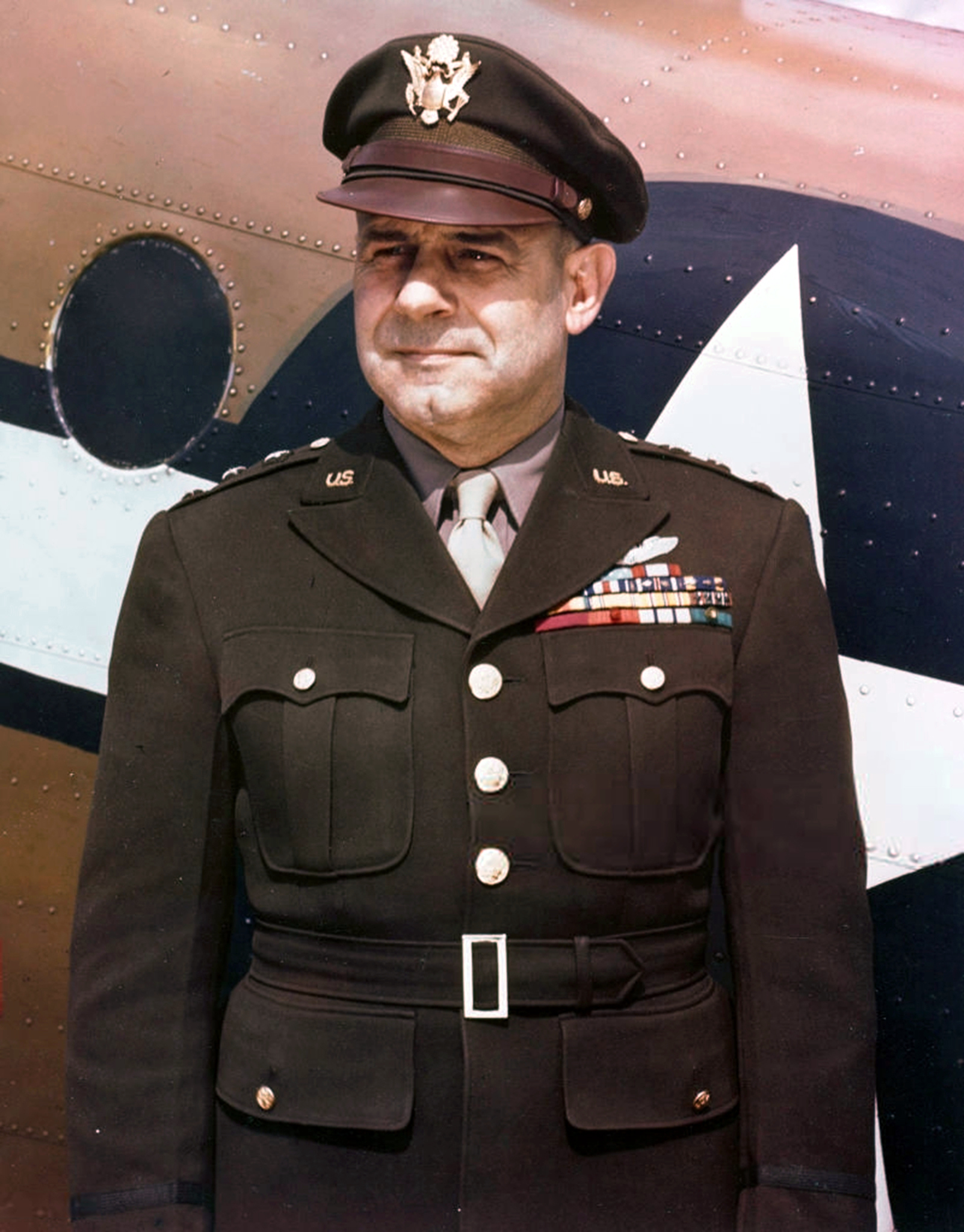
Portrait of James Doolittle
The Impossible Take-Off
On the morning of 18 April 1942, in a heaving sea six hundred and fifty miles from Japan, a twin-engine Army medium bomber sat with its brakes locked and its engines screaming at the forward end of the flight deck of the carrier Hornet. It had about four hundred and sixty feet of deck. B-25s needed considerably more, had never flown from a ship, and had no arresting gear, no folding wings and no way of ever coming back. The first aircraft off was flown by the man who had planned the whole operation, on the sound principle that if it could not be done he would be the one who found out.
James Harold Doolittle was by then forty-five years old and had already had one complete and spectacular career. He had flown the first coast-to-coast crossing in under a day, taken the Schneider, Bendix and Thompson trophies, performed the first outside loop, and — most consequentially — in September 1929 flown an aircraft from take-off to landing with the cockpit hooded, navigating entirely by instruments he had helped develop. He was also, and this is the part usually left out of the legend, a doctor of aeronautical engineering from MIT.
The archive types him ESTP: the physical virtuoso whose recklessness was always, on inspection, arithmetic. Doolittle did things that looked suicidal and had usually calculated them to three decimal places first.
ESTP. Dominant Extraverted Sensing — mastery of the machine in the moment, with an engineer's ledger open underneath it.
Hands on the Machine
Doolittle's entire life ran through his hands. He was a competitive boxer as a teenager, small and quick and willing to be hit. He barnstormed and raced, won the Schneider Trophy in 1925, and took the Bendix and the Thompson in 1931 and 1932 — in a period when air racing killed pilots at a rate that would now be a public scandal. He broke both ankles in Chile in 1926 and, with both legs in casts, performed an aerobatic display anyway.
That physical relationship with the aircraft is what made the Tokyo raid thinkable. Doolittle personally ran the modification and training program at Eglin Field: stripping the B-25s of their Norden bombsights and lower gun turrets, adding fuel tanks in every void, mounting broomsticks in the tail cones to suggest guns that were not there, and drilling volunteer crews for weeks on short-field take-offs marked out on a runway to carrier dimensions. He flew the profile himself until he knew, in his body, exactly how much deck a loaded B-25 needed with full flaps and a thirty-knot headwind over the bow.
And when the plan collapsed, he adapted inside a minute. The task force was spotted by a Japanese picket boat some two hundred miles short of the intended launch point, and Halsey turned the raiders loose early — meaning every crew would run out of fuel over China in darkness and bad weather. Doolittle led sixteen aircraft off the deck, put his bombs on Tokyo at rooftop height in broad daylight, flew west until the tanks were dry, and bailed out into a rice paddy in Zhejiang in the dark. Se does not panic when the plan changes; it simply keeps flying the aircraft it is in.
The Doctorate Behind the Stunt
Doolittle took a doctorate in aeronautics from MIT in 1925, with a thesis on the stresses aircraft structures suffer in accelerated flight — work he conducted partly by throwing fighters around the sky with instruments strapped in the cockpit until they came apart. This is the auxiliary Introverted Thinking that organizes everything else about him: the stunt is never only a stunt; it is an experiment with a pilot inside it.
His most durable contribution was made in 1929 in a Consolidated NY-2 with a canvas hood over the cockpit. Working with the Guggenheim Fund, Doolittle helped develop and then personally validated the combination of artificial horizon, directional gyro and precision altimeter that made blind flight possible, and flew a complete take-off, circuit and landing seeing nothing but the panel. Every commercial airliner that has ever landed in cloud descends from that flight. It did more for aviation than the Tokyo raid did for the war.
The same analytical streak ran through his later commands. As an Army Air Forces general he pushed through the 100-octane aviation fuel program with Shell before the war — an unglamorous chemistry problem that gave American engines a decisive power margin — and in early 1944, commanding the Eighth Air Force, he made the decision that broke the Luftwaffe: releasing the escort fighters from close formation with the bombers and letting them hunt. Bomber crews hated it, because the fighters were no longer visible beside them. It was, on the arithmetic, the correct trade, and within months German fighter strength collapsed.
A Raid Aimed at Morale
The Tokyo raid had almost no material effect; sixteen aircraft dropped sixteen tons of bombs on a city of millions. It was never meant to be a material operation. It was aimed squarely at what people felt — at an American public four months into a run of unbroken defeats, and at a Japanese high command that had promised the home islands could not be touched. Doolittle understood that, and the fact that he was already a famous name was part of the instrument.
Tertiary Extraverted Feeling shows most plainly in the hours after the raid. Sitting on the wreckage of his bomber in China, having lost all sixteen aircraft, Doolittle told his crew chief he expected a court-martial when he got home. He was thinking about the men — eight captured, three executed by the Japanese, others killed in the crashes, and the Chinese civilians of Zhejiang who would suffer a savage reprisal campaign for sheltering the raiders. He came home to the Medal of Honor and a brigadier general's star instead, and spent the rest of his life insisting the decoration belonged to the crews.
He kept that up for fifty years. The Doolittle Raiders held an annual reunion with a set of eighty silver goblets, each engraved with a raider's name, turned upside down as each man died — collective ritual that is pure Fe, and that Doolittle sustained until he was among the last few standing.
The Consequence He Did Not Foresee
An ESTP's Introverted Intuition is the least developed part of the apparatus, and Doolittle's case is unusually clean: the most important effect of his most famous operation was one nobody involved had planned. The humiliation of bombers over Tokyo settled a long-running argument inside the Imperial Navy in Isoroku Yamamoto's favor. The eastern perimeter had to be pushed out; the American carriers had to be forced to a decisive battle; the Midway operation, which the Naval General Staff had been resisting, was approved. Six weeks later four Japanese fleet carriers were on the bottom.
Doolittle himself never claimed that chain of causation, and to the end described the raid in the flattest possible terms — sixteen aircraft, a few bombs, a lot of luck. The strategic reading was supplied by historians afterward. He operated brilliantly on the situation in front of him and left the meaning of it to other people, which is what the inferior function does.
Where he did reach for the long view, he reached late and cautiously — the postwar Air Force studies he chaired, the space and missile advisory work. He lived to ninety-six, saw the instruments he had proved in a hooded cockpit become universal, and remained, in his own account of himself, a pilot who had been good with an aeroplane.
Why ESTP Over ISTP
Why not ISTP?
The doctorate, the instrument-flight research and the 100-octane fuel program all argue for the quiet technical craftsman, and Doolittle was unquestionably that in part. But the ISTP works inward and alone, and Doolittle spent his life in front of crowds — a racing pilot who understood publicity as a tool, a commander who recruited eighty volunteers for a mission he could not describe and held them together on personal credit, and the deliberate public face of a raid whose entire purpose was emotional. He read rooms and audiences as fluently as he read an aircraft. That outward-facing Fe, sitting under Se and Ti, is the extraverted variant.
Set beside William Halsey, the other ESTP in this cluster, the comparison is instructive. Both were aggressive, physical, press-conscious men who moved toward danger. Halsey's Ti served his instinct — he analyzed fast in order to act faster, and at Leyte Gulf the instinct outran the analysis. Doolittle's ran the other way: his Ti was a trained scientific instrument that made his most theatrical risks the safest available version of themselves. The same type, calibrated by an engineering education, produces a man who bets everything and rarely loses.
Connected Figures
Further Reading
- I Could Never Be So Lucky Again — James H. Doolittle with Carroll V. GlinesHis own memoir — flat, technical and unsentimental, which is itself revealing.
- Thirty Seconds Over Tokyo — Ted W. LawsonWritten by one of the raid's pilots within a year of it; the crews' view of the mission.
- The First Heroes: The Extraordinary Story of the Doolittle Raid — Craig NelsonModern account, strong on the fate of the captured crews and the Chinese reprisals.
- Target Tokyo: Jimmy Doolittle and the Raid That Avenged Pearl Harbor — James M. ScottThe fullest scholarly treatment, including the raid's effect on Japanese strategic decisions.
- Masters of the Air — Donald L. MillerCovers the Eighth Air Force under Doolittle and the fighter-release decision that broke the Luftwaffe.
