 Historical Figure MBTI
#962 · 7-15-26 · The Pacific War
William Halsey
Admiral · "Bull" Halsey · Aggression as Doctrine
1882 — 1959
8 min read
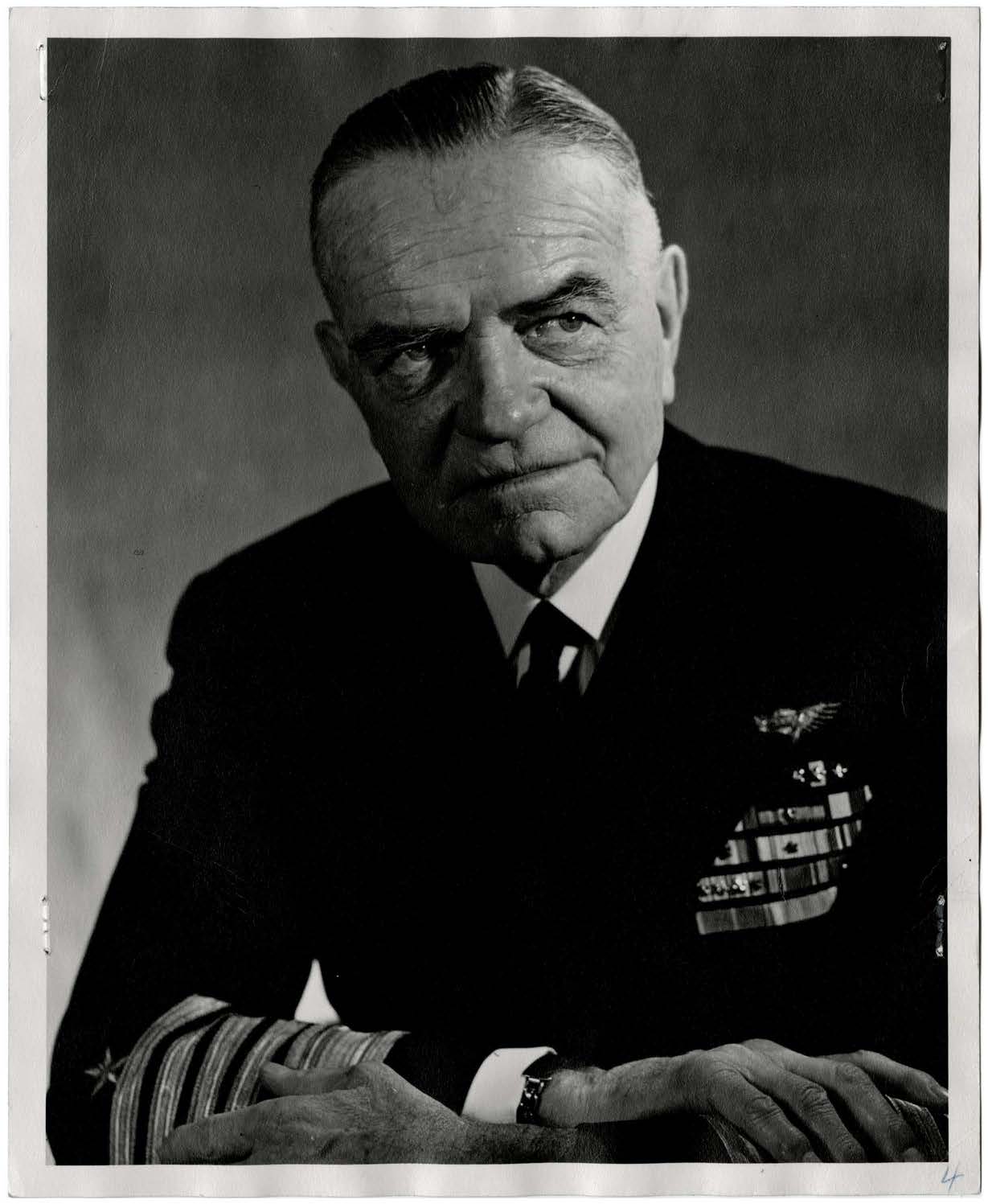
Portrait of William Halsey
The Fleet Needed Someone to Punch Something
In October 1942 the American position at Guadalcanal was close to collapsing. The Marines ashore were starving and malarial, the Navy had lost four cruisers in a single night off Savo Island and would not risk its transports after dark, and the theater commander was privately drafting the case for withdrawal. Chester Nimitz relieved him and put in William Halsey. Halsey's first act, on being asked by war correspondents for his strategy, was to say: kill Japs, kill Japs, keep on killing Japs. Marines in the mud on Guadalcanal read it in the field papers and, by every account of the campaign, the mood changed within days.
That is what Halsey was for. He was not the war's cleverest admiral, and he knew it. He was its most physically present one — a heavy-jawed, profane, gregarious sailor who wore his emotions in public, drank with his officers, took his flagship into places prudence forbade, and generated around himself a field of pure forward motion. He had qualified as a naval aviator at fifty-two, an absurd age for it, essentially because he wanted to fly the aircraft he intended to command. He hated the nickname “Bull” — an invention of the press — and lived up to it anyway.
The archive types him ESTP: the tactician of the immediate, whose gift and whose defect are the same organ. He read a developing situation faster than any officer in the Pacific and could not stop himself from moving toward the nearest fight.
ESTP. Dominant Extraverted Sensing — an appetite for the fight in front of him, powerful enough to be a doctrine and dangerous enough to be a flaw.
Motion as a Theory of War
In the first months of 1942, when the U.S. Navy had nothing to hit back with, Halsey took carriers on raids that more careful officers considered pointless — the Marshalls and Gilberts in February, Wake, Marcus Island — deep strikes into Japanese-held water that did modest damage and enormous psychological work. In April he steamed Enterprise and Hornet to within eight hundred miles of Japan so that James Doolittle's Army bombers could be launched at Tokyo, then turned and ran when a picket boat spotted the force. He was not building a campaign. He was refusing to let the war be a thing that happened to him.
At Guadalcanal he did the same thing on a larger scale, and it was the right instrument. Where his predecessor had husbanded ships, Halsey spent them — sending the damaged Enterprise back to sea with a repair crew still aboard, committing battleships into the confined, reef-strewn waters of Ironbottom Sound at night in November 1942, a use of capital ships that doctrine flatly forbade and that broke the Japanese reinforcement effort. He visited the front constantly, walked among the Marines, ate what they ate. His command style was physical, sensory and immediate: be there, see it, hit it now.
The same Se made him the war's great morale engine: the growled quotes, the sign posted in the South Pacific, the promise to ride the Emperor's white horse through Tokyo. It was a caricature, and a deliberate one, and it worked on tens of thousands of exhausted men.
The Technician Under the Bluster
Beneath the persona was a genuinely capable operator, and the auxiliary Introverted Thinking is where he did his real work. Halsey was one of the earliest senior officers to grasp that the aircraft carrier had made the battle line obsolete, and he grasped it in the concrete way an ESTP does — by getting the pilot's wings himself in 1935 and flying enough to understand what an air group could actually do. He ran Saratoga and later a carrier division on that understanding.
His Ti also shows in his tactical improvisation. The Doolittle Raid was an engineering puzzle — Army medium bombers had never left a carrier deck — and Halsey handled his half of it with unsentimental clarity: the launch point was a calculated function of fuel, detection risk and the fleet's escape route, and when the force was sighted early he launched at once, two hundred miles farther out than planned, knowing it would cost the raiders their landing fields. It was a hard, correct, coldly reasoned call, made in minutes.
What Ti in the auxiliary slot does not give you is a strategic frame. His ability to look at a chart and immediately see the move was real; the question of whether that move served the campaign was somebody else's department, and usually Nimitz's.
The Admiral His Men Loved
No American commander of the war was more openly emotional in front of his own people. Halsey wept in public at the losses on Guadalcanal, ate in the enlisted mess, wrote personal letters to the families of dead aviators, and cultivated the press with an ease Spruance found distasteful and Nimitz simply could not manage. His crews adored him, and he knew exactly what that was worth in a theater where the material odds had, for a year, been against them.
Tertiary Fe also explains his generosity toward peers. Ordered ashore with a savage case of psoriasis on the eve of Midway, he recommended Raymond Spruance — a cruiser man with no aviation background — to take his carriers, then spent the rest of his life refusing to hint that he might have done it better. The shadow of the same function is its dependence on an audience. Halsey was acutely conscious of how he was being seen, and his most damaging decisions came at moments when the aggressive move was also the one the Navy, the press and his own reputation would applaud. A commander who feels the room can be steered by it.
Leyte Gulf, and the Bait He Could Not Refuse
On 24 October 1944, with the American landings at Leyte still unloading, Halsey's scouts found a Japanese carrier force to the north. The carriers were nearly empty — they had almost no aircraft left, and had been sent specifically as bait to pull the Third Fleet away from the San Bernardino Strait, through which a battleship force would then fall on the vulnerable invasion shipping. Halsey took every ship he had, including the fast battleships covering the strait, and went north. The strait was left unguarded. Only the suicidal resistance of a handful of escort carriers and destroyers off Samar the next morning prevented a catastrophe.
This is the inferior function in its purest form. Introverted Intuition asks what the enemy's move means — why these carriers, why here, why now — and it is precisely the question Halsey did not ask. What he saw was enemy flight decks within reach, and the sight of them was decisive. Nimitz's subsequent query as to the whereabouts of Task Force 34, garbled by a signalman's padding into something that read as mockery, reduced him to tears on his own flag bridge.
The same blind spot cost him two typhoons. In December 1944 and again in June 1945 he drove the Third Fleet into storms his own aerologists' data should have warned him off, losing three destroyers, some eight hundred men and hundreds of aircraft. Courts of inquiry twice found him at fault; he was twice retained, because by then he was too valuable a symbol to relieve.
Why ESTP Over ESTJ
Why not ESTJ?
He was loud, dominant, command-oriented and immensely effective at getting a demoralized theater moving, all of which reads ESTJ at a distance. But the ESTJ leads through structure — procedure, hierarchy, the institution's accumulated way of doing things — and Halsey repeatedly did the opposite. He put battleships into a reef-choked night battle against doctrine, launched the Doolittle raiders hundreds of miles early on a snap judgment, and abandoned a guarded strait because enemy carriers were visible to the north. His decisions were made by feel, in the moment, against the manual. That is Se leading with Ti solving, not Te administering.
The cluster makes the case by contrast. Nimitz built the institution and trusted its systems; Spruance built a model of the enemy's next four hours and executed it coldly; Halsey saw a target and went. Each was catastrophically wrong for the other two's assignments — Halsey at Midway would very likely have chased Nagumo into the night and lost carriers America could not replace, and Spruance in the South Pacific in October 1942 would not have lifted a single Marine's morale. Nimitz's real achievement was understanding this and spending each of them where his temperament was an asset.
Connected Figures
Further Reading
- The Admirals: Nimitz, Halsey, Leahy, and King — Walter R. BornemanGroup biography of the four five-star admirals; strong on Halsey's rise and his post-Leyte protection.
- Admiral Bill Halsey: A Naval Life — Thomas Alexander HughesThe modern scholarly biography, and the best account of the gap between the persona and the officer.
- Neptune's Inferno: The U.S. Navy at Guadalcanal — James D. HornfischerThe campaign where Halsey's aggression was exactly the right instrument.
- The Last Stand of the Tin Can Sailors — James D. HornfischerThe battle off Samar — what happened after the Third Fleet went north from San Bernardino Strait.
- Halsey's Typhoon — Bob Drury and Tom ClavinThe December 1944 storm, the court of inquiry, and the limits of driving a fleet by instinct.
