 Historical Figure MBTI
#961 · 7-15-26 · The Pacific War
Raymond Spruance
Admiral · The Quiet Calculator · Victor of Midway
1886 — 1969
8 min read
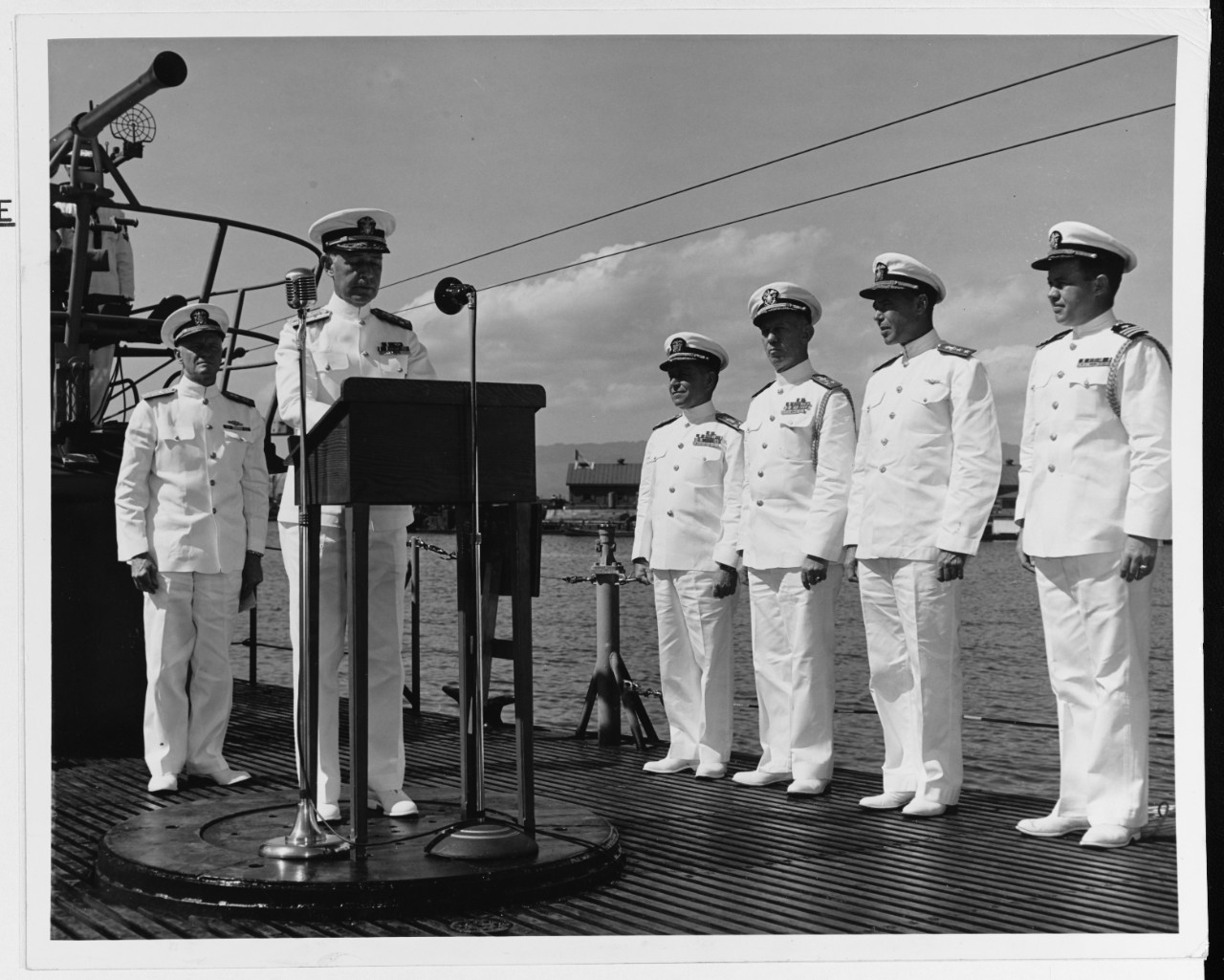
Portrait of Raymond Spruance
The Admiral Who Would Not Perform
In late May 1942, William Halsey came into Pearl Harbor covered in a psoriatic rash so severe he could not sleep, and was ordered ashore to a hospital bed on the eve of the most important battle the U.S. Navy would ever fight. Asked to name a successor for his carrier task force, Halsey named his cruiser screen commander — a man with no aviation training, no carrier experience, and no combat command of his own. Chester Nimitz took the recommendation. Six days later Raymond Spruance destroyed four Japanese fleet carriers in a single morning and permanently altered the balance of the Pacific war.
He was, by universal report, the least colorful officer of his rank in the service. He walked several miles a day, gave no interviews, refused to let war correspondents aboard, and declined to write a memoir. What he possessed instead was an unusual and rather cold mental habit: he could hold an entire operational situation in his head as a single moving picture, run it forward, and act on where it was going rather than where it was.
The archive types him INTJ — the strategist whose decisions are made in advance, in private, against a model of the future rather than the pressure of the present. It is the single most important reason Midway went the way it did.
INTJ. Dominant Introverted Intuition — a private model of where the battle is going, held against every instinct to react to where it is.
The Battle Before It Happens
On the morning of 4 June 1942, Spruance had one piece of information: a scout report placing two Japanese carriers roughly 175 miles away, at the edge of his aircraft's effective range. The conventional move was to close the distance and strike from a position of safety. Spruance did the opposite. He reasoned forward from what the enemy was doing rather than where the enemy was — Nagumo's carriers had just launched a strike against Midway and would shortly have to recover and rearm those aircraft, and during that interval their decks would be crowded with fueled planes and stacked ordnance. He launched everything he had at extreme range, an hour earlier than doctrine advised, to hit a window that did not yet exist.
The window opened exactly as he had modeled it. American dive bombers arrived over Akagi, Kaga and Sōryū in the minutes when their flight decks were at maximum vulnerability, and three carriers burned within six minutes. Historians have since noted that the fragmented, badly coordinated American attack succeeded partly through luck. That is true of the execution. It is not true of the decision, which was a deliberate trade of certainty for timing, made by a man reasoning about a future state of the enemy's deck.
The same faculty ran his later campaigns. At the Philippine Sea in June 1944 he concluded, from an incomplete picture, that a Japanese force might be trying to draw him away from the Saipan invasion beaches, and refused to sail west to hunt the enemy carriers. The aviators in his own fleet were furious; the phrase “Spruance lost his nerve” circulated for decades. He had simply extended the situation forward and seen that his mission was the landing force, not the enemy fleet, and that the fleet would come to him anyway. It did, and lost some six hundred aircraft doing it.
Execution Without Ornament
An INTJ's Extraverted Thinking is the machinery that turns the private vision into orders, and Spruance's was ruthlessly economical. He took over Halsey's staff wholesale before Midway and did not replace a single officer, because he needed carrier expertise he did not have and it was already sitting in front of him — then used Miles Browning, Halsey's abrasive chief of staff, as a technical resource while reserving every actual decision to himself. It is a startlingly unsentimental piece of organizational design, assembled in about forty-eight hours by a man taking a job he had never trained for.
His command style was similarly stripped down: short verbal orders, almost nothing written, subordinates expected to think. As commander of the Fifth Fleet he ran the largest amphibious operations in history — Tarawa, Kwajalein, Saipan, Iwo Jima, Okinawa — as engineering problems with a schedule, and helped institute the practice of rotating the whole fleet staff, so that while he fought one operation Halsey planned the next and the same ships sailed under two numbers. It doubled the tempo of the war.
The Te also shows in what he refused to spend. After Midway he broke off pursuit on the night of 4 June rather than steam west in the dark toward a beaten enemy who still had battleships and a surface night-fighting advantage. He wrote afterward that he did not want to be caught before dawn by a superior surface force. He had won; the correct move was to bank the win. Half the Navy thought him timid. He had merely finished the calculation.
A Private Standard
Spruance's tertiary Introverted Feeling was almost invisible and entirely uncompromising. He had a horror of publicity that went well beyond modesty: he banned reporters from his flagship, suppressed his own name in press releases, and after Midway allowed the credit to settle on others without objection. When Congress later moved to promote him, he did not lobby, and he ended the war outranked in fame by men he had outfought.
He also carried a quiet, undemonstrative loyalty to Halsey — the friend who had recommended him, whose reputation he never traded on and never undercut, even when Halsey's judgment at Leyte Gulf invited the comparison and the entire officer corps was making it. He was equally unwilling to defend himself against the aviators' charge that he had thrown away the Philippine Sea, on the grounds that his reasoning had been recorded at the time and either stood or did not.
What Fi does not supply is warmth on demand. He was distant with almost everyone, took long silent walks that subordinates learned to join without speaking, and reportedly found the emotional performance expected of a wartime commander faintly embarrassing. His men did not love him the way Halsey's loved Halsey. They trusted him more.
The Missing Appetite
Inferior Extraverted Sensing is the INTJ's blind spot, and in a naval commander it takes a very specific form: a distrust of the immediate, visible, seizable opportunity. Every criticism ever made of Spruance is a criticism of his Se. He would not chase at Midway. He would not chase at the Philippine Sea. He was, in the aviators' phrase, an admiral who fought battles rather than pursued enemies, and the killer instinct that would have turned two great victories into annihilating ones was simply not in him.
It is worth being precise about the cost. At the Philippine Sea, Japan's carrier aviation was destroyed but its carriers largely escaped, and those same hulls reappeared four months later at Leyte Gulf as the decoy force that lured Halsey out of position. A more Se-driven commander might have ended the Japanese carrier arm outright in June 1944. Spruance judged the risk to his invasion force unacceptable, and by the terms of his own mission he was right; by the terms of the wider war, the argument has never fully closed.
Where his Se did surface, it surfaced as physical discipline rather than appetite — the daily walks, the indifference to comfort, the habit of pacing a flag bridge for hours in silence. He handled the sensory present by regimenting it.
Why INTJ Over ISTJ
Why not ISTJ?
Spruance shares the surface with Nimitz — quiet, reserved, procedurally exact, allergic to publicity — and the ISTJ reading is the obvious one. It fails on the two decisions that made his name. Launching at extreme range against a carrier deck that was not yet vulnerable, and breaking off a pursuit that every precedent and every instinct in the service demanded, are not procedural moves; they are independent forecasts overriding doctrine. An ISTJ reasons from the accumulated record of what has worked. Spruance repeatedly reasoned from a projected future state that no record contained, and accepted being thought timid rather than revise it. That is Ni leading, with Te executing.
Set the two men side by side and the difference is clean. Nimitz was a custodian: he held the institution together, remembered what it could bear, and chose which subordinate the moment required. Spruance was a calculator: he built a model of the enemy's next four hours and bet three irreplaceable carriers on it. Both were reserved, both were disciplined, both refused theatrics — and the resemblance ends the moment either of them had to decide something. Nimitz decided by weighing what was known. Spruance decided by seeing what was coming, which is why the Navy handed him the battle rather than the fleet.
Connected Figures
Further Reading
- The Quiet Warrior: A Biography of Admiral Raymond A. Spruance — Thomas B. BuellThe standard life, and the fullest defense of his decisions at Midway and the Philippine Sea.
- Shattered Sword: The Untold Story of the Battle of Midway — Jonathan Parshall and Anthony TullyReconstructs the Japanese side hour by hour and sharpens what Spruance's timing actually achieved.
- Miracle at Midway — Gordon W. PrangeNarrative account built on both American and Japanese participants' testimony.
- The Admirals: Nimitz, Halsey, Leahy, and King — Walter R. BornemanUseful for the contrast between Spruance's calculation and Halsey's aggression under the same superior.
- History of United States Naval Operations in World War II — Samuel Eliot MorisonThe official narrative; Morison's judgment of Spruance as the war's finest flag officer sits here.
