 Historical Figure MBTI
#963 · 7-15-26 · The Pacific War
Joseph Rochefort
Codebreaker · Station Hypo · The Man Who Proved "AF"
1900 — 1976
7 min read
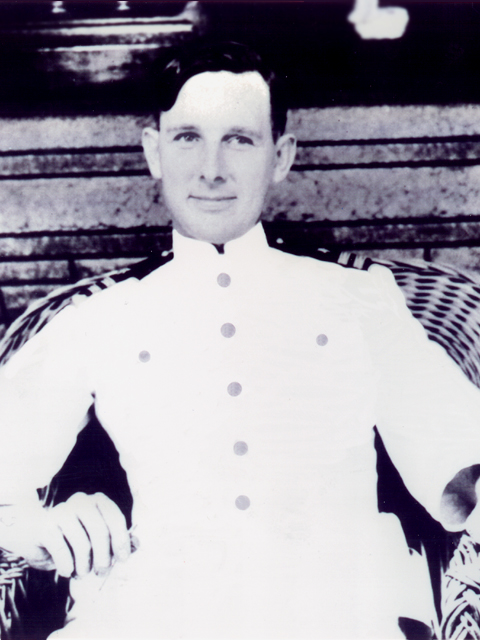
Portrait of Joseph Rochefort
The Basement Under the Navy Yard
He worked in a windowless concrete room in the basement of the Fourteenth Naval District building at Pearl Harbor, where the air conditioning ran cold enough that he wore a red smoking jacket over his uniform and carpet slippers on his feet. He slept on a cot when he slept at all and drove his analysts through eighteen-hour shifts sorting five-digit groups of a Japanese naval code the Navy had never fully read. In May 1942 that room told Chester Nimitz where the Japanese fleet was going, and the Pacific war turned on it.
Joseph Rochefort was an oddity even by the standards of cryptanalysis: an enlisted man commissioned from the ranks, without a college degree, pushed into codebreaking in 1925 because he was good at crossword puzzles, who then spent three years in Japan learning the language well enough to think in it. That combination — fluent Japanese, deep cryptanalytic training, and years of watching how the Imperial Navy actually talked to itself — existed in perhaps two or three people alive.
The archive types him INTP: an obsessive internal analyst whose great moment came not from following the procedure but from generating a sideways idea nobody had thought to try.
INTP. Dominant Introverted Thinking — a mind that would not accept a conclusion it had not personally derived, in a service that ran on rank.
The Private Logic of JN-25
JN-25 was a code superimposed on a cipher: a book of some 45,000 five-digit groups, each further disguised by an additive key. In early 1942 Station Hypo could read perhaps ten to fifteen percent of any given message. Working a code at that fraction is not decryption but reconstruction — you infer the missing structure from the shape of what survives, and must be able to say precisely why each inference holds. Rochefort could hold the whole edifice of assumptions in his head at once and audit it continuously.
Ti in the dominant position shows most clearly in what he would not do: accept a finding on authority. Washington's own code section, OP-20-G, read the same traffic and reached a different conclusion about the Japanese objective, arguing for the South Pacific or even the American west coast. Rochefort did not defer. He went back through his own derivations, satisfied himself that the internal logic held, and then told his commander-in-chief that the Navy's central intelligence organization was wrong. He was a lieutenant commander at the time.
The Water-Shortage Trick
By mid-May 1942 Hypo could see an enormous operation forming against a place the Japanese called “AF.” Rochefort was convinced AF was Midway; the evidence was circumstantial, and Washington was not persuaded. There was no procedural route to certainty — you cannot make a broken code tell you the one thing it will not say. So Rochefort and his officers did something no manual describes: they made the enemy say it.
Midway's garrison was instructed, over a secure undersea cable, to broadcast in clear, unencrypted English a report that its water distillation plant had broken down and the island was short of fresh water. Within two days Hypo intercepted a Japanese signal reporting that AF was short of fresh water. The identification was no longer an inference; it was a confession. Nimitz now had the target, and from further traffic the approximate date and the composition of the attacking force, and he set the ambush north-east of Midway that cost Japan four fleet carriers.
That trick is the signature of auxiliary Extraverted Intuition working off a Ti foundation. The analysis had narrowed the possibilities to a near certainty; what was missing was proof, and Ne supplied it laterally — not by digging harder at the cipher, but by realizing the enemy's own reporting habits could be used as an instrument and baiting them into operating it.
Twenty Years of Stored Traffic
Tertiary Introverted Sensing gave Rochefort the raw material his logic worked on. He had spent the interwar years accumulating an intimate, concrete familiarity with the Imperial Japanese Navy's communications: the honorifics, the call-sign conventions, the individual operators whose keying habits could be recognized like handwriting, the ordinary rhythm of a fleet at peace. Traffic analysis depends entirely on knowing what normal looks like, and Rochefort had two decades of normal stored away. It was that baseline, more than any single decrypt, that let Hypo detect the Midway operation forming — a surge of messages to one command, a carrier division's call signs appearing where they should not, none of it decisive alone, all of it legible against a remembered background.
The Politics He Could Not Play
Inferior Extraverted Feeling is the INTP's exposed flank, and Rochefort's career was destroyed by it. He was blunt to the point of insubordination about the competence of officers senior to him, made no effort to flatter Washington, and had humiliated OP-20-G in front of the commander-in-chief. Within months of Midway the men he had contradicted arranged his removal. Nimitz twice recommended him for the Distinguished Service Medal; the recommendation was twice blocked. Rochefort spent the rest of the war commanding a floating drydock in San Francisco — the Navy's finest Pacific cryptanalyst, kept away from the code room for the duration.
He never publicly complained, and never explained himself well either. Where his Fe did operate was inward, on his own unit: analysts remembered a commander who worked beside them and took the blame upward without passing it down. The medal was finally awarded in 1986, ten years after he died.
The Other Basement, Six Thousand Miles Away
Rochefort's basement had a twin. At Bletchley Park the same war was being fought against a different machine by the same kind of people — Alan Turing, whose bombe mechanized the search through Enigma's settings; Gordon Welchman, whose diagonal board made that search vastly faster and who built the industrial organization of Hut 6 around it; Joan Clarke, one of the few women admitted to the naval Enigma problem on equal terms; and before all of them Marian Rejewski, the Polish mathematician who had reconstructed the Enigma's wiring from pure permutation theory and handed the British their starting point.
The two efforts never merged, but they were the same discovery arrived at independently: that a modern war is won in a room full of quiet, ferociously analytical people who are never seen and cannot be thanked. Both rooms produced the same organizational tragedy as well. Turing was prosecuted and ruined by the state he had saved; Welchman was stripped of his clearance for writing about what he had done; Clarke worked at a fraction of the pay and rank her work commanded; Rejewski spent the war shut out of the problem he had solved. Rochefort is the American entry in that ledger — proved right at the decisive moment of the Pacific war, and exiled to a drydock for it.
Why INTP Over ISTJ
Why not ISTJ?
Codebreaking looks like clerical work, and Rochefort's twenty years of stored traffic knowledge, his tolerance for grinding routine and his personal reserve all point toward ISTJ. The Midway proof rules it out. Nothing in the procedure told him to have a garrison broadcast a false message in clear and wait for the enemy to repeat it back; that was a sideways inferential leap generated on the spot, built on a private analysis he had already satisfied himself was sound. Add his flat refusal to accept OP-20-G's finding on authority — the exact opposite of the ISTJ's deference to the institution — and the reading is Ti reasoning with Ne improvising, not Si with Te.
It is also the reading that explains his ruin. An ISTJ of comparable ability would have delivered the same intelligence and kept his career, framing the disagreement as a matter of record and letting rank resolve it. Rochefort argued as though being right were sufficient — a proposition only a Ti-dominant believes, and only in a laboratory. He won the argument, won the battle, and lost everything that followed from it.
Connected Figures
Further Reading
- Joe Rochefort's War: The Odyssey of the Codebreaker Who Outwitted Yamamoto at Midway — Elliot CarlsonThe definitive biography, including the Washington politics that ended his career.
- And I Was There: Pearl Harbor and Midway — Breaking the Secrets — Edwin T. Layton, with Roger Pineau and John CostelloMemoir by Nimitz's intelligence officer and Rochefort's closest ally; the insider account of the AF proof.
- Shattered Sword: The Untold Story of the Battle of Midway — Jonathan Parshall and Anthony TullyWhat the intelligence was actually worth once the Japanese fleet was in range.
- The Codebreakers — David KahnThe standard general history of cryptology; places Hypo alongside the British and Polish efforts.
- The Hut Six Story — Gordon WelchmanThe Bletchley Park counterpart's account — the book whose publication cost Welchman his clearance.
