 Historical Figure MBTI
#960 · 7-15-26 · The Pacific War
Chester Nimitz
Fleet Admiral · Institutional Steady Hand · Architect of the Pacific Victory
1885 — 1966
9 min read
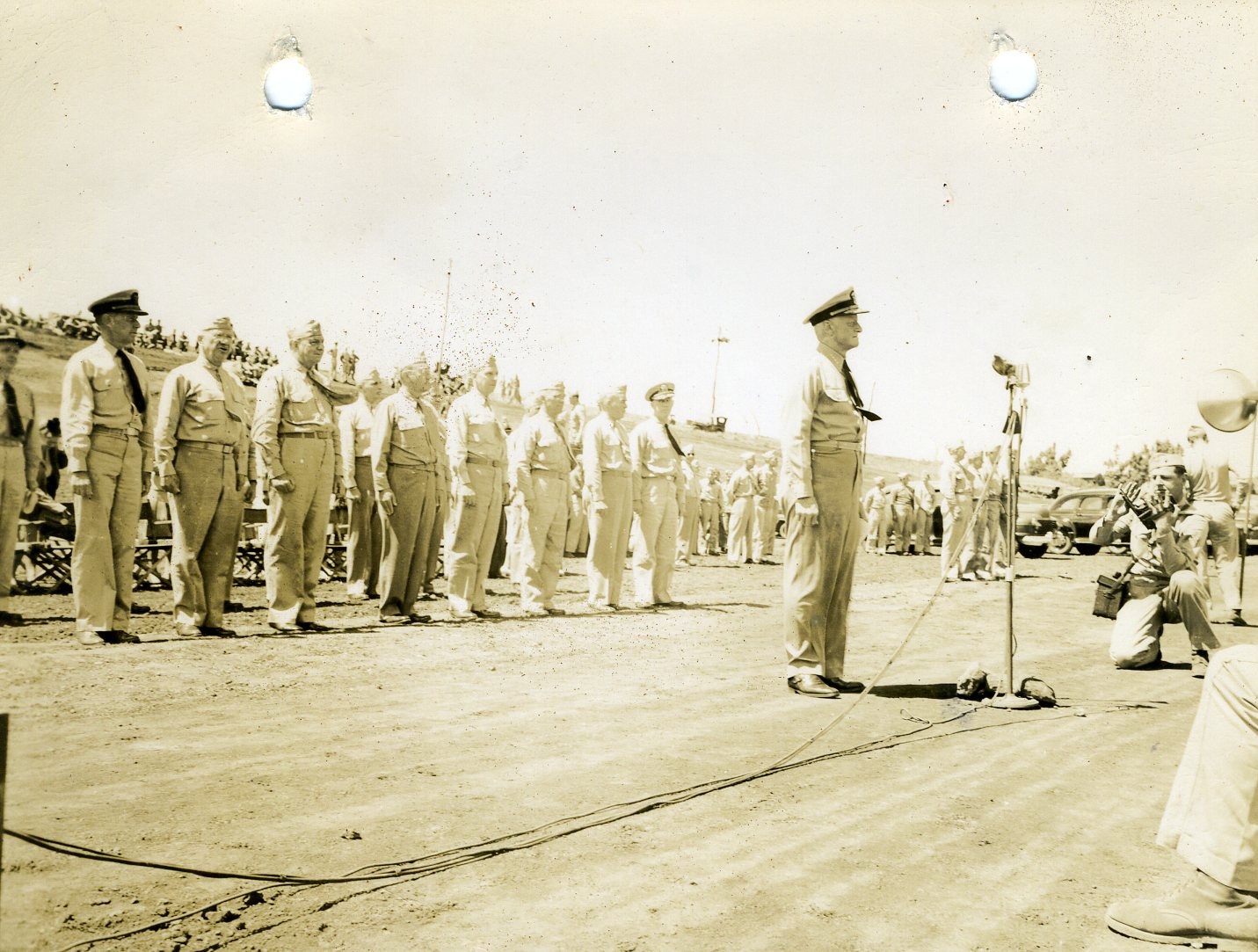
Portrait of Chester Nimitz
The Man Who Inherited a Graveyard
He arrived at Pearl Harbor on Christmas Eve, 1941, and was rowed through an oil-slicked harbor past the capsized hull of the Oklahoma and the still-smoking wreck of the Arizona. Bodies were being recovered from the water as his boat passed. It was the least enviable command in the world: a battle line on the bottom of the harbor, an officer corps in shock, a predecessor relieved in disgrace, and an enemy running unchecked from the Aleutians to the Java Sea. Chester Nimitz's first act as commander of the Pacific Fleet was not a plan of attack. It was to keep almost every officer on the existing staff in place, and to tell them, plainly, that he had confidence in them.
That decision tells you nearly everything. A more theatrical man would have cleaned house, made an example, arrived with a new doctrine and new favorites. Nimitz looked at a functioning institution that had suffered a catastrophe and decided the institution was sound and the catastrophe survivable. He commanded the largest fleet ever assembled and remained, in temperament, a submarine engineer from Fredericksburg, Texas, who liked routine, disliked publicity, and kept his voice down.
He is the hardest kind of great commander to dramatize, because his virtues were institutional rather than personal. He did not charge, did not coin slogans, did not stand on a bridge in a storm. He built a system that could not be knocked over, aimed it, and let men like Halsey and Spruance do the swinging. The archive types him ISTJ — the custodian temperament that wins wars slowly by never losing the thread.
ISTJ. Dominant Introverted Sensing — a memory for how things actually work, fused to a refusal to be stampeded off it.
The Custodian's Memory
Nimitz spent the interwar years in the unglamorous interior of the Navy: diesel engines and submarines, a tour building the first Naval ROTC unit at Berkeley, the Bureau of Navigation shuffling officer assignments. That last posting is the least romantic job in the service and the most revealing one for his psychology. For years he handled personnel files — who was competent, who was brittle, who had been passed over unfairly, who was ready for a step up. When he took the Pacific Fleet, he did not need to be told who his people were. He had a stored, concrete, individually indexed picture of the officer corps in his head, and he drew on it constantly.
Introverted Sensing is not nostalgia; it is an accumulated internal record of how things have actually behaved, consulted before anything new is attempted. Nimitz ran the Pacific war out of that record. He knew what a fleet oiler could and could not do, because he had been an engineer. He knew how long a hull took to repair, and so when the damaged Yorktown limped into Pearl before Midway with a repair estimate of weeks, he walked into the drydock himself, waded into the water in his shoes to look at the damage, and gave the yard seventy-two hours. She sailed in three days and her aircraft helped sink two Japanese carriers. That was not inspiration. That was a man who knew, from long acquaintance, what the yard could really do when told the truth about the stakes.
The same faculty produced his famous stability. He kept a fixed daily routine at Pearl — pistol practice, a long walk, horseshoes, an early bed — through the worst months of 1942, and subordinates described the effect as contagious calm. It was the outward face of an inner life organized around continuity: the war would be long, the machine would grind, and the commander's job was to keep the grinding regular.
Logistics as a Theory of Victory
Nimitz's auxiliary Extraverted Thinking shows in the shape of the campaign he ran. The Central Pacific drive from 1943 onward was not a series of brilliant strokes; it was an assembly line. The bloody chaos at Tarawa in November 1943 produced a specific institutional output: amphibious tractors in greater numbers, better pre-landing bombardment, reef reconnaissance, revised naval gunfire doctrine. The next landing, at Kwajalein, cost a fraction as much. That is Te at its purest — treat a disaster as data, restructure the procedure, move on.
His signature strategic instrument was the same thinking made enormous. Rather than reduce every Japanese garrison, he bypassed them, leaving fortified islands like Truk and Rabaul to starve behind the advance while the fleet took only what it needed for airfields and anchorages. Meanwhile Service Squadron Ten turned the fleet train itself into a mobile base, refueling, rearming and repairing warships at sea so that the fast carriers never had to go home. It was an unglamorous, deeply organizational idea, and it did more to beat Japan than any single battle.
He also had the Te executive's willingness to make a decision on the evidence and then own it entirely. In May 1942, when Station Hypo's cryptanalysts concluded the next Japanese blow would fall on Midway, Washington's own code section disagreed and argued for the South Pacific. Nimitz weighed the two readings, backed his own intelligence officer, and committed three carriers he could not replace to an ambush north-east of a two-mile atoll. He then wrote out the operating principle for his commanders himself: calculated risk — engage only where the expected damage to the enemy exceeds the expected loss to us. It is possibly the most characteristic sentence he ever produced. Even his gambles were written as policy.
The Quiet Interior
Nimitz's tertiary Introverted Feeling was almost entirely private and almost entirely about decency. He wrote to his wife constantly. He personally answered condolence correspondence. He refused, throughout the war, to permit the racial abuse of the enemy that was the common idiom of the Pacific theater — he did not use it, did not print it, and let his distaste for it be known. After the surrender he made a point of publicly opposing the desecration of Japanese war dead and, in the 1950s, quietly contributed to the restoration of Admiral Togo's flagship Mikasa, an act that cost him goodwill at home and that he never explained at length. He did not argue his values. He simply acted on them and declined to discuss it.
The same function shows in his handling of failure. He inherited a fleet whose previous commander, Husband Kimmel, had been made the scapegoat for Pearl Harbor, and he refused to join the pile-on; he protected officers who had made honest mistakes and got them back to sea. Fi in the tertiary position is also a limit. Nimitz was not warm in the way Halsey was warm, could not perform affection for a crew or a newsreel, and was famously hard to read. Officers who worked for him for years described a man they revered and did not know. What they got instead of charm was something more useful — the certainty that he would not lie to them, would not steal their credit, and would not throw them overboard to save himself.
Borrowed Imagination
An ISTJ's inferior Extraverted Intuition is the weakest instrument in the kit, and Nimitz managed his the way a good executive manages any weakness: he outsourced it. He did not generate the wild idea, but he built a headquarters designed to receive one. His staff conferences were famously open — junior officers were expected to argue, and he listened without signaling his own position first. Rochefort's Midway deduction, the submarine campaign against Japanese merchant shipping, the leapfrogging of Truk: none of these originated with Nimitz. All of them were adopted by him, which was the harder part.
Where the inferior function did break surface, it broke as gambling — the Midway decision, the early 1942 carrier raids most of his staff thought pointless, the willingness to let Doolittle's Army bombers ride a carrier deep into Japanese waters. He hedged them all the same way: with an explicit formula for how much he was prepared to lose. The shadow side appeared in his one real strategic misjudgment. Nimitz had trouble imagining an operation whose value was political rather than material, and so he argued against the reconquest of the Philippines and for striking Formosa instead — a cleaner, more efficient path on the map, and a proposal that discounted everything Douglas MacArthur understood about what a broken promise costs. Roosevelt overruled him. Nimitz, characteristically, stopped arguing the moment the decision was made and executed the operation he had opposed.
Why ISTJ Over ISTP
Why not ISTP?
The engineering background and the low-key, unshowy manner make ISTP tempting — Nimitz was a submariner who could read a diesel plant and wade into a drydock to check a hull himself. But the ISTP's strength is hands-on tactical improvisation in the present moment, and Nimitz never once fought that way. His decisive contributions were organizational: rebuilding a shattered command structure, standing up a logistics train that let a fleet live at sea for months, converting a bloody landing into revised doctrine, and trusting a system of intelligence he could not personally verify. He did not solve problems by touching them; he solved them by building an institution that would keep solving them without him in the room. That is Si–Te custodianship, not Ti–Se craft.
The clarifying comparison is with the two men beside him. Halsey fought by feel, in the moment, and was magnificent and dangerous for exactly that reason. Spruance thought his way to a picture of the battle and then executed it coldly. Nimitz did neither. He assembled the conditions — the ships, the fuel, the intelligence, the commanders — and then chose which of his subordinates' temperaments the situation required. Midway got Spruance because Midway was a calculation. The South Pacific in late 1942, where morale was collapsing, got Halsey because that theater needed a brawler. Knowing which instrument to reach for, and having built the cabinet they were kept in, is the ISTJ's form of genius.
Connected Figures
Further Reading
- Nimitz — E. B. PotterThe standard full-length biography, written with access to the admiral and his family.
- The Admirals: Nimitz, Halsey, Leahy, and King — Walter R. BornemanGroup portrait of the four five-star admirals; strong on how their temperaments divided the war between them.
- Miracle at Midway — Gordon W. PrangeDetailed reconstruction of the intelligence picture and Nimitz's decision to commit his carriers.
- Shattered Sword: The Untold Story of the Battle of Midway — Jonathan Parshall and Anthony TullyRevisionist account from the Japanese records that reframes what Nimitz's gamble actually risked.
- Neptune's Inferno: The U.S. Navy at Guadalcanal — James D. HornfischerThe grinding campaign that tested Nimitz's logistics and forced his decision to send Halsey south.
