 Historical Figure MBTI
#959 · 7-14-26 · The Pacific War
Masaharu Homma
General · Bataan Death March Commander · Executed for Others’ Crimes
1887 — 1946
7 min read
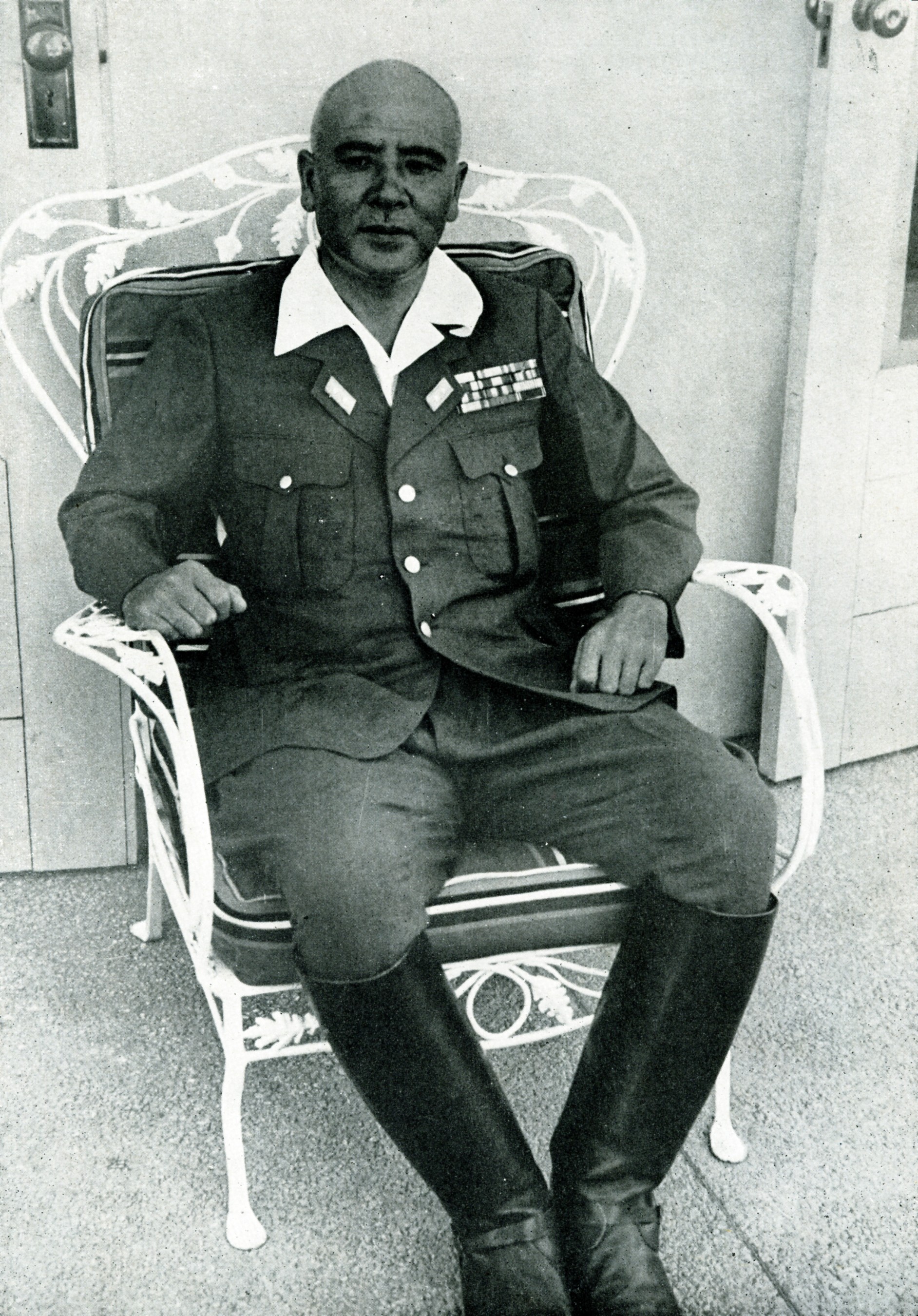
Portrait of Masaharu Homma
The Poet General and the Road Out of Bataan
Begin with the fact that decided everything. In April 1942, after the surrender of Bataan, some seventy-six thousand American and Filipino prisoners were force-marched roughly sixty-five miles north toward Camp O’Donnell. Men already starving and sick with malaria and dysentery were denied water, beaten, bayoneted, and shot where they fell; estimates of the dead on the march run from several hundred to more than six hundred Americans and from five thousand to as many as ten thousand Filipinos, with many thousands more dying in the camps in the weeks that followed. This happened under the command of Lieutenant General Masaharu Homma, commander of the Japanese 14th Army, and it is the reason his name is remembered at all.
The controversy that has never been resolved is what Homma himself knew and did. By most accounts — including the testimony at his own trial — the march’s brutality was organized and executed by subordinate officers and guards, and Homma, headquartered elsewhere and absorbed in reducing Corregidor, was not shown its scale in real time and issued no order for it. He claimed he learned the details only two months later. His prosecutors did not need to prove that he had ordered it: the American military commission that tried him in Manila in early 1946 held him to a standard of command responsibility — that a commander is answerable for the conduct of the men under him and for the failure to know. He was convicted and executed by firing squad in April 1946. Whether that standard was applied justly or was, in part, a victor’s and a rival’s verdict is still argued by lawyers and historians. Neither reading returns the dead, and neither dissolves the fact that the atrocity happened inside his command.
What makes Homma an unsettling study is that the man in the dock did not resemble the crime. He painted, wrote poetry and plays, had spent eight years attached to the British Army, spoke fluent English, was reckoned pro-Western by his own general staff, and was known in Japan as the poet general.
Homma reads as an ISFP: a Fi-dominant aesthete with a private, deeply felt moral world and almost no instinct for the grinding Te work of controlling the machine he had been handed.
A Private Conscience in a Public Uniform
Dominant Introverted Feeling is a self-referential moral compass — intensely held, rarely argued, and often invisible to everyone outside it. Homma’s was formed abroad. Sent to the British Army as a language officer, he served with the Indian Corps in France in 1918, won a Military Cross, and came home with an admiration for the Anglo-American world that he never fully concealed and that cost him steadily in a general staff moving the other way. He argued against the wider war with China and against war with the United States, and was regarded in Tokyo as soft — a suspicion that followed him into the Philippines command.
Fi also explains his conduct in occupation. He treated Filipino civil society with a conciliatory hand, released political prisoners, courted the local elite rather than terrorising them, and pressed a policy of accommodation that his own staff and Tokyo found insufficiently ruthless. It explains, too, the trial. Where other defendants denied everything, Homma took the stand, admitted that he had been the commander, declined to hide behind his subordinates, and accepted the finding with a composure that impressed even the prosecution. In his last letters he apologised to his wife for the disgrace and asked to be shot as a soldier rather than hanged; the request was granted.
None of this is exculpation, and the entry should not be read as offering any. A commander who holds a private moral standard while the men under him kill prisoners on the road has not been moral; he has been absent. Fi that never converts into enforcement is, in a man with seventy-six thousand lives in his charge, precisely the failure the doctrine of command responsibility was written to reach.
The World Taken In Through the Eye
Auxiliary Extraverted Sensing shows in how Homma engaged the world: directly, physically, aesthetically. He painted. He wrote plays and had them staged. He was a working journalist’s correspondent for a time and wrote about what he had seen rather than what he had theorized. His years in London and with the British in the field were not a study assignment to him but a lived immersion, and the impressions stuck for the rest of his life.
In command, Se made him decisive at the point of contact and impatient with the plan behind it. The Lingayen landings and the drive on Manila were fast and effective; the city fell within a month. But when the American and Filipino forces withdrew into the Bataan peninsula rather than fighting for the capital, Homma’s war became a problem of logistics, sanitation, and administration on a scale he had not prepared for — and his attention stayed on the present tactical object, Corregidor, while the machinery behind him improvised. The evacuation plan for prisoners had been drawn for a fraction of the number who actually surrendered, and the men who inherited that gap solved it with clubs.
Tokyo, which had wanted Bataan in fifty days, took the delay as proof of the softness it had always suspected. Homma was relieved after Corregidor fell, sent home in August 1942, and spent the rest of the war in reserve, without a command, until Douglas MacArthur’s military commission called him to Manila.
Why ISFP Over INFP
Why not INFP?
The poetry, the moral isolation, and the dissent from his own government all point toward INFP, and the shared dominant Fi makes the two easy to confuse. The difference is the second function. Homma’s engagement with the world was sensory and concrete — painting, theater, reportage, the lived texture of eight years in England — not a system of ideals developed in the abstract. He opposed the American war on assessed practical grounds, having actually seen British and American industrial capacity, rather than from a pacifist principle; an Ne-auxiliary would have generated a philosophy, and Homma generated an eyewitness’s judgment. His gift and his limit were both immediacy: superb at the thing in front of him, blind to the system running behind him.
That blindness is where the typing meets the history. Inferior Te in a man commanding an army is not a charming weakness; it is the missing faculty that should have produced inspections, accountability, and the demand to be told what was happening on the road north. Homma had the temperament of an artist and the responsibilities of a conqueror, and the gap between them was filled by other men who had neither his scruples nor his restraint. The tribunal called that gap a crime. The judgment remains contested — most sharply because the officer who convened the commission was the same one Homma had beaten in 1942 — and the deaths on the road out of Bataan remain a fact that no verdict, contested or not, has ever made lighter.
Connected Figures
Further Reading
- Tears in the Darkness: The Story of the Bataan Death March and Its Aftermath — Michael Norman and Elizabeth M. NormanThe fullest modern account, including a long and unsparing treatment of Homma's trial.
- Bataan: The March of Death — Stanley L. FalkThe standard operational and documentary reconstruction of the march itself.
- But Not in Shame: The Six Months After Pearl Harbor — John TolandNarrative history of the Philippine campaign drawing on Japanese participants, Homma included.
- The Case of General Yamashita — A. Frank ReelA defence counsel's critique of the Manila commissions and the command-responsibility standard.
- Judgment at Tokyo: World War II on Trial and the Making of Modern Asia — Gary J. BassContext for the Allied war-crimes trials and the contested law Homma's case helped establish.
