 Historical Figure MBTI
#955 · 7-14-26 · The Pacific War
Douglas MacArthur
Supreme Commander · “I Shall Return” · American Caesar
1880 — 1964
8 min read
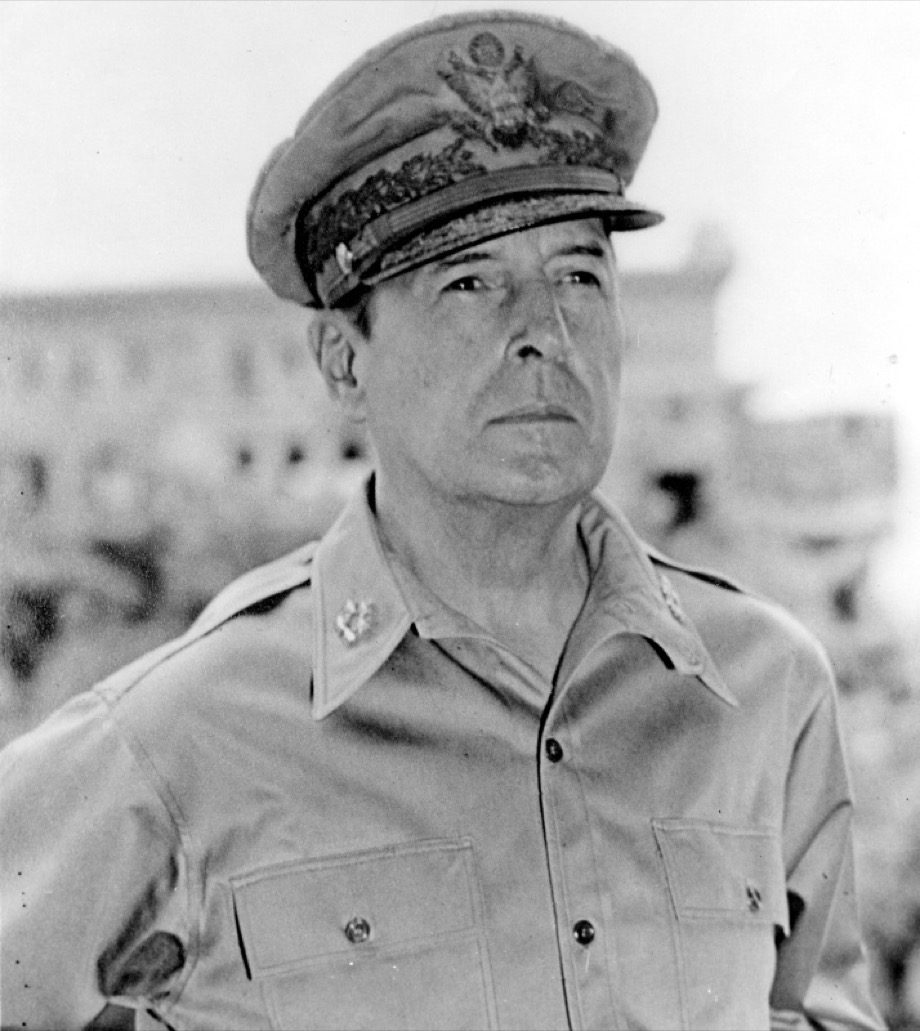
Portrait of Douglas MacArthur
The Man Who Directed His Own Legend
He wore sunglasses he did not need and carried a corncob pipe he rarely smoked, and both were props. Douglas MacArthur understood before almost any soldier of his century that a modern general commands two theaters at once — the one with the maps and the one with the cameras — and that the second theater decides how the first is remembered. When he waded ashore at Leyte in October 1944, he did it more than once, because the first take was not right. That is not usually how we describe courage. It is exactly how we describe a man who thought of his own life as a campaign with objectives, phases, and a desired end state.
The essential MacArthur episode is the one he would least have chosen. In early 1942, with the Philippines collapsing and the garrison starving on Bataan, Roosevelt ordered him out. He went — reluctantly, by PT boat, through Japanese waters — and left Jonathan Wainwright to hold Corregidor and take the surrender. Arriving in Australia, MacArthur turned an evacuation into an oath: I came through and I shall return. The War Department begged him to say “we shall return.” He refused. The pronoun was the point. Defeat had been converted, in a single sentence, into a personal promise that only he could keep — and, in 1944, did.
This is a man best read as ENTJ: an organizer of enormous systems whose charisma was an instrument of control rather than an act of communion. He built armies, theaters, and eventually an occupied nation the way other men build arguments, and he treated the public record as one more subordinate command to be brought into line.
MacArthur was an ENTJ whose dominant Te did not stop at armies — it organized the story of MacArthur too, until the general and the legend reported to the same headquarters.
The Empire of Command
Extraverted Thinking is the drive to impose workable order on the outside world, and MacArthur exercised it at a scale that few soldiers ever get to attempt. He graduated first in his West Point class with one of the highest academic records the academy had recorded, ran the Rainbow Division in France, became Superintendent at West Point at thirty-nine and rewrote its curriculum and athletic program wholesale, and was Army Chief of Staff by fifty. When the Philippine Commonwealth wanted an army, he did not advise on one; he moved to Manila as Field Marshal and undertook to build the institution himself, uniforms, academy, conscription schedule and all.
The Southwest Pacific campaign is Te as a method of war. Rather than grind through every garrison the Japanese had emplaced, MacArthur’s command practiced what became known as leapfrogging — bypassing strongpoints such as Rabaul, seizing the airfield or anchorage that actually moved the line forward, and leaving a hundred thousand enemy troops behind to wither without shipping. It was a logistician’s answer to a heroic problem: identify the objective that produces the measurable result, and refuse to spend men on the ones that merely look decisive.
And the same faculty ran his press. MacArthur’s headquarters issued communiqués written in his own idiom, often naming only one commander in the theater; correspondents who declined the framing found themselves outside the tent. It is fashionable to call this vanity, and vanity is in it. But structurally it is Te — the conviction that an unmanaged narrative is an unmanaged asset, and that a theater commander who lets Washington define his war will soon be given someone else’s objectives.
One Future, Held Without Flinching
Introverted Intuition supplies the single converging vision that Te then builds toward, and MacArthur’s was fixed early and never revised: the Philippines were the hinge of the Pacific, and he would come back to them. Through 1943 the Joint Chiefs and the Navy argued, with real force, for bypassing Luzon altogether and striking at Formosa; the islands could be left to starve like Rabaul. MacArthur went to Roosevelt in Hawaii in July 1944 and argued the return as a strategic and moral necessity, and he won the argument. Leyte followed in October.
Ni also explains the quality that made him formidable and, eventually, dangerous: a vision held with such conviction that contrary evidence reads as noise. He believed Japan could be reconstructed as a democracy by a firm outside hand and, remarkably, was substantially right. He believed in 1950 that a landing at Inchon — tides, seawalls, and every planner’s objection notwithstanding — would unhinge the North Korean army, and he was right there too, spectacularly. Then he believed China would not intervene in force across the Yalu, and he was catastrophically wrong, and the machinery that had made Inchon possible had no brake for it.
That is the recognizable Te-Ni failure mode. The vision is not a hypothesis to be tested but a destination already arrived at; the organization exists to close the distance. When it is right it looks like prophecy. When it is wrong there is no one inside the system whose job it is to say so.
The Photograph, the Gesture, the Stage
MacArthur had a physical instinct for the image that would land — tertiary Se in the service of the plan. In France in 1918 he refused a helmet and gas mask, walked trench raids in a turtleneck sweater with a riding crop, and was decorated repeatedly; the costume was deliberate, and his soldiers talked about it, which was the intended effect. Two decades later he understood that a wire photograph could do work no communiqué could.
Hence Leyte. He could have come ashore dry, on a dock. Instead he came down the ramp into the surf with Sergio Osmeña beside him, jaw set, water at his knees, and the resulting frame became one of the defining images of the Pacific war — restaged for the cameras when the first attempt did not satisfy him. The same instinct governed the surrender ceremony aboard the Missouri in September 1945, staged with the ship’s deck as a proscenium and pens distributed as relics, and his arrival in Japan days earlier, stepping unarmed onto an airfield in a country that had been an enemy the week before. It was physically brave and it was theater, and he never saw why those should be different things.
The Private Cathedral of Destiny
Underneath the machinery ran something intensely personal and almost unshareable: a conviction of his own singular destiny, inherited from a Civil War Medal of Honor father and a mother who followed him to West Point and lived beside the academy grounds. Inferior Fi does not make a man warm. It makes a private, absolute, unexaminable set of values that he cannot argue about because he has never had to put them into words — and that flare into the open when they are touched.
They were touched often. He accepted a payment of half a million dollars from Quezon’s government in 1942 and saw nothing to explain, because his service was self-evidently beyond purchase. He read criticism as a wound to something sacred rather than as a claim to be evaluated. And when Truman relieved him in April 1951 for publicly undercutting administration policy on China, the response was not an argument about civil-military authority but a farewell address to Congress — old soldiers never die, they just fade away — that cast a firing as a martyrdom, and moved a nation to tears while conceding nothing.
The occupation of Japan is where the whole stack shows at once. He governed as a viceroy from the Dai-Ichi building, arriving and leaving on a schedule the country could set its clocks by, and imposed land reform, women’s suffrage, labor rights, and a constitution drafted in a matter of days by his own staff — Te building the structure, Ni certain of the destination, Fi convinced that a personal moral authority entitled him to remake a civilization. That it worked as well as it did remains one of the strangest facts of the century.
Why ENTJ Over ENFJ
Why not ENFJ?
The charisma is real, so the ENFJ reading is tempting — but Fe is attunement, and MacArthur never attuned. An Fe-dominant reads the room and adjusts; MacArthur announced the room’s emotional content and expected it to comply, which is why “I shall return” survived the War Department’s request that he soften it to “we.” He inspired troops he seldom visited and was called Dugout Doug by the men on Bataan he had left behind — a nickname an Fe user would have felt coming and moved to prevent. His warmth was broadcast, not exchanged: the flourish that made a crowd feel chosen, deployed by a man who was not listening back.
Read the pattern across the whole life and it is organizational, not relational. He built institutions — a rewritten West Point, a Philippine army from nothing, a theater command, a reconstructed Japanese state — and he defended his authority over them against Roosevelt, against Chester Nimitz and the Navy’s competing Pacific strategy, and finally against Truman, until the chain of command reasserted itself. INTJ is the other plausible near-miss and it fails on the same evidence in reverse: MacArthur did not work behind the vision, he fronted it, running press operations and public appearances as extensions of command. The dominant function faces outward. It organized armies, occupations, and, with equal seriousness, the historical memory of Douglas MacArthur.
Connected Figures
Further Reading
- American Caesar: Douglas MacArthur 1880–1964 — William ManchesterThe standard popular biography — admiring, skeptical, and unmatched on the theatrical instinct.
- Old Soldiers Never Die: The Life of Douglas MacArthur — Geoffrey PerretA soldier's-eye reassessment that takes the Southwest Pacific campaign seriously as operational art.
- The Most Dangerous Man in America: The Making of Douglas MacArthur — Mark PerryFocused on the war years and the running friction with Washington and the Navy.
- Embracing Defeat: Japan in the Wake of World War II — John W. DowerThe occupation from the Japanese side — indispensable corrective to MacArthur's own account of it.
- Reminiscences — Douglas MacArthurHis memoir; unreliable as history, essential as evidence of how he wished to be read.
