 Historical Figure MBTI
#958 · 7-14-26 · The Pacific War
Arthur Percival
General · The Fall of Singapore · Britain’s Worst Defeat
1887 — 1966
5 min read
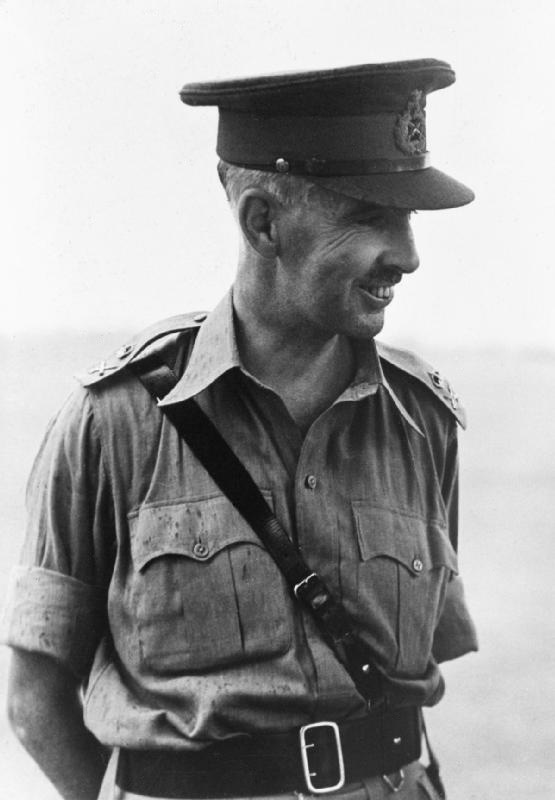
Portrait of Arthur Percival
The Right Officer for the Wrong War
On 15 February 1942 a tall, thin, buck-toothed English general walked toward the Ford factory at Bukit Timah under a Union Jack and a white flag, and surrendered roughly eighty thousand British, Australian and Indian troops to a Japanese force less than half that size and nearly out of ammunition. It was the largest capitulation in British military history. Churchill called it the worst disaster and largest capitulation in British history, and the photograph of Percival walking to meet Yamashita — flag bearer ahead, shorts, tin hat, defeat legible in the posture — became one of the most reproduced images of the war, precisely because it was so easy to read as a verdict on the man.
The verdict was too easy. Percival was a genuinely able soldier: a clerk who enlisted as a private in 1914, won a Military Cross and a DSO in France, was rated one of the outstanding staff officers of his generation, and — this is the bitter part — had himself written the 1937 appreciation warning that Singapore’s real danger was a landing in northern Malaya and an overland advance down the peninsula. He knew where the attack would come from. He simply could not, when it came, stop thinking like the staff officer who had written the paper.
Percival was an ISTJ: a Si-dominant professional whose careful, correct, procedurally impeccable mind met an enemy that had thrown the procedure away.
The Fortress in the Filing Cabinet
Introverted Sensing works from the established, remembered picture of how things are, and Percival’s picture of Singapore was the one the interwar army had built: a naval base whose threat axis ran from the sea, defended by fixed batteries and a garrison holding known ground. He had commanded and staffed and instructed inside that picture for two decades. When the Japanese landed at Kota Bharu and came down through the jungle on bicycles, the picture did not update fast enough. Formations were held forward and fed piecemeal into a running withdrawal; repeated Japanese hooks — small forces landing behind the line or infiltrating around a flank — produced ordered retirements from positions that had not actually been broken.
The most quoted failure is the most Si of all. Percival declined to build substantial fixed defences on the northern shore of Singapore island facing Johore, and his stated reason was that digging them would be bad for civilian and troop morale — the sort of consideration that makes sense inside a settled institutional world and none whatever with an army coming through the rubber. The refusal was not stupidity; it was the reflex of a man for whom the correct peacetime conduct of a garrison was a deeply internalized standard, applied one campaign too late.
Correct Procedure to the Last Signal
Auxiliary Te is the drive to run things properly by an external standard, and Percival ran his command by the book with real competence — the paperwork, the appreciations, the chain of consultation. It made him a superb staff officer and a poor army commander in a fight that required somebody to override the system. He deferred to civil authority over labour and construction when a commander needed to seize it; he negotiated with a fractious Australian subordinate rather than sacking him; he issued orders that were sound in form and arrived after the situation they described had gone.
The surrender itself is Te doing arithmetic without illusion. Churchill had signalled that the city was to be fought street by street and no thought given to sparing troops or population. Percival’s commanders reported the reservoirs in Japanese hands, water for perhaps forty-eight hours, ammunition low, a million civilians in the perimeter under bombardment. He convened his conference, took the tally, concluded that further resistance would produce a massacre and no military result, and signed. The judgment was, by most later assessments, correct — and it was delivered by a man temperamentally unable to dress it up, argue it in public, or spin it afterward. He walked to Bukit Timah and let the photograph be taken.
Three and a half years of captivity followed, in Formosa and then Manchuria, alongside Jonathan Wainwright. In September 1945 Douglas MacArthur brought both gaunt men to the deck of the Missouri to stand behind him as Japan signed.
Why ISTJ Over ISFJ
Why not ISFJ?
The two share dominant Si, and Percival’s reluctance to dig defences “for morale” can look like an Fe reading of how people feel. Look closer and it is administrative doctrine, not attunement: the concern was the institutional standard for a garrison in a colony not yet under attack, applied impersonally, and Percival was famously remote — a quiet, unmagnetic man whose Australian and Indian subordinates complained he could not command their confidence in a room. His surrender was a Te calculation from water, ammunition, and casualty projections, where Wainwright’s at Corregidor was a feeling judgment about the men in front of him. Same decision, different engine.
What makes him tragic rather than merely inadequate is that the analytical faculty was real. He had identified the Malayan threat axis years before anyone acted on it, and after the war he declined to blame his subordinates in public, wrote a sober account, and spent his remaining years campaigning for the welfare of the Far East prisoners of war — his tertiary Fi surfacing as a quiet, private loyalty that had nowhere else to go. Britain never forgave him, and a knighthood that would have been automatic for almost any other lieutenant-general never came.
Connected Figures
Further Reading
- The War in Malaya — A. E. PercivalHis own restrained account of the campaign, notable for refusing to blame subordinates.
- Singapore Burning: Heroism and Surrender in World War II — Colin SmithThe fullest narrative history of the campaign and the seventy-day collapse.
- Did Singapore Have to Fall? Churchill and the Impregnable Fortress — Karl Hack and Kevin BlackburnDismantles the fortress myth and redistributes the responsibility away from Percival alone.
- Singapore: The Pregnable Fortress — Peter ElphickDetailed and harsher on the command failures, including Percival's own.
- Sinister Twilight: The Fall of Singapore — Noel BarberThe city's last weeks from the civilian side, and the surrender walk to Bukit Timah.
